Updated November 7, 2026
⚡ Quick Summary
The short version: Tesla wiper blades are a once-a-year part, and the first frost is when you find out a set is worn. The sizes are easy. The catch is the connector: Tesla’s arms take a top-lock blade, a 2025-and-newer Model Y takes a different one from the older cars, and a lot of popular aftermarket sets are built for hook arms and will not clip on. For the Model 3 and the 2020 to early-2025 Model Y, the Bosch Aerotwin sets are the same shape as the factory blades and have been the best blades on our cars. For the 2025+ Model Y, the Model S, the Model X and the Cybertruck, buy Tesla’s own blade.
For fluid, the manual is strict and worth following: below 40°F use fluid with antifreeze, and never a fluid with water repellent or bug wash. That rules out the whole Rain-X washer-fluid line, which applies water repellent by design. A plain de-icer does the job.
Disclosure: As an Amazon Associate, I earn from qualifying purchases. This comes at no extra cost to you and helps keep this site running.
I am writing this one because wipers are the part people get wrong on a Tesla more than any other, and the mistake is not the length. The length is printed in the owner’s manual. The mistake is buying a set that is the right length and the wrong connector, or a set with a coating that fights the cameras, or filling the reservoir with a fluid the manual tells you not to use. I have done the second of those myself. A set of Rain-X water-repellent blades on one of our cars left streaks and a haze on the glass, worst right around the cameras at the top of the windshield, and the Bosch Aerotwin blades that replaced them have been the best blades we have run, by a wide margin.
So this page does four things, from 100,000+ combined miles across our three-Tesla household and from Tesla’s own manuals, which I read again this week. It gives the blade size for every current Tesla, explains the connector problem so you do not order twice, walks through Wiper Service Mode so you do not crack a windshield, and goes through washer fluid the way the manual does. If you want the full list of things to do before the first frost, that is our winter prep checklist; this is the long version of its item 2.
Why a worn blade matters more on a Tesla
On a gas car a streaky wiper is an annoyance. On a Tesla it is also a sensor problem, and the manual says so in plain words: ineffective wipers can lead to reduced visibility for the front windshield cameras, which may lead to degraded performance or unavailability of Self-Driving features. The forward cameras are mounted to the windshield above the rearview mirror, which is glass the driver’s blade sweeps over. When the blade leaves a smear there, the car sees through the smear. That is why the haze from the water-repellent blades bothered me where it did, and why we have a separate guide on cleaning the windshield cameras when the car complains about them. If you lean on FSD the way I do, a clean sweep over that patch of glass is part of the deal; our piece on whether FSD is worth it has more on what degrades it.
The manual’s maintenance advice is simple. Clean the edge of the blades periodically and check the rubber for cracks, splits and roughness. If a blade is damaged, replace it right away, to protect the glass as much as to see. For best performance, replace the blades at least once a year. And if the wipers still streak after you clean them with washer fluid, rubbing alcohol or an automotive glass cleaner, replace them; cleaning only goes so far. The list of things the manual says foul a blade is worth a look too: ice, wax spray from car washes, washer fluid with bug or water repellent, bird droppings and tree sap. Two of those you pour in yourself.
Tesla wiper blade sizes, every model
These are the lengths from each car’s current owner’s manual, read October 31, 2026. The Model 3 and Model Y are not the same on the passenger side, which is the single most common ordering mistake.
| Car | Driver’s side | Passenger’s side | What else the manual says |
|---|---|---|---|
| Model 3 (2017–2023 and 2024+ Highland) | 26 in (650 mm) | 19 in (475 mm) | Same length in both manuals; Tesla’s Shop sells one Model 3 blade “compatible with all Model 3 vehicles” |
| Model Y, built before about February 2025 | 26 in (650 mm) | 20 in (500 mm) | Tesla’s Shop lists this as the “2020–2024” blade |
| Model Y, built from about February 2025 (Juniper) | 26 in (650 mm) | 20 in (500 mm) | Same lengths, different locking tab; Tesla’s Shop sells it as a separate “2025+” blade |
| Model S (2021+ manual) | 26 in (650 mm) | 20 in (500 mm) | Tesla’s Shop blade is for 2021+ cars only |
| Model X (2021+ manual) | 26 in (650 mm) | 21 in (530 mm) | “The wiper washing system is an integrated part of the wiper blades,” so the blade carries the washer jets |
| Cybertruck | One blade; the manual gives no length | The washer fluid sprays from nozzles along the blade, and the blade can be heated from the touchscreen | |
Two notes on that table. The Model S and Model X figures are from the manuals for the 2021-and-newer cars; if you have an older S or X, the Tesla Shop’s blades are labelled for 2021+ only, so check your own car’s manual and the blade that is on it before ordering anything. And the Cybertruck is its own thing: one giant blade, sold one at a time by Tesla, with the washer hose plugged into the blade itself, so a replacement means disconnecting and reconnecting that hose.
The connector is the part that catches people
Every Tesla manual says the same two things about replacements: the connector on the new blade has to be the same as the original, because a different connector may not attach to the arm, and you should only install blades identical to the originals, because the wrong blade can damage the wiper system and the windshield. That second line reads like boilerplate until you look at what is on the shelf. Most wiper blades sold in the United States come with a hook adapter, for the J-hook arm that most cars use. Tesla’s arms are not hook arms. The Bosch set that matches the factory Model Y blade is sold as a top-lock blade with a 16 mm connector, and Bosch’s own listing for its standard ICON blades says they fit 9×3 and 9×4 hook arms and are not compatible with side lock, pinch tab or top lock wiper arms. Same brand, same length, will not clip on. Bosch’s 2025 catalog puts Tesla under a separate program, the ICON XT line, which ships with the top-lock adapters.
Then there is the 2025 change. Tesla’s do-it-yourself page for the Model Y shows two different locking tabs, one for cars built before about February 2025 and one for cars built after, and the Tesla Shop sells the 2020–2024 blade and the 2025+ blade as separate parts. The lengths did not change; the clip did. So a Juniper owner who orders the set that fit a friend’s 2023 car will be sending it back. The retailer pages for the Bosch Aerotwin Model Y set say the same thing: 2020 through 2024, not the 2026 Juniper. If you are sorting out what else changed on the new car, our Juniper accessories guide keeps the fitment list.
How to replace them without cracking the glass
Tesla wipers park low, tucked under the hood line, and the arms do not lock in a raised position the way a lot of cars’ arms do. If you grab one and pull it up cold, you are bending it past where it wants to go. Tesla’s procedure, the one in the manual and on its do-it-yourself page, avoids that, and it is the same on the Model 3, Model Y, Model S and Model X.
- Shift into Park and turn the wipers off.
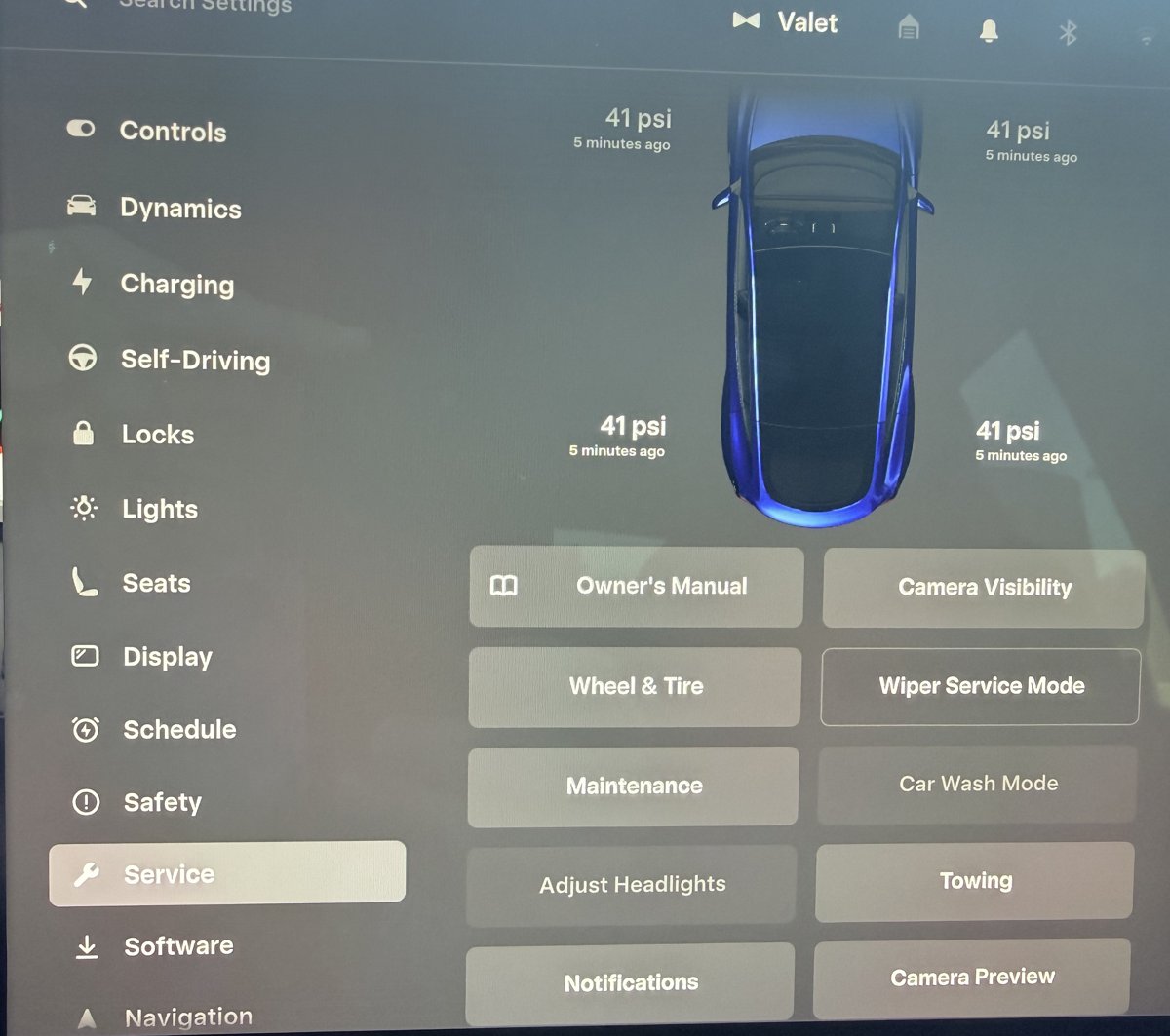
- On the touchscreen, touch Controls > Service > Wiper Service Mode. The wipers move up the glass to the service position.
- Lift the arm a short distance off the windshield, just far enough to get at the blade. The manual’s caution: the blades do not lock in a lifted position, so do not lift an arm beyond its intended position.
- Put a towel between the arm and the windshield. This is the step that saves the glass if the arm slips out of your hand.
- Hold the arm, press the locking tab, and slide the old blade away from the arm.
- Line up the new blade on the arm and slide it toward the end of the arm until it locks. Then push and pull on it. You should hear and feel a click; the manual says a blade that is not locked can come off while you are driving.
- Turn Wiper Service Mode off and the wipers go back to their parked position.
 The Cybertruck procedure is a little different, and its manual adds a step I had not thought about: make sure the wiper is set to Off and not Auto, because in Auto the blade can sweep on its own if it detects liquid on the glass, with your hands on it. Then it is towel, lift, press the tab, slide the blade off, pull the washer hose off the barb fitting on the old blade, push it onto the new one, slide the new blade on toward the base of the arm, and do the push-pull test. The same Off-not-Auto habit is a good one on any Tesla, since the Auto setting is still marked as a beta in the manual.
Which blades to buy
Tesla’s own blades: the safe answer, and the only answer for some cars
Tesla sells replacement blades on its own shop, one blade at a time, driver or passenger, and the manual points you there. They are the factory part, so the connector question goes away. For four cars they are also the only blade I would send you to right now: the 2025-and-newer Model Y, because the aftermarket sets I can verify are built for the older tab; the Model S, because its blade is sold for 2021+ cars and I have no aftermarket set I can vouch for; the Model X, because the blade carries the washer jets, so a plain aftermarket blade is not the same part; and the Cybertruck, which has one blade with the nozzles built in. The shop says you must be a Tesla owner, signed in to the account tied to the car, to buy them, and the Cybertruck blade was listed as out of stock on the shop page when I checked this fall, so order before the frost, not during it.
Model Y (2020 to early 2025): the Bosch Aerotwin set
This is the blade I would put on an older Model Y. It is a beam blade, no exposed frame, so there is nowhere for freezing slush to pack and set, which is the thing that turns a framed blade into a chattering one after a single cold night. It comes pre-assembled with the 16 mm top-lock connector, so it slides onto a 2020–2024 Model Y arm the way the factory blade comes off, and the lengths are the manual’s 26 and 20. Bosch describes a dual rubber compound with a graphite coating, two tensioned steel springs under a custom curve to keep even pressure across the glass, and an asymmetrical wind spoiler to hold the blade down at highway speed. The Aerotwin is the blade behind my “best by far” line in the intro; it is the set I run on both of our Model Ys, the 2023 and the 2024, and the raised blades in the photo at the top of this page are that set on the 2023. The retailer notes are consistent that it does not fit the 2026 Juniper, so if your Model Y was built from spring 2025 on, go back up to Tesla’s blade. Our Model Y accessories hub is where the rest of the car’s fitment lives.
Bosch Aerotwin 3397014621 Wiper Blades, Set of 2 (26″ and 20″), Top Lock 16 mm
Why it’s here: the factory lengths and the factory connector in one box. The listing describes it as an original-equipment replacement set with a pre-assembled OE-style adapter, a bracketless beam design with no metal or plastic joints or hinges, a dual rubber compound with graphite coating, and an asymmetrical spoiler for blade-to-windshield contact at highway speed. Beam construction is also the right shape for winter, because there is no frame to pack with slush. It is a mid-tier blade, well above a no-name set and about where Tesla’s own blades sit.
Fits: Tesla Model Y built before about February 2025 (the “2020–2024” blade in Tesla’s own shop). Not the 2025+ Juniper, which uses a different locking tab. Match the connector on your old blade before you order; the manual is firm on that.
Honest note: the buy box on this listing moves around. On one check it was held by a third-party seller, on the next by Amazon itself, and an open-box offer sat alongside it both times. Look at “Sold by” and the condition line before you add it to the cart, and pick a new, Bosch-packaged set.
Model 3 (all years): the Bosch Aerotwin A102S set
The Model 3 takes the 26 and 19 pair, and Bosch’s part for it is the Aerotwin A102S, part number 3397014116, which is the one you will find on the European Tesla accessory shops and the one the Tesla owner forums have settled on. It is the same beam design and the same top-lock connector as the Model Y set, in the Model 3 lengths. One thing to know before you click: the Amazon listing that reads cleanest, In Stock and sold by Amazon itself, is titled as the European part and says “only for left-hand drive,” which is Bosch’s way of saying it is the LHD-market set. A US Model 3 is a left-hand-drive car, and the Bosch model number on the listing is 3397014116, so it is the right part; the title is just written for a different shelf. Tesla’s own shop says its single Model 3 blade fits all Model 3 vehicles, old body and Highland alike, and the manuals for both generations give the same 26 and 19, so this set covers the 2024-and-newer car as well. The Model 3 accessories hub has the rest of the per-year fitment.
Bosch Aerotwin A102S (3397014116) Wiper Blades, Set of 2 (650 mm / 475 mm)
Why it’s here: the Model 3 lengths, 26 and 19 inches, with the same beam design as the Model Y set. The listing describes a set of two front blades, 650 mm driver and 475 mm passenger, with Bosch’s Power Protection Plus for longer service life, silent operation on wet and semi-dry glass, an aerodynamic design that stops lifting and vibration at speed, and a pre-assembled adapter for quick installation. Mid-tier, like its Model Y sibling.
Fits: Tesla Model 3 (the listing’s model number is Bosch’s 3397014116, the Model 3 part; Tesla’s Shop sells one blade for all Model 3 vehicles, and both the 2017–2023 and 2024+ manuals give 26 in / 19 in). The listing title is written for the European left-hand-drive market; a US Model 3 is left-hand drive. Check the connector on your old blade against the picture before ordering, as with any blade.
Honest note: I have not run this exact Model 3 set myself; the Aerotwin experience in this article is from the set on one of our own cars. The design and connector are the same. Stock on this listing runs thin and an open-box offer sits next to the new one, so check the condition line before you buy, and if it is gone, Tesla’s own Model 3 blade is the fallback.
What to skip
Water-repellent blades. The Rain-X Latitude 2-in-1 blades that went on one of our cars put a coating on the glass as they wiped, and on a Tesla that coating hazed right where the cameras look. The manual does not name those blades, but it does say contaminants on the glass or the blade reduce wiper effectiveness and lists water repellent among them. I am naming the product because I ran it, not linking it. Hook-adapter blades. Any set whose listing talks about J-hook, 9×3 or 9×4 arms is built for a different car; Bosch’s own ICON “A” series says so in its bullets. If a listing does not say top lock, assume it is not. Heated blades. Tesla documents two free ways to keep the blades from freezing to the glass, covered below, and our winter accessories guide already makes the case against paying for heated ones.
Washer fluid: what the manual says, and the Rain-X catch
Washer fluid is the one fluid a Tesla owner tops up, and the manual treats it with more care than most people give it. Three rules. First, in temperatures below 40°F use a washer fluid with antifreeze, because fluid without it can impair visibility through the windshield in cold weather, which is a polite way of saying it freezes on the glass as you drive. Second, do not add formulated washer fluids that contain water repellent or bug wash; the manual says they can cause streaking, smearing, and squeaking or other noises. Third, do not use untreated water, because the manual warns it can grow bacteria in the system and cause an odor or damage that is not covered by warranty. Tesla’s own recommended fluid is sold through Service, and the manual points to parts.tesla.com, but any fluid that meets those three rules is what most owners actually use.
The second rule is the one the store shelf makes hard to follow. Walk into any store in November and the winter shelf is mostly Rain-X. Rain-X’s own product pages say the same thing about every washer fluid in the line, the De-Icer, the Heavy Duty De-Icer, the All-Season 2-in-1: the fluid “applies water beading technology to your windshield.” That is the water repellent the Tesla manual says not to add, and the 2-in-1 adds bug wash on top of it. The same goes for Prestone’s 2-in-1, which is labelled as de-icer plus bug wash. On a gas car that coating is a feature. On a car that drives by looking through the top of the windshield, the manual says it is a smearing and squeaking problem, and after the water-repellent blades on our car I believe it. What you want is a plain de-icer: freeze protection, a cleaner, and nothing that leaves a film.
What actually goes into our cars is the cheap blue washer fluid from Walmart. Nothing fancier than that, and nothing on the manual’s do-not-add list.
Topping it up, and why “full in March” does not mean full now
The reservoir is behind the front trunk, and it is the only reservoir on the car you can add anything to. The manual’s steps: open the hood, clean around the filler cap first so dirt does not go in, open the cap, and fill until the fluid is visible just below the filler neck. Wipe up any spill right away and rinse the area with water. The Model Y holds 4.5 liters, the Model 3 holds 3.2 liters, and the Cybertruck holds 4.2 liters behind its powered frunk liner; the Model S and Model X manuals give the same steps without a figure. When the level gets low you get a message on the screen, so you do not need to check it on a schedule.
One more thing from Tesla’s winter page that surprised me: de-icing agents can evaporate over time, so a reservoir that was filled with winter fluid last spring is not necessarily still protected to the number on the jug. Tesla’s advice is to top off with fresh cold-rated fluid regularly through the winter rather than trusting what is in there. There is also a note in the manual about regions that restrict VOCs, the alcohols used as antifreeze in washer fluid; a low-VOC fluid is fine only if it still gives enough freeze protection for everywhere you drive. If a blocked jet is the problem rather than the fluid, the manual says to clear the nozzle with a thin strand of wire, with the washers off.
Three winter habits that cost nothing
Clear the ice before you turn the wipers on. The manual’s reason is specific: ice has sharp edges that cut the rubber. In harsh climates it also tells you to make sure the blades are not frozen to the glass before running them. Scrape, or let the defroster work, then wipe. Use Wiper Service Mode the night before a freeze. Tesla’s winter page says some cars have wiper defrosters, which you reach by tapping the temperature at the bottom of the screen and then the wiper defrost icon, and that cars without them can put the wipers in the service position so they thaw when the windshield does. On the Cybertruck the blade can be heated from the windshield icon on the screen. Our winter prep checklist covers the rest of the free settings, and the winter range piece explains what the cold does to the battery while you are at it. Turn Auto off at the car wash. Tesla’s manual says to make sure the hood is closed before running the wipers, and the Cybertruck manual says not to leave the wiper in Auto while washing because it can sweep on its own; the same caution applies to any car with Auto wipers, and Car Wash Mode handles it for you on the cars that have it.
The picks at a glance
| Pick | For | Connector / type | Tier |
|---|---|---|---|
| Tesla’s own blade (Tesla Shop) | 2025+ Model Y, Model S, Model X, Cybertruck, or anyone who wants the factory part | Factory | Mid |
| Bosch Aerotwin 3397014621 | Model Y built before ~Feb 2025 | Top lock 16 mm, beam | Mid |
| Bosch Aerotwin A102S (3397014116) | Model 3, all years | Top lock, beam | Mid |
Frequently Asked Questions
Are Model 3 and Model Y wiper blades the same?
No. The driver’s blade is 26 inches on both, but the passenger’s blade is 19 inches on the Model 3 and 20 inches on the Model Y, straight from the two manuals. A Model Y set on a Model 3 leaves an extra inch of blade with nothing under it at the edge of the glass, and the other way around leaves a strip unwiped. Buy the set labelled for your car, not the one a friend with the other car swears by.
Will the blades from my 2023 Model Y fit a 2025 or 2026 Model Y?
No. The lengths are the same, 26 and 20, but Tesla’s do-it-yourself page shows a different locking tab for cars built from about February 2025, and the Tesla Shop sells the 2020–2024 blade and the 2025+ blade as two different parts. Every aftermarket set I can verify is built for the older tab. For the new car, buy Tesla’s 2025+ blade.
Can I use Rain-X washer fluid in a Tesla?
The manual says not to add washer fluid that contains water repellent or bug wash, and Rain-X’s product pages say its washer fluids apply water-beading technology to the glass, which is water repellent by another name. So by the manual’s rule, no, not even the plain De-Icer. Use a de-icer without a repellent additive, rated below the coldest temperature you expect.
How often should Tesla wiper blades be replaced?
Tesla’s answer is at least once a year for best performance, and sooner if the rubber shows cracks, splits or roughness, or if the blades still streak after you clean them. On a Tesla there is an extra reason not to stretch it: the manual ties worn wipers to reduced camera visibility and degraded or unavailable Self-Driving features. If the car starts complaining about camera visibility in the rain, look at the blades before you look at the cameras.
Our Honest Verdict
If you have a Model 3 of any year or a Model Y built before spring 2025, buy the Bosch Aerotwin set for your car. It is the factory connector and the factory lengths, it is a beam blade that does not pack with slush, and on our own car it has been the best blade we have run. Check the connector picture against your old blade before you order, and look at who is selling it.
If you have a 2025 or newer Model Y, a Model S, a Model X or a Cybertruck, buy Tesla’s own blade from the Tesla Shop and do not try to save a few dollars on a set that was built for a different clip, or on the X, a blade without the washer jets.
For fluid, pick a plain de-icer rated well below your coldest morning, skip anything that says Rain-X, 2-in-1, bug wash or water repellent, and top it off through the winter instead of trusting the fill from last spring. Put the wipers in Service Mode the night before a freeze. None of that costs more than a gallon of fluid.