Updated November 7, 2026
⚡ Quick Summary
The short version: a Tesla needs less winter prep than a gas car, but the little that it needs tends to show up all at once on the first frosty morning. This Tesla winter prep checklist is the ten things to do in one afternoon before that morning, in the order I would do them. Most of them cost nothing.
- Tire pressure. Check it cold and top it up; it drops about 1 psi for every 10°F.
- Wipers and washer fluid. Replace blades that streak, and fill with fluid rated for freezing weather.
- The 12V battery. Know which type you have and how old it is. It strands more Teslas than the big battery does.
- Software. Install the update that has been waiting, at home on Wi-Fi.
- The free winter settings. Charge port heater, Wiper Service Mode, mirror auto-fold off, and Defrost Car in the app.
- Charging habits. Stay plugged in, schedule charging to finish at departure, and keep the car above half.
- Floor mats before the slush.
- Mud flaps and a wash plan before the salt.
- If you park outside: a windshield cover and a brush that reaches the roof.
- The winter kit in the car, and a decision about tires and chains.
Disclosure: As an Amazon Associate, I earn from qualifying purchases. This comes at no extra cost to you and helps keep this site running.
I put this list together because every year the first cold morning catches me doing three things at once that I could have done in October. The tire pressure light is on, the wipers smear the frost instead of clearing it, and the washer fluid is the summer bottle. None of it is serious. All of it is annoying at 6 AM, and all of it is easier in a driveway on a mild Saturday than in a parking lot in the dark.
A Tesla gives you less to do than a gas car. Tesla’s own maintenance page says its cars need no oil changes, no fuel system maintenance, no spark plugs and no emission checks, and that they do not need annual maintenance or regular fluid changes. What a Tesla does have is a set of winter features that only help if you turn them on, a small 12-volt battery that cold weather is hard on, tires that lose pressure like any other tires, and a range number that gets smaller when the temperature does. This checklist covers those, tested across our three Teslas, a 2021 Model 3, a 2023 Model Y and a 2024 Model Y, in a part of the country that gets frost every year and real snow only now and then. If you already know what you want to buy, our winter accessories guide has the full product list. This page is about what to do, and it links to that one where a product is the answer.
1. Set the tire pressure for cold weather
Start here, because it is the one that shows up as a warning light. Tesla’s own service page says your tires will lose one PSI for every 10°F drop in outside temperature, that pressures will drop in cold ambient temperatures, and that if the TPMS light appears you should inflate the tires before driving. A set that was right in September is several psi low by the first frost, and the light tends to come on the first morning the temperature really falls. Check them cold. Tesla’s page says it takes only about a mile of driving to warm the tires enough to change the reading, and warns against letting air out of warm tires to hit the cold number.
The number you want is on the sticker inside the driver’s door jamb, not on the tire. Set all four to it with a gauge you trust, and plan to check again after the next big drop. Tesla also points out that proper pressure protects the tires from potholes and improves range, which matters more in winter when you are already losing some. On our cars the tires go to Discount Tire every 10,000 miles for rotation, which is longer than the 6,250 miles Tesla’s maintenance page recommends, so I am stretching it and I know it. The 2023 Model Y is on its second set; a nail near the sidewall, on tires that were already worn, ended the original Pirellis. The pressure check is also when I look for anything in the tread. Our tire care guide covers rotation, pressure and the service counter in more detail.
GOOLOO A5 Jump Starter with Air Compressor
Why it’s here: it does the tire job in this item and the 12V job in item 3 with one battery. The listing describes a six-in-one: jump starter, tire inflator, ball pump, tire pressure gauge, a 74 Wh battery for charging a phone, and a light. For the tires, you set the pressure from the door sticker and the listing says the pump auto-stops when the preset is reached, which is the feature that makes it worth owning over a gas-station hose; the listing claims a 160 PSI maximum and a sedan tire from 30 to 36 PSI in about 30 seconds. GOOLOO says the 2026 version added a built-in 45 W USB-C cable (output only) and a display readable in sunlight, and gives a working range of −4°F to 140°F with a recharge every three months in storage. It is the inflator we recommend across the site, and it is not a unit I have used myself. One rule of ours the listing does not follow: it says to keep it in the trunk. For the jump-starter half, keep it on a garage shelf or in a second car, because a Tesla with a dead 12V battery locks you out of the trunk it is sitting in. The 12V article explains why.
Fits: any car; it is a tool, not a fitted part. The listing names gas engines and diesels up to 10 liters.
2. Replace tired wipers and fill cold-rated washer fluid
The first frost is when a worn summer wiper blade shows up. The Model Y manual says to check the rubber periodically for cracks, splits and roughness, to replace a damaged blade immediately, and to replace the blades at least once a year for best performance. It also says something Tesla owners should take seriously: ineffective wipers can reduce what the front windshield cameras see, which can degrade or disable Self-Driving features. A streaky blade on a Tesla is a camera problem as well as a visibility problem. The manual gives the sizes, 26 inches on the driver’s side and 20 inches on the passenger’s side, and tells you to match the connector to the original. On our cars I have had the best luck with Bosch Aerotwin blades, and I had a bad experience with a set of Rain-X water-repellent blades that left streaks and haze, worst right around the cameras. The winter accessories guide has the beam-blade card and the fit note that goes with it, so I am not repeating the card here. The sizes for every model, the connector catch and the fluid rules are in our wiper blades and washer fluid guide.
Then the fluid. The manual is direct about this one: in temperatures below 40°F, use a washer fluid with antifreeze, because fluid without it can impair visibility in cold weather. Tesla’s winter page adds that de-icing agents evaporate over time, so a bottle that was rated for freezing weather last March is not necessarily still doing the job, and it recommends topping off with fresh fluid regularly. The manual also warns against fluids with water repellent or bug wash, which can streak, smear and squeak, and it puts the reservoir at 4.5 liters, behind the frunk. Buy the cold-rated fluid at any auto parts store or big-box store; I am not linking one here because the Amazon listings for it come and go as cases of six gallons. One more manual line worth knowing before the first ice: remove the ice from the windshield before you turn the wipers on, because ice has sharp edges that cut the rubber.
3. Look at the 12V battery, because it strands more owners than the big one
Everyone knows a Tesla has a big high-voltage battery. Many owners do not realize there is also a small low-voltage battery, the same job as the 12-volt in a gas car, and you are more likely to be stranded by that one than by the big one. Cold is hard on it, and cold mornings are when a tired one quits. The Model Y manual’s own alert text says that when the low-voltage battery shows degraded performance and needs replacing, vehicle software updates will not complete until it is replaced, so a battery on its way out can also be the reason item 4 fails.
Which one you have depends on the car. Our 2021 Model 3 has the older lead-acid type, the kind that ages like a gas car’s battery. Both of our Model Ys, the 2023 and the 2024, show “Lithium-ion” under Controls, Software, Additional Vehicle Information, and the manual’s specifications page lists that lithium-ion low-voltage battery at 15.5 volts and 6.9 amp-hours. None of our three cars has ever thrown a 12V warning or needed a replacement, so I do not have a failure story for you, and I am not going to make one up. What I can tell you is to look at the car’s age and that screen, and to read our 12V battery guide, which covers the warning you will see, what each type costs to replace, and the honest catch about where to keep a jump starter. Short version: not in the car. A dead 12V seals the doors, the trunk and the frunk, and the tool locked inside is no help.
4. Install the software update, at home, on Wi-Fi
If there is a yellow download icon at the top of the screen, deal with it now, not on the first cold trip. Tesla’s software page says the touchscreen shows “Update available” when one is waiting, that you must remain connected to Wi-Fi while an update downloads, and that the car needs a stable connection of at least three bars; if you see fewer, move the car closer to the router or wait. Tesla says that leaving Wi-Fi turned on and connected whenever possible gives the fastest and most reliable delivery of updates, and that they roll out on a schedule Tesla sets, not on request. Winter is also when you do not want the car tied up installing something in a parking lot, so let it do the download in the driveway while you do the rest of this list.
While you are in the software menu, open Controls, Software, Additional Vehicle Information once and read it. The manual says that screen tells you whether the car has a heat pump, which is the system behind the odorless steam you may see from the front of the car while charging in the cold, and on both of our Model Ys it is also where the low-voltage battery type from item 3 shows up. Five minutes there answers two questions you will otherwise ask the internet in January.
5. Turn on the free winter settings
About half of Tesla winter prep is a setting, not a purchase. Our winter accessories guide walks through each one in detail; here is the list to work through in one sitting, all from Tesla’s winter page and the Model Y manual.
The charge port heater, under Controls, Service, is the answer to a frozen charge port latch. The manual notes that a frozen latch can still charge at a slow AC rate even when it will not lock the cable, and that Defrost Car in the app thaws the latch too; it also says the Schedule settings can prevent the latch from freezing in the first place. Wiper Service Mode, under Controls, Service, raises the wipers against the windshield so they defrost when the glass does, which is what you want the night before a freeze if your car does not have wiper defrosters. Mirror Auto-Fold, under Controls, Mirrors, should go off if ice is expected when you park, because ice can stop the mirrors from folding or unfolding; if they do freeze, Tesla says to open and close them by hand to restore the automatic fold. And in the app, Climate, then Defrost Car, melts snow, ice and frost on the windshield, charge port, windows and mirrors, and warms the battery while it does it. The manual recommends starting the climate at least 30 to 45 minutes before you leave. One more that is not a setting: the manual suggests putting WD-40 on the door handle pivot pins ahead of time to keep ice from building up inside the handle, and it describes how to free a frozen Model Y handle, press the front of the handle hard to rock it and break the ice, then press the back as usual.
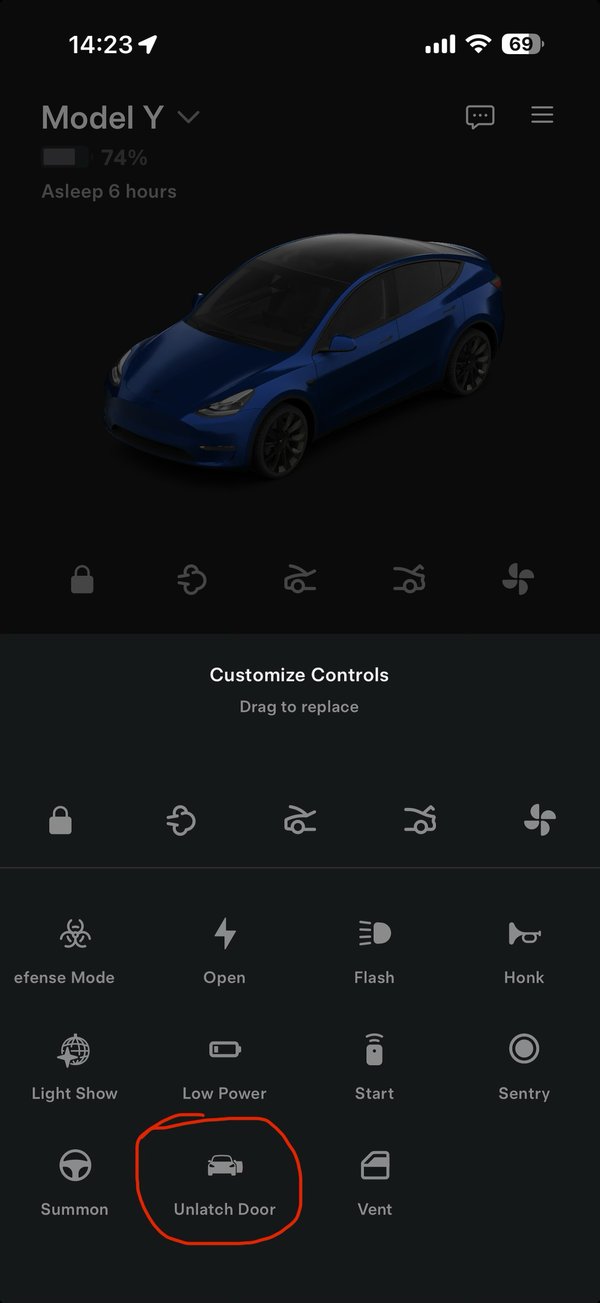
My door handles have frozen, and I did not fight them. I used the app to unlatch the door. Tesla’s winter page describes the setup: in the app, touch and hold one of the quick controls under the picture of the car to open Customize Controls, drag Unlatch Door into one of the slots, and from then on one tap pops the driver’s door open from the inside. Set it up now, in October, on a warm afternoon, because you do not want to be reading instructions with cold hands the first morning it happens. The screenshot below is where the control lives on my phone.
6. Fix the charging habits before the cold does it for you
This is the item with the biggest effect on range, and it is free. Tesla’s winter page says that in cold weather the car uses more energy to overcome increased aerodynamic drag and to heat the cabin and the high-voltage battery, and that when the car is plugged in, preconditioning runs on the wall rather than on the battery, which leaves more for driving. The manual puts it plainly under After Driving: leave the car plugged in when not in use, so the charging system keeps the battery warm instead of the battery doing it. Our two Wall Connectors are out in the driveway, one on each side, and the cars get plugged in when they are parked at home. If you are still charging on a regular wall outlet, read Tesla’s note before winter: in temperatures well below freezing the car may need more power to charge than a 120-volt outlet can provide, and Tesla still recommends leaving it plugged in to keep the battery warm. If that describes your setup, our Level 2 home charger guide is the long-term fix, and the plug-in units there go on a dryer-type 240-volt circuit.
Then set the schedule. Tesla says that scheduling a charging session to end closer to your departure time reduces the energy needed to warm the battery, and that scheduled preconditioning warms the battery and cabin ahead of your departure so you do not leave with a cold battery and limited regen. Both live under Controls, Schedule, and the manual recommends scheduling a charge together with the precondition so the car has enough energy for the trip. I use scheduled preconditioning in winter, and in summer I precool the cabin from the app before I head out. Last, the charge level. Tesla’s winter page says keeping the charge above 50 percent when the car is not plugged in reduces the impact of cold temperatures. My own habit is 80 percent daily, 90 before my weekly 2.5-hour drive in the really cold stretches, and 100 only before a very long trip with several charging stops. Expect the range number to come down regardless; our winter range article has the lab numbers and what I actually see, which is roughly 10 to 15 percent fewer miles here.
7. Put the all-weather mats in before the slush
The carpet mats that came with the car are fine until the first morning you climb in with snow on your boots. After that they hold water, they smell, and the salt stains do not come out. A set of molded all-weather mats with a raised edge fixes this for a few winters, and the time to put them in is before the first slush, not after the carpet is already wet. Our 2021 Model 3 and the red 2024 Model Y both have aftermarket mats; the blue 2023 is a question I will not answer from memory. The thing to get right is fitment: mats are molded per generation, so a Model Y set is not a Model 3 set, and a 2021–2024 Model Y set is not a 2025 Juniper set. The card below is the legacy Model Y set we recommend across the site. For the 2025-and-later Model Y, the same brand’s 11-piece Juniper set is in our Juniper accessories guide, and the Model 3 options by generation are in the Model 3 accessories guide.
SUPER LINER TPE Floor Mat Set, Model Y 2021–2024, 9 Pieces
Why it’s here: it is the full-coverage set, not just the front two. The listing says the nine pieces cover the front, rear, trunk and cargo liners plus backrest protectors, with a raised edge the listing describes as a barrier that traps liquids, dirt and dust before they reach the carpet, which is the entire job in winter. The material is TPE, which the listing calls odor-free and flexible and says is built to withstand extreme weather, and it is cleaned by wiping, hosing or shaking out. It is the set we carded in the Model Y hub and the new-owner guide, and it is sold by the brand’s own store. I have not run this particular set; the aftermarket mats in two of our cars are an older purchase and I do not have the brand on file, so the fit notes here are the listing’s.
Fits: the listing says “Tesla Model Y 2021-2024 (5-Seat).” Not the seven-seat car and not the 2025-and-later Juniper; the Juniper set is a different listing, linked above.
8. Mud flaps on, and a plan for the salt
Tesla’s own winter page says it: road conditions get worse with snow, salt and debris, and it suggests paint protection film and mud flaps. I run mud flaps and I do not run film. The flaps are one of the best things I have bought for the cars; they keep them much cleaner between washes. They are also the one accessory I have paid for twice. The first set on the red 2024 Model Y was a firm, molded plastic set, and they hit parking curbs and broke off. The set on that car now is a flexible one, a softer flap on a hard frame, and it is still on the car. The molded firm ones do look better, but the flexible ones are more durable and forgiving of bumping them on things. The blue 2023 Model Y still has its original rigid set, unbroken, so this is one owner’s experience with one set, not a verdict on every rigid flap. The card below is the in-stock set with the two-material construction that I pointed to as the same idea as what I run; I have not installed this exact set.
The salt plan is the other half. What I do is simple: I hold a wash-club membership, and after driving on salted roads the car goes through the automatic wash with the undercarriage wash as soon as I can get it there. If you do not have a club nearby, our winter salt protection article covers the at-home alternative and the honest case for film, which I have never used. It also goes deeper on why “flexible” on a listing is not a buying signal by itself; the set that broke on my car advertised itself as flexible too. One more salt item from Tesla’s maintenance page that most owners have never heard of: if you drive where roads are salted in winter, Tesla recommends having the brake calipers cleaned and lubricated every 12 months or 12,500 miles, because road salt can corrode the brakes and affect braking, and the service can be booked in the app; the same page notes that Model Ys built after February 2025 do not need it. The same page says brake pad replacements are rare on a Tesla because regenerative braking does most of the slowing, so the brakes get so little use that you would not notice a problem with them.
CYBERBEANS No-Drill Mud Flaps, Model Y 2020–2024
Why it’s here: the construction. The listing says the flap is made of PP+TPE, “highly flexible,” and claims it will not break even if it hits something while driving, which is the exact failure my first rigid set had. It installs with the included clips in the factory holes, no drilling and no tape, and the listing says the flaps are enlarged and add bottom fixing holes beside the side ones for a more stable mount. It is the flap set carded on our salt article and our winter accessories guide. I have not run this set; I run a different flexible set, and this is the in-stock listing with the same two-material idea. Grade a flap by its construction, not by the word flexible.
Fits: read this one carefully, because the listing argues with itself. The title says 2022–2024 Model Y, one bullet says 2020 through 2025, and the first bullet says “Not Fit 2025 Model Y Refresh Juniper!” Treat it as the 2020–2024 legacy Model Y and skip it for a Juniper.
9. If you park outside: a windshield cover and a brush that reaches the roof
Skip this item if the car sleeps in a garage. If it does not, two things make the frosty mornings shorter. The first is a cover over the windshield, because a Tesla’s defrost is good but a cover means there is nothing to defrost. Tesla’s winter page lists the things you must clear before driving, and it is more than the glass: clear snow from the hood, roof and tailgate so it does not blow off onto the car behind you, clear the rest to reduce drag, and clear all the sensors, cameras and the cabin air intake of ice, snow and debris so those systems work. That last line is the Tesla-specific one. The manual makes the same point about the wipers: when the front cameras cannot see well, Self-Driving features can be degraded or unavailable, and a camera under snow cannot see at all. The second thing is a brush long enough to reach the middle of the roof, which on a Model Y is one fixed glass panel, so you want to be careful what you drag across it.
Nmoiss 3-in-1 Windshield Snow Cover, Tesla Model 3 / Model Y Size
Why it’s here: it is cut for the Model 3 and Model Y front glass rather than sold as one-size, and the listing describes the parts that keep a cover from blowing away, which is the usual complaint: dual mirror straps, hooks at the front wheels and a door-flap seal at the back. The material is 600D Oxford over a vinyl layer, which the listing says resists water and low-temperature cracking. It comes with mirror covers and a small ice scraper for the side windows, and it folds into a bag. It is the top pick in our winter accessories guide. I have not used it; our cars are not covered overnight, and the construction here is the listing’s.
Fits: the listing says it is designed for the front windows of the Model Y and Model 3 and sells six sizes; L is the Tesla size, and the Amazon link should land on Large. It does not name model years, and it does not name the 2025 Juniper, so measure if you have one.
AstroAI 46″ Extendable 3-in-1 Snow Brush and Ice Scraper
Why it’s here: reach and the squeegee. The listing says the handle extends from 36.6 to 47.2 inches, which gets you to the middle of a Model Y roof from one side, with a head that pivots 180 degrees, a detachable ice scraper, and a silicone squeegee on the back of the brush for pushing water and slush off the glass. It breaks down into three pieces to live in the trunk. One honest note: the head is a bristle brush, in the listing’s own words, not foam. On a glass roof I would use the squeegee side for the slush and keep the bristles for loose snow; if you want a foam head for the glass, the foam broom is carded in our winter accessories guide. I have not used this brush; the specs are the listing’s.
Fits: any car. It is a tool, not a fitted part.
10. Put the winter kit in the car, and settle the tire question
The last item is the one most people never get to. A blanket, water, a light, a phone cable and something to dig with belong in any car in winter, electric or not, and a Tesla has the room for them under the trunk floor where they do not get in the way. I built that list already, from an RN’s point of view, in our EV winter emergency kit article, so I am not repeating it here. If you are driving to family for the holidays, the holiday road trip prep page adds the charging-at-a-relative’s-house part.
Then decide about tires and chains before you need them. Tesla’s winter page says to consider winter tires if you frequently drive on snowy or icy roads, and to check local rules on chains. All three of our cars run all-season tires year-round, the 2023 Model Y on Michelin Pilot Sport All Seasons and the 2024 on its original Continentals, and I have never put chains or socks on any car. We do not get heavy snow here, and the times we have had snow, the Teslas have handled it well. If your winter is harder than that, read two things before you buy: our snow chains article, which is built on the tables in Tesla’s own manuals of which chains the cars allow and on which wheels, and the tire care guide for the winter-tire question. The manual notes that after installing winter tires, regen can be reduced for a short time until the car recalibrates, and that selecting winter tires under Service, Wheel and Tire, Tires speeds that up.
Quick comparison
| Product | Checklist item | Fits (per the listing) | Best for | Price tier |
|---|---|---|---|---|
| GOOLOO A5 jump starter + inflator | 1 (tires) and 3 (12V) | Any car | Everyone; store it in the garage, not the car | Mid |
| SUPER LINER 9-piece mats | 7 (mats) | Model Y 2021–2024, 5-seat | Legacy Model Y, snow on the boots | Mid |
| CYBERBEANS flexible mud flaps | 8 (salt) | Model Y 2020–2024; not Juniper | Anyone who parks against curbs | Budget |
| Nmoiss windshield cover | 9 (parking outside) | Model 3 / Model Y, size L; years not stated | Cars that sleep outside | Budget |
| AstroAI 46″ snow brush | 9 (parking outside) | Any car | Reaching a Model Y roof; squeegee for slush | Budget |
Frequently Asked Questions
When exactly should I do this list?
Before the first frost means when the overnight lows start heading toward 40°F, for two reasons in Tesla’s own manual. The washer fluid rule kicks in below 40°F, and tire pressure drops one psi for every 10°F, so a 30-degree fall from a warm September afternoon to a cold October morning is three psi. In most of the country that is some week in October or early November. If you are reading this in January, do it today; nothing on the list is worse for being late.
What does the blue snowflake on the screen mean?
It means the battery is cold, not broken. Tesla’s page says the icon appears when the battery is too cold for full power and ideal range, that you may notice reduced regenerative braking and acceleration, and that the part of the charge you cannot use for the moment shows in blue on the battery meter. Driving, charging and preconditioning all warm the battery, and the snowflake goes away when it is warm enough. Scheduled preconditioning in item 6 is how you avoid seeing it in the morning at all.
Is a regular 120-volt wall outlet enough for winter?
Sometimes not. Tesla’s winter page says that in temperatures well below freezing the car may need more power to charge than a standard household outlet can provide, and that you should leave it plugged in anyway to keep the battery warm. In a mild winter and a short commute it works. If you are losing ground every night, a 240-volt Level 2 charger is the fix, and our Level 2 guide covers the plug-in units that go on a dryer-type circuit.
Should I raise my charge limit for winter?
A little, when you need the range. Tesla’s guidance is to keep the daily limit around 80 percent on cars with that recommendation and to keep the charge above 50 percent when the car sits unplugged in the cold. I stay at 80 most days and go to 90 before my weekly 2.5-hour drive in the really cold stretches. There is no reason to sit at 100 every night in winter; the manual says to save that for a long drive.
Our Honest Verdict
Do items 1 through 6 this weekend. They cost nothing beyond a gauge and a bottle of washer fluid, and they are where the first-frost problems come from: tire pressure, wipers, the 12V battery, the software update, the free settings, and plugging in with a schedule.
Buy the mats and the flaps if the car does not have them, before the first slush, because that is when they pay for themselves. Buy the windshield cover and a long brush only if the car sleeps outside. Skip winter tires and chains unless your roads actually call for them; ours do not, and all-seasons have been fine on all three cars.
Keep the jump starter in the garage, not the trunk. Put the winter kit under the trunk floor and forget about it until you need it.