Updated November 7, 2026
⚡ Quick Summary
The short version: every Model 3 and Model Y ordered in the US after October 1, 2026 can run gear off its battery through the charge port. Tesla calls it Powershare. The car cannot do it on its own: you need a Gen 3 Mobile Connector and Tesla’s Outlet Adapter, both from the Tesla Shop, and together they give you one 120-volt, 20-amp outlet rated for 2,400 watts. That is enough for a CPAP, a compressor cooler, lights, phones and laptops, a fan or a heated throw, and it is not meant for a space heater or anything with a big motor.
Check your own car first, because some cars built before October also have it: Controls, then Software, then Additional Vehicle Information, and look for “Powershare Support: Enabled.” Below is what the two Tesla parts do, how the 2,400-watt budget works, and seven things from Amazon that are worth plugging in, starting with the extension cord that gets the outlet to where you actually need it.
Disclosure: As an Amazon Associate, I earn from qualifying purchases. This comes at no extra cost to you and helps keep this site running.
Tesla North America said on October 27 that every new Tesla sold in the US and Mexico can now power tools and gadgets through Powershare, and a new Model 3 or Model Y owner who reads that is going to find out the car does nothing about it by itself. So this is the walk-through I wanted when I read it. You need two parts from Tesla first. Then you need to know what a 2,400-watt outlet will and will not run, because the owner’s manual draws that line more tightly than the marketing does.
I have wanted this feature for years. We have had a seasonal campground site for six years, and on one storm night the camper lost power, I slept in the Model Y on a borrowed mattress topper, and my CPAP had no way to run off the car. There was a very large battery under me and no outlet on it. A Model Y ordered this fall has that outlet, for the cost of an adapter, and a common CPAP like the ResMed AirSense 10 draws about 53 watts by its own manual, which is nothing against 2,400. I have not used Powershare myself, and I say so again at the bottom, so everything here about the adapter comes from Tesla’s own pages and manuals, read the day I wrote this, and the gear picks come from reading the listings and from years of running two Tesla Wall Connectors at home plus the Mobile Connector on the road.
Does your car have it? Check before you buy anything
Tesla’s support page puts it plainly: every Cybertruck ever built, and every Model 3 and Model Y ordered in the US and Puerto Rico after October 1, 2026, is capable of Powershare. It also says that some, but not all, Model 3 and Model Y cars produced before October 1 are capable too. The Outlet Adapter’s own shop page gives the build dates behind that: Model Y Performance built from December 2025, Model Y Premium from April 2026, Model Y L Premium from September 2026, and every other Model 3 and Model Y trim from October 2026. So a Performance bought last winter may already have it, and a Standard trim built in the summer will not.
The check takes a minute. Make sure the car is on software 2026.32.6 or later, tap the car icon at the bottom left of the screen, then Software, then Additional Vehicle Information. If the car can do it, the line reads “Powershare Support: Enabled.” I ran it on both of our Model Ys, the 2023 and the 2024, and neither one shows the line at all, which is Tesla’s way of saying the hardware is not there; the feature is for cars built with it, not a software unlock for older ones. Tesla’s manual also notes that using the Outlet Adapter needs software 2025.44 or later on a Model 3 or Model Y, and firmware 24.20 or later on the Mobile Connector, which the car updates for you when you plug the adapter in.
If you ordered after October 1 you are in the same boat as the owners of the new 16-inch-screen Model 3, which is to say a lot of what is written about these cars is a year behind yours. The rest of the car’s fitment lives on our Model Y accessories hub and the Model 3 hub.
The two Tesla parts you need first
A Gen 3 Mobile Connector
The Mobile Connector is the charging cable with the brick in the middle that plugs into a wall outlet on one end and the car on the other. For Powershare it works backwards: the car end stays in the charge port, and the wall end gets the Outlet Adapter instead of a wall plug. Only the Gen 3 version does this. Tesla’s manual is direct about it: the Gen 2 Mobile Connector does not support Powershare, and you should not try the adapter on it. The Gen 3 is the current one, sold in the Tesla Shop for about $300 with a 20-foot cable, a NEMA 5-15 adapter for a regular household outlet, a NEMA 14-50 adapter for a 240-volt outlet, and a bag. The shop requires a Tesla account tied to a car before it will sell you one.
All three of our cars came with a Mobile Connector at delivery, so check your trunk before you order a second one. Ours are all the Gen 3, the brick with the adapter that snaps in, which is the one the Outlet Adapter is made for. If you do not have one, the Mobile Connector is worth owning anyway. It is what we used to charge from a regular 120-volt outside outlet at a relative’s house with no trouble, and it is the cable we run on the campground’s 30-amp pedestal through an adapter; our campground charging guide covers that setup.
The Tesla Outlet Adapter
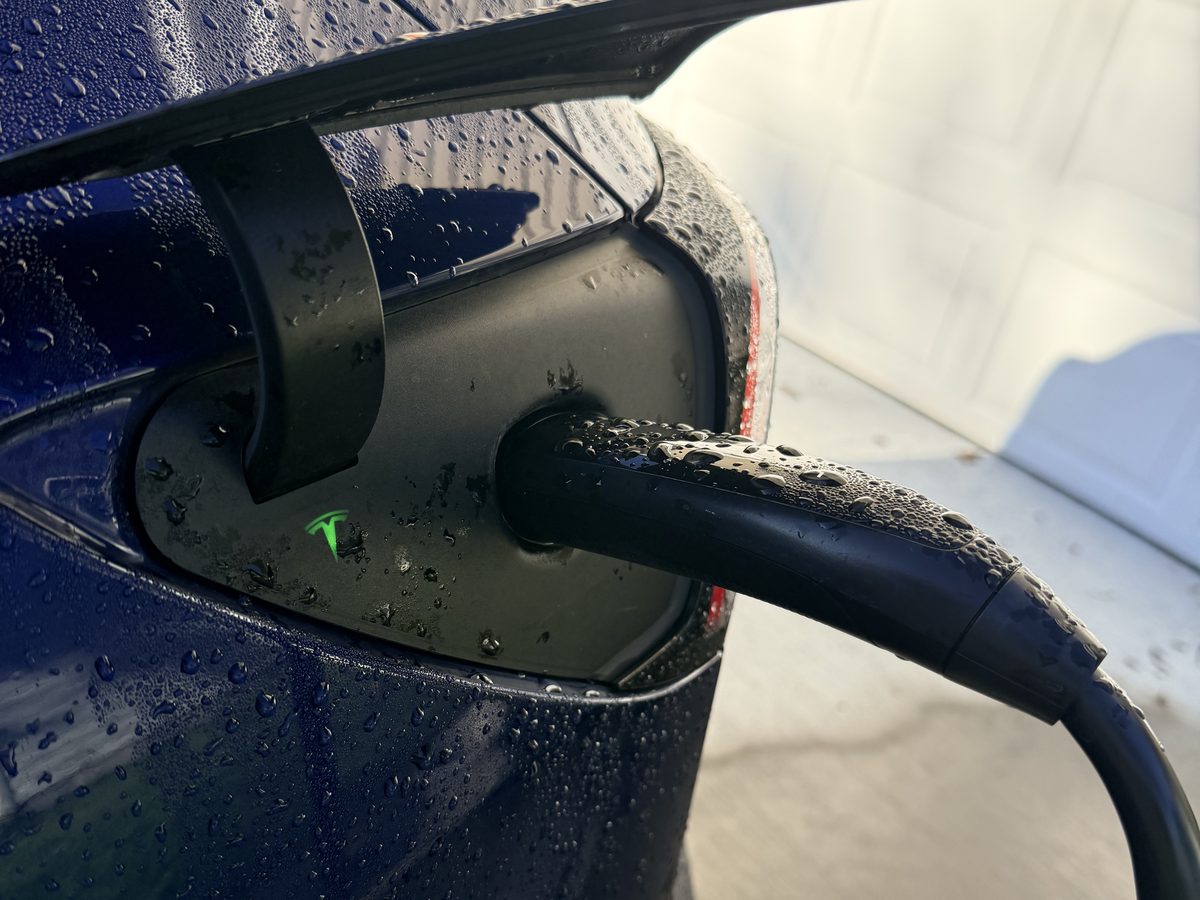
This is the small part that turns the Mobile Connector into an outlet. It snaps onto the brick where the wall adapter normally goes, and the end of it is a NEMA 5-20 receptacle, the 20-amp version of a household outlet with a T-shaped slot, which accepts a normal three-prong plug as well as a 20-amp plug. Tesla’s specifications are 120 volts, 20 amps, and 2.4 kilowatts maximum, which is 2,400 watts. It sells for about $80 in the Tesla Shop, to Tesla owners signed in to the account tied to their car, the same rule as the Mobile Connector; it read out of stock there the morning this published, so expect it to come and go. The manual’s checklist for using it is short: attach the adapter to the Mobile Connector, open the charge port, plug the handle in, and when the port light turns green plug your device into the adapter. The Mobile Connector’s lights stream green away from the car while it is feeding power.
Two sentences from Tesla matter more than the rest. The shop page says the vehicle warranty does not cover damage caused by third-party bidirectional adapters or chargers, so the cheaper look-alike adapters you will see advertised are a warranty risk on a brand-new car, and I am not going to recommend one. And the manual says the Outlet Adapter cannot be used to power an electrical panel and is not a bidirectional inverter. Backing up a house is a different product, Powershare Home Backup, which needs a Powerwall and a Wall Connector installed by an electrician; our home charger installation guide is the place to start if that is what you actually want.
The 2,400-watt budget, and the two things that quietly lower it
The Model Y manual describes the adapter as a way to power “small-to-medium appliances or tools (excluding devices with high-wattage heating elements or large, heavy-duty motors),” and that one parenthesis is the whole buying guide. A plug-in space heater is the textbook high-wattage heating element. A shop vac or a full-size air compressor is the heavy motor. Tesla’s own shop copy for the adapter says it can power “refrigerators, heaters and power tools,” and when the shop and the manual disagree, follow the manual. A heated throw is a heating element too, but a small one, and the manual’s objection is to the wattage, not the category.
The first thing that lowers the budget is whatever you plug into the adapter to get the power somewhere useful. The adapter is rated for 20 amps, but most household extension cords and power strips are rated for 15 amps, and a 15-amp cord is a 1,875-watt cord; the Iron Forge cord below prints exactly that on its listing. That is not a problem for anything on this page, but it means the ceiling you actually live with is the cord’s rating, not Tesla’s. The second thing is the car’s own cutoff. The manual says the outlets draw a small amount of power whenever they are enabled, even with nothing plugged in, and that when the battery gets very low the car shuts the outlet off and puts a message on the screen. So plan your night around the charge you arrived with, and unplug the Mobile Connector when you are done, because Tesla says not to leave it plugged into the car when it is not in use.
One more line from the Mobile Connector manual, because it will come up: Tesla says never to plug the Mobile Connector itself into an extension cord or a power strip. That rule is about the wall side, when you are charging the car. It says nothing about running a cord from the Outlet Adapter to your gear, and that is what the first card below is for.
Seven things worth plugging in, at a glance
| Pick | Job | Draw, per the listing | Best for | Price tier |
|---|---|---|---|---|
| Iron Forge Cable 12/3 cord, 50 ft | Gets the outlet to the tent, the table or through a window | Rated 15 A, 1,875 W (the cord is the ceiling) | Everyone; buy this first | Middle |
| Tripp Lite TLP615 surge strip | Turns one outlet into six, 15 ft away | 15 A breaker | Phones, CPAP, a lamp, a laptop at once | Low |
| P3 Kill A Watt P4400 | Tells you what each thing actually draws | Measures, does not draw to speak of | Anyone who wants to know before the car tells them | Low |
| EUHOMY 23-quart compressor fridge | Cold food with no ice, days at a time | 45 W, per the listing | Campsite, tailgate, an outage | Middle |
| Sunbeam heated throw | Warmth in the car without running the cabin heat all night | Not stated on the listing; read the tag | Sleeping in the car in the shoulder seasons | Low |
| DEWENWILS corded work light | Light with a magnet, a hook and a pass-through outlet | Not stated on the listing; an LED | Camp kitchen, a dark driveway, a flat tire | Low |
| Amazon Basics 20-inch box fan | Moving air at a tailgate or in the car | 67 W, per the listing | Summer, and anyone who sleeps with a fan | Low |
None of these seven is a Tesla part and none is Tesla-specific. That is the point. Once the car has an outlet, it is an outlet, and the best things to plug into it are the ordinary, well-made versions of things you already own. What makes them worth a card here is the fit with a 2,400-watt budget and the ways a car outlet differs from a wall: it is outside, it is at the end of a 20-foot cable, and it is running off the battery you need to drive home on.
1. Reach: a 12-gauge, 50-foot outdoor extension cord
Buy this before anything else. The Mobile Connector’s cable is 20 feet with the adapter on, and the outlet ends up at the back corner of the car, outside, in whatever weather you parked in. Fifty feet more gets it to the picnic table, into the tent, or through a cracked window to the refrigerator in the kitchen during an outage. Gauge matters more than length here. Twelve gauge is the heavy end of what a hardware store sells, and this one is rated for the full 15 amps over all 50 feet. Iron Forge’s 50-foot cord is a 12/3 SJTW cord, which means three 12-gauge conductors in a jacket rated for outdoor use, and the listing gives its ratings as 15 amps, 125 volts and 1,875 watts, UL certified, with a working temperature range of minus 40 to 140 degrees. The lighted end tells you the car is feeding power before you walk back to check the status lights.
Two habits from the campground carry over. Keep the connection between the cord and the adapter off the ground and out of standing water, because the Mobile Connector manual is strict about rain running down the cable into the charge port or the outlet. And the Mobile Connector brick itself does not love direct sun: on a hot day at our 30-amp pedestal it cut its charging current down to 12 amps until I shaded it and unplugged and replugged it. Powershare runs the same brick in reverse, so park it in the shade or drape a towel over it. The winter emergency kit post has the rest of the keep-in-the-trunk list this cord belongs on.
Iron Forge Cable 12 Gauge Heavy Duty Extension Cord, 50 Ft, Yellow SJTW, Lighted End
Why it’s here: the outlet is 20 feet from the charge port and outdoors; this moves it 50 feet to where you are. The listing’s ratings are 12 AWG, 15 amp, 125 volt, 1,875 watt, UL certified, SJTW outdoor jacket, minus 40 to 140 degrees F, with reinforced prong blades and a lighted end that shows when power is on. Iron Forge is a veteran-owned US cord brand, and a mid-tier price for a cord you will own for a decade.
Fits: any Tesla with Powershare; the plug is a standard three-prong that goes straight into the Outlet Adapter’s 5-20 receptacle. Your total load through it stays under its 15-amp rating, not the adapter’s 20.
Honest note: a 50-foot cord is a lot of cord to coil wet. If your use is a tailgate right behind the car, Iron Forge sells the same 12/3 cord in shorter lengths on the same listing family; the 50 is the length for campsites and windows. On the day this published the buy box was a third-party seller with Amazon doing the shipping and returns; look at “Sold by” before you order.
2. More than one plug: a surge strip with a long cord
The adapter gives you one outlet. A night in the car or a night without house power is a CPAP, two phones, a lamp and maybe a laptop, all at once, and none of them draws much. A basic surge-protected strip with its own long cord solves that without adding a second extension cord to the chain. The Tripp Lite TLP615 has six outlets, one of them spaced for a wall-wart transformer, on a 15-foot cord with a 15-amp resettable breaker, and it filters line noise, which matters a little more here than at home because you are running sensitive electronics off a car’s inverter rather than the grid. It is a plain office strip in the usual putty gray, and that is fine; the job is six low-draw things at the bedside, not a job site.
Do the arithmetic once. The strip’s breaker is 15 amps, so it caps at the same 1,875 watts as the cord. A CPAP, phone chargers, a laptop and an LED lamp together are a small fraction of that, and a compressor fridge on the same strip still leaves room. What does not go on the strip is anything with a heating element bigger than a heated throw. Put the fridge and the strip on the cord, and leave the kettle at home. If sleeping in the car is the plan, our Tesla camping setup post covers the mattress and window covers that go with it.
Eaton Tripp Lite TLP615 Surge Protector, 6 Outlets, 15 ft Cord
Why it’s here: six NEMA 5-15R outlets, one spaced for a bulky transformer, on a 15-foot cord with a NEMA 5-15P plug, a 15-amp resettable breaker, EMI/RFI line-noise filtering, automatic shutoff if the protection circuit is compromised, and a green LED for protection status, per the listing. Lifetime limited warranty and connected-equipment insurance from Eaton. Low tier.
Fits: plugs into the Outlet Adapter or the Iron Forge cord. Total load through it stays under 15 amps.
Honest note: the listing’s bullets give two different joule ratings, so I am not quoting one. Treat it as basic surge protection and a six-way split with a long reach, which is all this job needs.
3. Know your draw: a plug-in watt meter
Why a cheap meter belongs in a 2,400-watt plan
Most of what you own does not say what it draws, or says a maximum on a tag that is nothing like what it pulls most of the time. A refrigerator’s compressor cycles. A laptop charger idles at a few watts and jumps when the battery is low. The Kill A Watt is the cheap, old, correct answer: plug it into the outlet, plug the device into it, and the display shows watts right now and kilowatt-hours over time. Spend one evening at home measuring the things you plan to run off the car, write the numbers on a card, and you will know before the trip whether the fridge plus the fan plus the CPAP fits under the cord’s 1,875 watts and roughly how many kilowatt-hours a night costs you in range.
That second number is the useful one. The manual says the car shuts the outlet off when the battery gets very low, and the cutoff is not a figure you want to discover at 3 a.m. with a CPAP on your face. If the meter tells you a night of fridge, fan and CPAP is a handful of kilowatt-hours, you can raise your charge limit before the trip, the way we charge higher before a long drive, and arrive with that margin on top of the drive home. The P4400 is the basic model with four readouts; the listing notes it is designed for 115-volt appliances and is compatible with inverters, which is what a car outlet is.
P3 P4400 Kill A Watt Electricity Usage Monitor
Why it’s here: the only way to know what your gear actually draws before you ask the car to run it. The listing describes four settings to monitor usage, a large LCD that counts consumption by the kilowatt-hour, cost estimates by day, week, month or year, and compatibility with inverters; it is designed for 115-volt appliances. Low tier, and a tool that pays for itself on the first trip you plan around real numbers instead of nameplate maximums.
Fits: any 120-volt device with a standard plug; it sits between the Outlet Adapter (or the strip) and the thing you are measuring.
Honest note: on the read for this article the buy box belonged to a third-party seller, not Amazon or P3 directly. Check “Sold by” before you order, and expect the plain gray P4400, not the newer models with a display cord.
4. Cold food for days: a compressor fridge
This is the purchase that changes a campsite or a tailgate the most, and it is the one that makes the most sense on a car outlet. A compressor cooler is a small real refrigerator: it holds a set temperature, it can freeze, and it needs no ice. The EUHOMY 23-quart is sized for a weekend of two people’s food or a tailgate’s worth of drinks, and the listing’s figure for its draw is 45 watts, which is a rounding error against a 1,875-watt cord and small enough that a night of it is a modest bite out of the battery. It comes with both a 12/24-volt DC cord and a 100 to 240-volt AC cord, so it can ride in the car on the 12-volt socket while you drive and move to the Powershare outlet at the site. It runs quietly, the listing says about 40 decibels, and the lid seals with magnets.
Two things to know. The listing’s three-level battery protection is about the 12-volt socket of whatever car it rides in; on the Powershare outlet it does nothing, and the car’s own low-battery cutoff is the protection. And EUHOMY is a value brand, not a Dometic. If you want the premium version of this idea, Dometic’s CFX line is the one everyone copies, at a premium-tier price, and I did not card it here because its listing does not state a wattage and I will not guess one. The frunk cooler bags on our holiday road trip prep post are the no-power version for the drive itself.
EUHOMY 23-Quart 12 Volt Refrigerator, Compressor Electric Cooler, 12/24 V DC and 100–240 V AC
Why it’s here: a real compressor fridge that the listing says cools from 77 to 32 degrees in about 15 minutes and holds anywhere from minus 4 to 68, consumes 45 watts, runs at about 40 decibels, has ECO and MAX modes, Bluetooth app control, a magnetic sealing lid, anti-shock design for rough roads up to a 30-degree incline, and ships with both the DC and AC adapters. Middle tier for the category, with a two-year tech-support promise.
Fits: any Powershare outlet via the AC cord, and the car’s 12-volt socket via the DC cord while driving. Not Tesla-specific.
Honest note: on the read for this article an Amazon Resale used offer sat alongside the new one, and the buy box can rotate between them. Look at the condition line and “Sold by” before you add it to the cart, and buy new.
5. Warm without running the heat: a heated throw
Tesla’s exclusion is for high-wattage heating elements, and a heated throw is the low-wattage kind: a blanket with a thin wire in it, not a coil that glows. It is also the sensible answer to the question every car-camper asks, which is whether to run the cabin heat all night. Running climate keeps the whole cabin warm and spends battery on all that air; a throw warms the person. The Sunbeam Royal Ultra throw is a 50 by 60 inch fleece with four heat settings, a push-button controller, and a four-hour auto-off, which is the right behavior for something you fall asleep under. It is machine washable and ETL certified, per the listing.
The listing does not state the wattage, and I am not going to put a number on it that Sunbeam did not. Read the tag on the controller when it arrives and write it on your card from the Kill A Watt evening. Heated throws as a category are built to be safe under a sleeping person, which is why they carry an auto-off, and the four-hour timer means it will turn itself off around the time you would have anyway. Pair it with the window covers from the camping setup post, and the cold-weather notes in our winter prep checklist, and a shoulder-season night in a Model Y is comfortable without touching the climate controls.
Sunbeam Electric Heated Throw Blanket, Royal Ultra Fleece, 50 x 60, 4 Heat Settings, 4-Hour Auto-Off
Why it’s here: the heating element Tesla’s manual does not object to. Four heat settings, fast heating, a built-in controller you can reach without shifting, an extra-long cord, a four-hour auto shut-off, machine washable and dryer safe, ETL certified and OEKO-TEX tested fabric, per the listing. Low tier, and a far cheaper night than running cabin heat.
Fits: any Powershare outlet, directly or through the strip. Not Tesla-specific.
Honest note: no wattage on the listing. Check the controller tag before you count it in your budget; it will be small, but know the number.
6. Light where the car is: a corded LED work light
A car with an outlet is a car with real light, which matters for a camp kitchen after dark, a flat tire on the shoulder, or a dark driveway in an outage. Battery lanterns are fine until they are not charged. The DEWENWILS work light is the simple corded kind: a 1,200-lumen COB LED on a 15-foot 16/3 SJTW cord, a strong magnet on the back so it sticks to the car’s steel, a 360-degree swivel hook so it hangs from a tent pole or the liftgate, and a grounded pass-through outlet in the handle so the light does not use up your only plug. That last detail is why it is here instead of a clip lamp.
Two cautions. A magnet only holds on steel, so test the spot you plan to use before you trust the light hanging over paint. And an LED work light draws very little, but the listing does not state a wattage, so it goes on the card from the Kill A Watt evening like everything else. If you are the kind of owner who ends up changing a tire at night, our emergency kit post has the rest of that bag, and the jack pads and plug kit that go with it.
DEWENWILS LED Work Light, 1200 Lumens, 15 ft Cord, Magnet, Swivel Hook, Grounded Outlet in the Handle
Why it’s here: a corded light that does not cost you your only outlet. The listing describes a 15-foot 16/3 SJTW waterproof cord, a 1,200-lumen COB LED with a wide viewing angle, a non-slip grip, a neodymium magnet on the back, a 360-degree rotating retractable hook, ETL listing, and a grounded outlet at the bottom of the handle for a second device. Low tier.
Fits: any Powershare outlet or the cord. Not Tesla-specific; the magnet needs steel behind the panel.
Honest note: the listing gives no wattage. It is an LED and will be small, but measure it.
7. Moving air: a 20-inch box fan
The fan is the summer version of the heated throw. Running the air conditioning all night in a parked car works, and plenty of owners do it, but it spends battery on cooling the whole cabin. A box fan in the hatch with a window cracked moves enough air to sleep, and at a tailgate it is the difference between a shady spot and a hot one. The Amazon Basics 20-inch box fan is the plain, light, three-speed fan everyone has owned at some point, and the useful fact is right in its title: 67 watts. That is the kind of number this whole page is about. A fan and this fridge together are a little over 110 watts by their listings’ figures, and the 1,875-watt cord is nowhere in sight.
I would skip the clever rechargeable camp fans here. They are built around their own battery because most campers do not have an outlet, and you do now. A corded fan is cheaper, moves more air, and never needs charging. At 5.8 pounds with a carry handle it rides in the trunk well, and it is the same fan you will use in the garage the rest of the year. For the drive to the site, the no-power picks on our Model Y accessories hub are where the sunshades and seat-back organizers live.
Amazon Basics 3-Speed 20-Inch Box Fan, 67 Watts, Black
Why it’s here: a three-speed box fan with a stated 67-watt draw in its title, a carry handle, 5.8 pounds, five blades, and extra-large feet for wobble-free operation on a flat surface, per the listing. Sold by Amazon itself on the read for this article. Low tier.
Fits: any Powershare outlet or the cord. Not Tesla-specific; it stands in the hatch or on the tailgate table.
Honest note: it is a box fan. It is not quiet on high, and it does not fold. If you want quiet, pick a smaller fan and measure it; the point here is the honest wattage, not the design.
Habits that keep the outlet useful
Arrive with charge. The outlet runs off the same battery you drive home on, and the car will shut it off when the pack gets very low, so the charge you pull in with is the budget for the night plus the drive out. Unplug when you are done, every time; Tesla says not to leave the Mobile Connector and adapter plugged into the car when they are not in use. Keep the brick and the connections out of rain and off wet ground. Start with the small loads and add one at a time, and if the status lights go red, the Mobile Connector manual has a table for what each pattern means, including a specific code for an adapter that is missing, loose, or not made by Tesla. And keep expectations in the right place: this is a 2,400-watt outlet for gear and small appliances, not a generator. The Cybertruck accessories post covers the truck’s bed outlets and the bigger Powershare story over there, and our Level 2 home charger guide is where the home side of charging lives.
Frequently Asked Questions
My Model Y was built before October 2026. Does it have Powershare?
Maybe. Tesla says every Model 3 and Model Y ordered in the US and Puerto Rico after October 1, 2026 has it, and that some, but not all, cars produced before that date have it too. The adapter’s shop page lists the earlier cutovers: Model Y Performance built from December 2025, Model Y Premium from April 2026, Model Y L Premium from September 2026. The only way to know for your car is the screen: update to 2026.32.6 or later, then Controls, Software, Additional Vehicle Information, and read the Powershare Support line.
Can I use the Mobile Connector that came with my car?
Only if it is the Gen 3. Tesla’s manual says the Gen 2 Mobile Connector does not support Powershare and tells you not to try the adapter on it. The Gen 3 is the one with the adapter that snaps into the brick, and it also needs its own firmware at 24.20 or later, which the car handles when you plug in. If you have a Gen 2 and want Powershare, the Gen 3 is a Tesla Shop purchase.
Is a cheaper third-party outlet adapter okay?
I would not. Tesla’s own shop page says the vehicle warranty does not cover damage caused by third-party bidirectional adapters or chargers, and the Mobile Connector’s troubleshooting table has a specific fault for an adapter that is not made by Tesla. On a car this new, saving a few dollars on the part that connects your battery to the outside world is the wrong place to save. The seven things on this page are where you spend the savings instead.
Can it run my house in a power outage?
Not this way. The manual says the Outlet Adapter cannot power an electrical panel and is not a bidirectional inverter. What it can do in an outage is run a cord through a window to the refrigerator, a lamp, phones and a CPAP, which is most of what people actually miss. Whole-house backup from a Model 3 or Model Y is Powershare Home Backup, which Tesla says needs a Powerwall plus a Universal Wall Connector or Wall Connector 3, installed and paired, and Tesla’s estimate for the extra backup a Model Y adds to a Powerwall is about two days at average household use. That is an electrician conversation, and our installation guide has the questions to ask.
Will it drain the 12-volt battery and leave me stranded?
No. The manual is specific that powering devices depletes the high-voltage battery, not the low-voltage one, and that the car cuts the outlet off when the pack gets very low. The thing to watch is the big battery, which is why the Kill A Watt evening and arriving with charge are the two habits on this page.
Our Honest Verdict
If your car shows Powershare Support: Enabled, buy the Tesla Outlet Adapter and, if you do not already have a Gen 3, the Mobile Connector, both from Tesla. Then buy the 50-foot 12-gauge cord before anything else, because the outlet is only useful where you can reach it. Add the surge strip if you will sleep near the car with a CPAP and phones, and the Kill A Watt so you know your numbers before the trip rather than during it.
If you camp or tailgate, the compressor fridge is the one that changes the weekend. The heated throw and the box fan are the cheap answers to not running climate all night, one for each season. The work light earns its place for the spare outlet in the handle as much as for the light.
Skip anything with a big heating element or a big motor. Tesla’s manual rules them out, and the cord’s 15-amp rating would stop you first anyway. And if what you actually want is to back up the house, this is not that product; that is a Powerwall conversation.