Updated September 1, 2026
Disclosure: As an Amazon Associate, I earn from qualifying purchases. This comes at no extra cost to you and helps keep this site running.
Tesla Wash Mode is easy to find and easy to use, and I cover it below, but the bigger reason for writing this is the page it sits on in the owner’s manual. Most guides tell you where the button is, that it closes the windows, and that you should use it, and that’s about all they cover.
The two screens of text right above that button say which washes are safe, which cleaning products can cost you a warranty claim, and why the wash mitt in your garage is the wrong tool for the job. Tesla wrote all of it down. Most articles about washing a Tesla don’t quote a word of it.
This guide covers both: how the mode works, and the short list of supplies Tesla’s own instructions call for. The supplies matter as much as the mode, because the most common way owners damage a Tesla’s finish is washing it with the wrong thing.
One of our three Teslas arrived from delivery with swirl marks already in the paint that had to be polished out before we drove it home. Swirls come from washing, from something dragging grit across the clear coat.
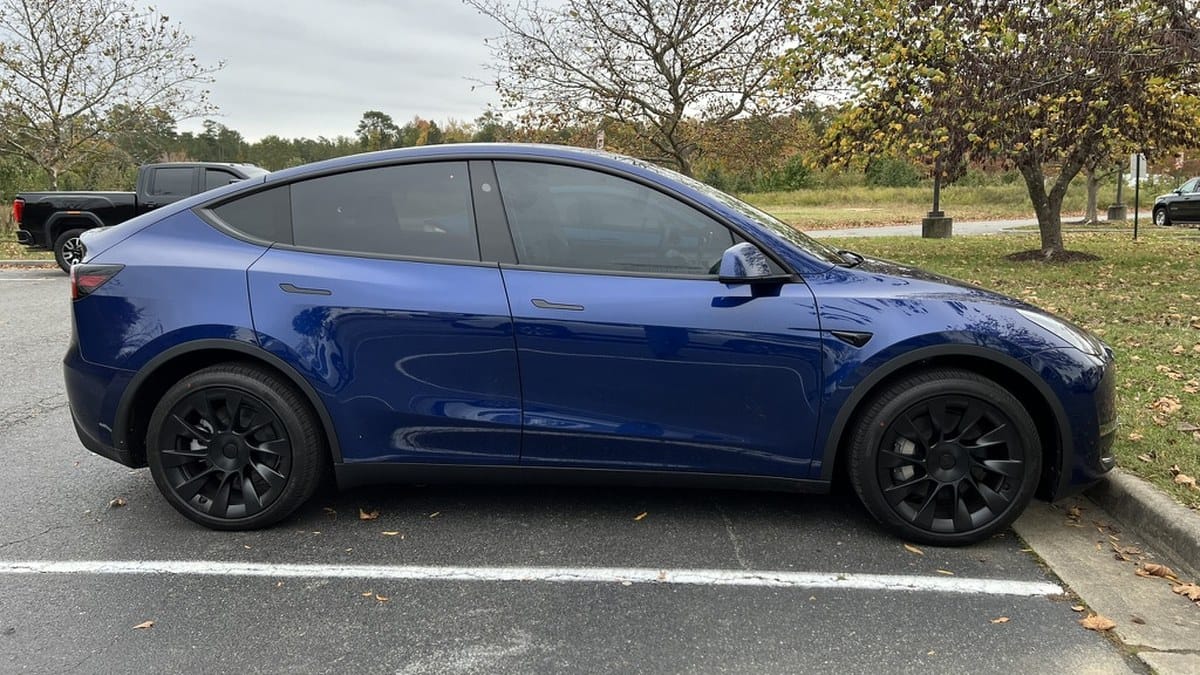
What Tesla Wash Mode actually does
Straight from the manual, with nothing added:
“When taking Model Y to a car wash, Car Wash Mode closes all windows, locks the charge port, and disables windshield wipers, Sentry Mode, walk-away door locking, and parking sensor chimes. To enable, touch Controls > Service > Car Wash Mode. Your vehicle must be stationary and not actively charging.”
Six things, and each one is there for a reason:
- Windows close. Obvious, and the one everyone knows.
- Charge port locks. High-pressure water into an open charge port is the expensive failure. This is the item that most justifies the mode.
- Wipers disabled. Rain-sensing wipers will happily try to sweep against a spinning brush or a high-pressure jet.
- Sentry Mode off. No alerts, no recording, no clip pile-up from a wash bay. (If you’ve been fighting Sentry footage filling a drive, that’s a separate problem worth fixing.)
- Walk-away door locking off. So the car doesn’t lock and re-arm every time you step away from it with a hose in your hand.
- Parking chimes off. No proximity beeping from the wash equipment.
Two conditions Tesla states plainly and most guides omit: the car must be stationary, and it must not be actively charging. If Wash Mode won’t engage, that’s usually why.
Why you should use Tesla Wash Mode every time
This is the sentence that turns a nice-to-have into a should-do:
“Failure to put Model Y in Car Wash Mode may result in damage (for example, to the charge port or windshield wipers). Damage caused by car washes is not covered by the warranty.”
Read that twice. Tesla is telling you two things in one breath — that skipping the mode can cause real damage, and that the warranty won’t catch you when it does. The mode is free and takes four seconds. There is no scenario where skipping it is the smart play.
It’s worth being just as clear about what Wash Mode doesn’t do. It doesn’t protect your paint. It doesn’t choose your soap. It doesn’t stop a rough cloth from putting scratches in your clear coat. It closes the car up and takes the electronics out of the equation — everything after that is down to what you wash with, which is the rest of this page.
How to turn on Tesla Wash Mode
- Put the car in Park and make sure it isn’t charging.
- Touch Controls on the touchscreen.
- Touch Service.
- Touch Car Wash Mode.
It stays on until you touch Exit on the screen, or until the car exceeds 9 mph (15 km/h) — Tesla’s stated cutoff. Drive out of the bay and it turns itself off.
If you’re going through an automatic wash that pulls the car along on a conveyor, there’s a second control worth knowing:
“If using an automatic car wash, Enable Free Roll keeps your vehicle in Neutral and activates free roll for the duration of the wash, while preventing Model Y from applying the Parking brake if you leave the driver’s seat. To enable, press on the brake pedal and touch Enable Free Roll; or shift into Neutral.”
Free Roll is the difference between the conveyor moving your car and the conveyor dragging a car that’s trying to hold itself still.
Tesla adds two more cautions for automatic washes:
“If washing in an automatic car wash, make sure the vehicle is locked. In addition, avoid using controls on the touchscreen that can result in accidentally opening doors or trunks while the vehicle is being washed. Any damage caused is not covered by the warranty.”
“Ensure the wipers are off before washing Model Y to avoid the risk of damaging the wipers.”
Wash Mode handles the wipers for you. It does not stop you from tapping the frunk button on the screen while you wait.
What Tesla recommends for washing your Tesla
Here’s where the manual gets genuinely useful, and where most articles go quiet. Tesla gives an actual four-step method:
“Before washing, flush grime and grit from the vehicle using a hose… Hand wash Model Y using a clean soft cloth and cold or lukewarm water and a mild, high-quality car shampoo… After washing, rinse with clean water to prevent soap from drying on the surfaces. Dry thoroughly with a chamois.”
Then a list of prohibitions that reads like it was written after a warranty-claims meeting:
| Tesla’s caution (verbatim) | What it rules out |
|---|---|
| “If washing in an automatic car wash, use touchless car washes only. These car washes have no parts, such as brushes, that touch the surfaces of Model Y.” | Soft-cloth and brush tunnels |
| “Do not wash in direct sunlight.” | Midday driveway washes — soap drying on hot panels |
| “Do not use hot water, detergents, highly alkaline or caustic cleaning ingredients or solvents, specifically those containing hydroxide. Avoid exposure to soaps and chemicals above pH 13.” | Dish soap, degreasers, most “heavy duty” truck washes |
| “Do not use acidic products either.” | Acidic wheel and bug removers |
| “Avoid using tight-napped or rough cloths, such as washing mitts. A high-quality microfiber cleaning cloth is recommended.” | The wash mitt in your garage |
| “Do not use chemical based wheel cleaners or pre-wash products. These can damage the finish on the wheels.” | Dedicated wheel cleaners and alkaline pre-soaks on the wheels |
| “If using a pressure washer, maintain a distance of at least 12″ (30 cm) between the nozzle and the surface” | Close-range pressure washing |
| “Do not aim water hoses directly at windows, door, or hood seals or at electronic modules or exposed cabling.” | Blasting the seals to chase a stubborn spot |
| “Do not use windshield treatment fluids. Doing so can interfere with wiper friction and cause a chattering sound.” | Rain-repellent on the windshield |
Three of these deserve a second look, because they’re the ones that quietly invalidate what’s probably in your garage right now.
The wash mitt line surprises people. Every detailing shelf in America sells a chenille mitt as the safe wash tool, and Tesla’s manual specifically names washing mitts as the thing to avoid, recommending a high-quality microfiber cloth instead. The logic tracks with how swirls actually happen: deep-napped mitts hold onto grit, and grit is what scratches.
The soap ceiling is stricter than most bottles admit. Nothing above pH 13, no detergents, no hydroxide, and no acidic products either. That rules out dish soap outright, and it rules out a lot of what gets marketed as heavy-duty car wash.
The wheel-cleaner line needs an honest caveat. Tesla says “chemical based wheel cleaners or pre-wash products” damage the wheel finish, but doesn’t define the term, and that sentence sits in the wheels caution. Our read, stated as a read and not as Tesla’s words: it’s aimed at dedicated wheel chemicals and aggressive alkaline pre-soaks, not at foaming your car with the same pH-neutral shampoo you’d use in the bucket. If you want zero ambiguity, use one soap for everything — which is exactly what the kit below does.
There’s one more that affects a system you actually rely on:
“To add a hydrophobic coating to your vehicle’s windows, apply the coating only to the side and rear windows, not the front windshield—doing so may affect the visibility of the Self-Driving cameras.”
If you run Autopilot or FSD, that’s not a cosmetic note. Tesla’s forward cameras look through the top of that windshield, and we’ve covered keeping the camera glass clean and what’s safe to use on it separately.
The wash kit that matches Tesla’s instructions
Six items. Each one exists because Tesla wrote a sentence that requires it — nothing here is a “nice extra,” and nothing here is a product we’re reaching for because it pays well. If you buy these and follow the four-step method, you’ve closed off nearly every way an owner damages their own finish.
CERAKOTE High Foam Vehicle Shampoo (32 oz)
Why it’s here: Tesla’s line is “a mild, high-quality car shampoo,” with a hard ceiling — nothing above pH 13, and no acidic products either. This one states pH neutral right in the product name, which lands safely between both limits, and the listing says it’s built for a foam cannon, a pressure washer, or a plain hand wash.
The buy-once argument: one pH-neutral soap covers paint, glass and wheels, which means you never reach for the dedicated wheel chemical Tesla told you not to use. It’s the single cheapest way to comply with three separate cautions at once.
Watch for: it’s a concentrate — dilute per the bottle, and don’t run it strong because a panel looks dirty.
Check price on AmazonChemical Guys Workhorse Plush Microfiber Towels, 16×16 (3-pack)
Why it’s here: This card exists because of one manual sentence — “Avoid using tight-napped or rough cloths, such as washing mitts. A high-quality microfiber cleaning cloth is recommended.” If you own a chenille mitt, this is the category that replaces it, and it’s the highest-value swap on this page.
Why three matters: one panel section per towel, and a towel that hits the ground is done for the day. A single towel dragged over an entire car is how grit gets redistributed into scratches.
Pro tip on the color: Chemical Guys color-codes this line by job, and this set is the black one — the brand’s pick for the dirtiest areas like wheels, arches and door jambs. That’s a feature, not a warning: buy a lighter color from the same line for paintwork and keep these for the filthy jobs, and you’ve got the dedicated-towel system that actually prevents swirls. Never let a wheel towel touch a body panel.
How to use them: flush and foam first so the towel moves over an already-rinsed surface, then straight lines rather than circles. Circles are how swirl marks got their name.
Check price on AmazonChemical Guys Megalodon Twisted Loop Drying Towel, 24×36
Why it’s here: Tesla says “dry thoroughly with a chamois,” and the modern equivalent is a large twisted-loop microfiber towel. Drying isn’t the boring last step — it’s where a lot of swirls actually get inflicted, because people chase a half-dry car with a small towel and a lot of pressure.
Why the size is the point: at 24×36 you lay it on a panel and drag, no pressure needed. That’s the whole trick, and a bath-towel-sized microfiber can’t do it.
The other half of Tesla’s drying instruction: “If necessary, dry the brakes by going on a short drive and applying the brakes multiple times.” Do that, especially in winter.
Check price on AmazonAmazon Basics Foam Cannon, 1/4-inch quick connect
Why it’s here: Tesla’s step 1 is “flush grime and grit from the vehicle using a hose” before anything touches the paint. A foam layer does that job better than a rinse alone — it lifts and suspends grit so your towel isn’t the thing removing it. Brass body, adjustable ratio, standard quick-connect.
Fitment check: the listing requires a pressure washer with at least 2.0 GPM and 1000 psi — plenty of homeowner units don’t clear that bar, so check yours before ordering. And remember Tesla’s rule when you use it: keep the nozzle at least 12 inches off the surface, keep it moving, and never aim it at the charge port while the car is charging.
Check price on AmazonChemical Guys TORQ Foam Blaster 6
Why it’s here: Most people don’t own a pressure washer, and the honest answer is you don’t need one — you need foam. This attaches to a standard garden hose and has an adjustable foam-ratio dial. Less dense than a cannon, but it does the job the cannon is there for.
Pick this one if: you’re in an apartment, a townhouse, or anywhere a pressure washer isn’t realistic. Buy the cannon above instead only if you already own a machine that meets its spec — don’t buy a pressure washer just to use a foam cannon.
Check price on AmazonInvisible Glass Premium Aerosol Glass Cleaner (2-pack)
Why it’s here: Tesla’s instruction for glass is short — “clean windows and mirrors using an automotive glass cleaner,” and don’t scrape or use anything abrasive. This is an automotive glass cleaner, ammonia-free and tint-safe, which matters on a car with a tinted glass roof. Pair it with waffle-weave microfiber towels, which are the right weave for glass.
Do not use it on the touchscreen. Tesla’s manual explicitly rules out glass cleaner on the display — that’s a different cloth and a different method, covered in our Tesla screen protector guide.
Check price on AmazonWhich of these you actually need
| Item | What it solves | Best for | Priority |
|---|---|---|---|
| pH-neutral shampoo | Tesla’s pH-13 ceiling, no-acid rule, and the wheel-cleaner ban in one bottle | Everyone | Buy first |
| Plush microfiber towels | Replaces the wash mitt Tesla names as the wrong tool | Everyone | Buy first |
| Large drying towel | “Dry thoroughly with a chamois,” without pressure | Everyone | Buy first |
| Foam cannon | Lifts grit before contact, at highest foam density | Owners with a 2.0+ GPM pressure washer | Optional upgrade |
| Foam gun | Same job, garden hose only | Apartments, townhouses, no machine | Optional upgrade |
| Automotive glass cleaner | Tesla’s separate glass instruction; tint- and roof-safe | Everyone eventually | Add-on |
If you buy nothing else, buy the first three. They’re the cheapest items here and they’re the three that Tesla’s own instructions most directly demand. The foam step is a genuine upgrade, not a requirement — pick the cannon or the gun based on whether you already own a pressure washer, never both.
Building out the rest of your Model Y setup? Our full Model Y accessories guide covers every category, and there’s a companion list of the accessories that aren’t worth your money.
Where to wash: what Tesla says
For automatic washes, Tesla’s position is one sentence and it isn’t hedged:
“If washing in an automatic car wash, use touchless car washes only. These car washes have no parts, such as brushes, that touch the surfaces of Model Y.”
The mechanism behind that rule is worth understanding: soft-cloth and brush tunnels reuse their media across every vehicle ahead of you, grit included, and drag it over your clear coat under pressure. That’s how swirl marks happen — thousands of fine scratches that show up as haze in direct sun.
Tesla is also emphatic about salt:
“To avoid corrosive damage that may not be covered by the warranty, rinse away any road salt from the underside of the vehicle, wheel wells, and brakes.”
A commercial bay with undercarriage jets does that better than a driveway hose in February. If you live where roads get salted, that rinse matters more than the shine.
| Hand wash at home | Touchless commercial bay | |
|---|---|---|
| Control over chemicals | Total — you choose a pH-neutral soap | None — you’re trusting the operator |
| Meets Tesla’s stated rule | Yes, with a microfiber cloth rather than a mitt | Yes — the one automatic wash Tesla endorses |
| Winter underbody rinse | Adequate with a hose | Best — undercarriage jets |
| Time | About an hour | About ten minutes |
| Best for | Owners who want it done to the manual’s standard | Salt season, speed, no driveway |
Frequently Asked Questions
Where is Wash Mode on a Tesla?
Controls → Service → Car Wash Mode. The car has to be in Park and not actively charging, or the option won’t engage. It turns itself off if you exceed 9 mph, or you can touch Exit on the screen.
Can I take a Tesla through an automatic car wash?
Tesla’s manual says to “use touchless car washes only. These car washes have no parts, such as brushes, that touch the surfaces” of the car. Soft-cloth and brush tunnels are what put swirl marks in clear coat, and Tesla states plainly that damage caused by car washes isn’t covered by the warranty. If you do use an automatic wash, put the car in Wash Mode, enable Free Roll if it’s a conveyor, and keep your hands off the touchscreen while you’re in there.
Does Wash Mode turn off Sentry Mode?
Yes. Wash Mode disables Sentry Mode along with the wipers, walk-away door locking, and the parking sensor chimes, and it locks the charge port. Sentry comes back when you exit the mode.
Can I pressure wash a Tesla?
Yes, with limits Tesla spells out: keep the nozzle at least 12 inches (30 cm) from the surface, keep it moving, don’t concentrate the jet on one area, and don’t aim it at window, door, or hood seals or at electronic modules and exposed cabling. Never spray high-velocity water toward the charge port while the car is charging — Tesla flags that one as a risk of serious injury, not just damage.
What soap is safe for a Tesla?
A mild, pH-neutral automotive car shampoo. Tesla’s ceiling is explicit — nothing above pH 13, no detergents, no highly alkaline or caustic ingredients (specifically anything with hydroxide), and no acidic products either. That rules out dish soap, degreasers, and most dedicated wheel cleaners.
Our Honest Verdict
Wash Mode is four taps, and Tesla says damage from skipping it isn’t covered under warranty. Use it every time, at a bay, at home, even for a quick rinse.
The mode is the small half, though. The bigger half is the page it lives on, which is unusually specific for a manual: a pH-neutral shampoo, a microfiber cloth instead of a mitt, twelve inches of standoff on a pressure washer, no chemical wheel cleaners, and a thorough dry. Do those five things and you’ve covered nearly every way an owner scratches their own paint. Skip them and the mode alone won’t protect your paint.
If you buy nothing else off this page, buy the microfiber cloths, the drying towel, and the pH-neutral shampoo. They’re the three cheapest items here and the three Tesla’s instructions most directly call for, and together they cost less than one paint-correction appointment.
Related Guides
—