Updated September 5, 2026
Disclosure: As an Amazon Associate, I earn from qualifying purchases. This comes at no extra cost to you and helps keep this site running.
This is my answer to the question “is Tesla FSD worth it,” and it comes from using Full Self-Driving for more than 50,000 miles, from the early beta builds through today’s v14. The early years were scary, a lot like supervising a student driver. Today it drives nearly every trip I take. Below I cover what it does well, where it still fails, who should not pay for it, and the time it reacted faster than I would have.
One thing up front, because it changed this year: you can’t buy FSD outright anymore. Tesla ended one-time purchases on February 14, 2026. It is now a subscription at $99 a month, or $49 a month if your car has Enhanced Autopilot. I cover what that does to the math below.
My Setup: Which Car, Which Hardware, How Much I Use It
I paid for FSD outright when I bought my 2023 Model Y — back when that was still possible. That car runs Hardware 4 (HW4), and it’s where all of my FSD miles live. We also have a 2024 Model Y that rarely gets driven, and a 2021 Model 3 on Hardware 3 — more on that one later, because the hardware difference turned out to matter a lot.
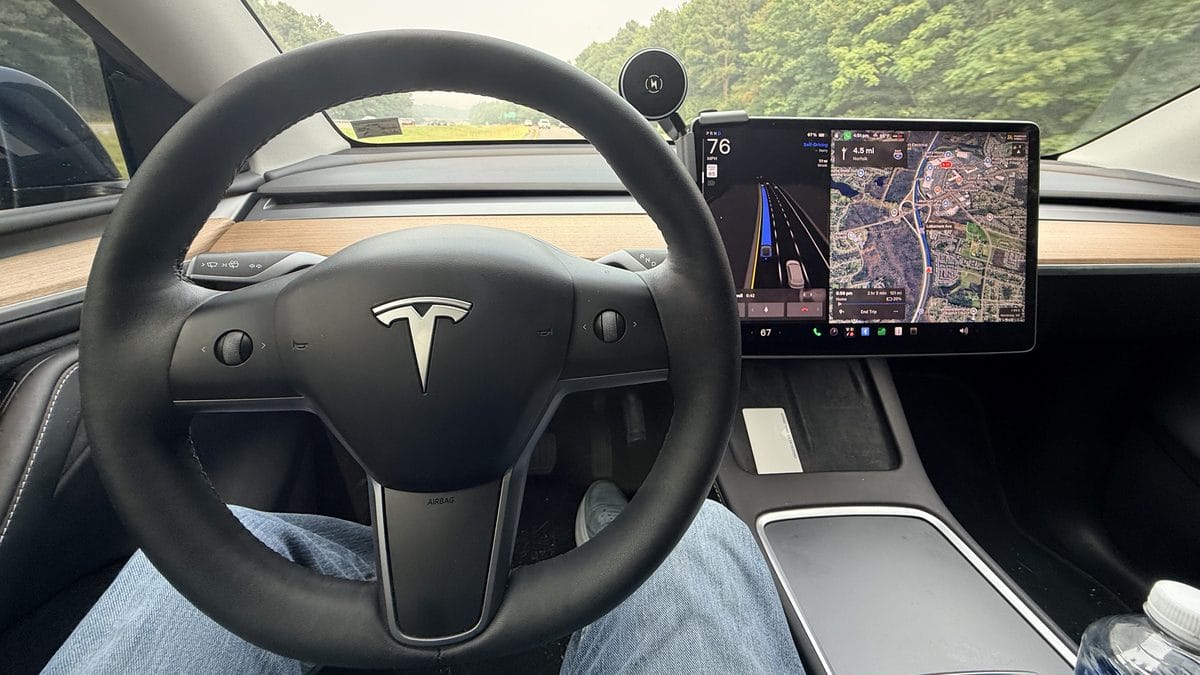
Today I use FSD for essentially 100% of every drive, whether it’s a two-mile errand or the 200-mile round trip I make once a week. That’s not an exaggeration for effect; engaging it is as automatic as putting on my seatbelt. That’s the single most useful data point I can give you, because nobody uses something for every single drive across years unless it’s actually earning its keep.
From Scary to Second Nature: What 50,000 Miles of Versions Taught Me
I’ll be honest about the early days: when I first got FSD, it was scary. The early builds made lots of errors, and you had to watch it every single second — it was more like supervising a student driver than being driven. If you tried FSD in that era and swore it off, I understand completely.
The turning point was v12, when Tesla shifted from rules-based driving to an end-to-end AI approach. That wasn’t an incremental update — it was a huge leap in both ability and reliability, and it’s the moment FSD went from “party trick I supervise nervously” to “the way my car drives.” Every version since has widened that gap. On v14, where I am now, the car handles situations I genuinely wouldn’t have trusted it with two years ago.
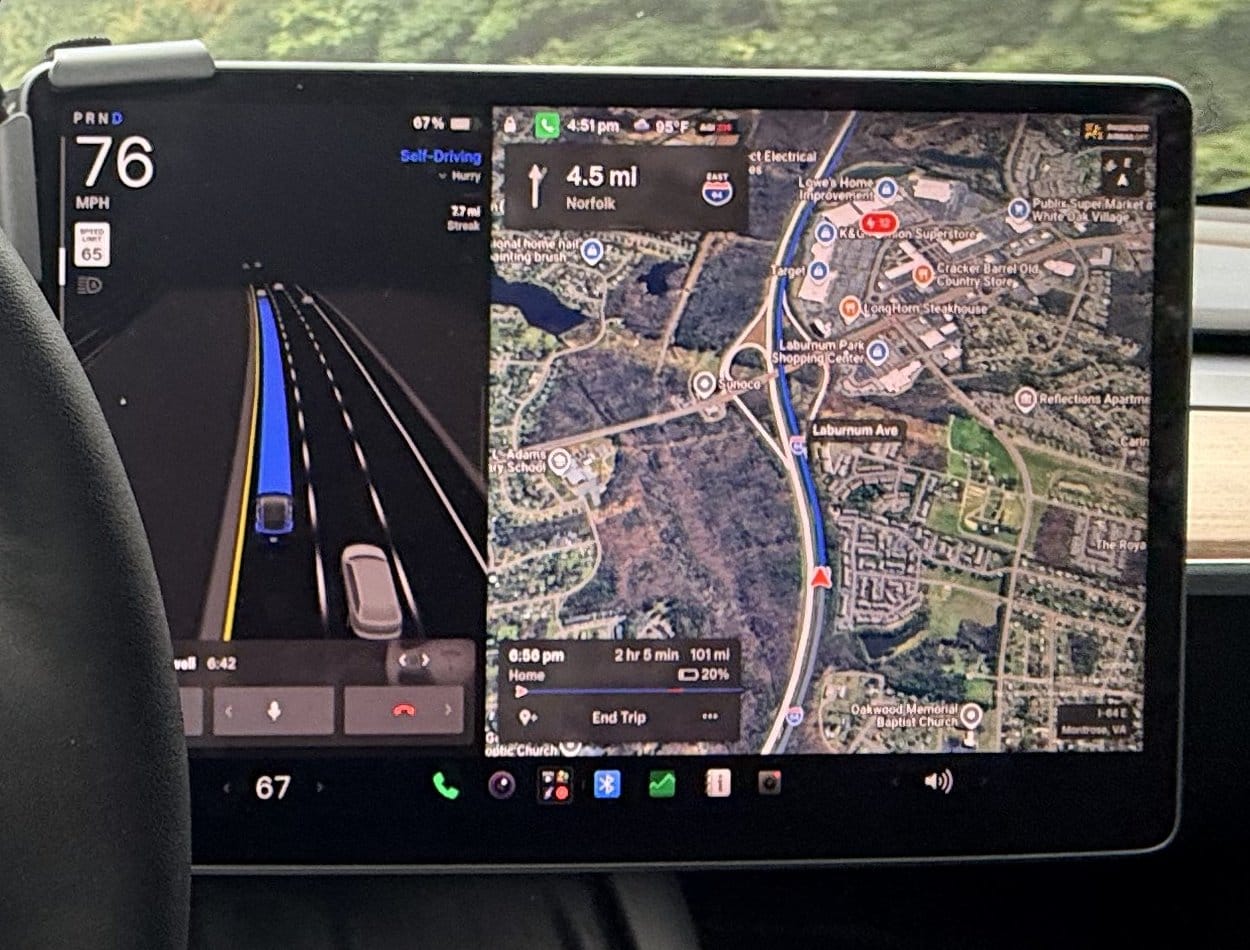
That history matters when you read FSD opinions online: a review from the v10–v11 era is describing a different product. The system you can subscribe to today is the post-v12 one.
The Moment That Sold Me: The Child Between the Parked Cars
Every FSD owner has wow moments. Mine is the one I measure everything else against.
A child ran out into the street from between two parked cars. My Tesla slammed on the brakes and avoided them before I had fully processed what was happening. I am honestly not certain I would have reacted as fast on my own — and I don’t like thinking about how that moment ends if I’m a half-second slower.
That’s the core of why I keep using FSD: it’s watching 360 degrees, all the time, with millisecond reflexes. It doesn’t get tired, doesn’t check a text, doesn’t glance at the radio. In my experience, that constant vigilance makes my supervised-FSD drives feel safer than my own unassisted driving — with the emphasis on supervised, because that’s both the legal requirement and the honest way to use it. FSD (Supervised) is a driver-assistance system: you stay attentive, and the car makes you a better, faster set of reflexes — not the other way around.
Where FSD Still Fails (Honestly)
It’s not perfect, and pretending otherwise helps nobody. Here’s what still goes wrong on v14, in my actual experience:
- Navigation quirks. It sometimes ignores the route I’d prefer, and occasionally does something silly like turning right three times instead of just turning left. Mildly maddening — but I classify these as navigation issues, not safety issues. The car drives the wrong route safely.
- You still have to pay attention. That’s not a flaw so much as the deal you’re agreeing to. It’s called FSD (Supervised) for a reason, and the car monitors your attention accordingly.
What I notably don’t experience anymore on HW4/v14: the phantom braking, lane-change hesitation, and intersection confusion that defined the early years. Those complaints are real — they’re just describing older software.
The 18-Hour Day: What FSD Does on Road Trips
Here’s the benefit nobody quantifies until they live it: FSD removes the fatigue of driving.
I recently made an 18-hour trip in a single day — a drive I would normally split across two days. I just kept going, because I never felt tired. The car did the constant micro-work of driving (the lane keeping, the speed management, the traffic monitoring) and I did the supervising. Arriving relaxed after a drive like that is something I didn’t believe until I experienced it.
The same effect shows up on my weekly 200-mile round trip. The drive that used to be dead, draining time is now genuinely low-stress. If you drive real miles every week, this — not the party trick of an empty driver’s seat — is what you’re actually paying for.
HW3 vs. HW4: The Honest Hardware Warning
This is the part most FSD reviews skip, and it matters if you’re shopping used.
We’ve run FSD on our 2021 Model 3, which has Hardware 3 — and it’s simply not as good as the same software on my HW4 Model Y. Good enough to demo, not good enough that I’d pay a monthly subscription for it. On HW3, my honest verdict is: not worth the cost. On HW4, it absolutely is.
If you’re buying a used Tesla partly for FSD, the hardware generation should drive your year choice — I break down exactly which years have which hardware in my best used Model 3 year guide and best used Model Y year guide.
The 2026 Math: Subscription-Only Changes the Question
When I bought FSD outright with the 2023 Model Y, the question was “is it worth thousands of dollars, up front, on faith?” That question is gone. Since February 14, 2026, Tesla no longer sells FSD outright — it’s a subscription:
| Option | Price | Who it’s for |
|---|---|---|
| FSD (Supervised) subscription | $99/month | Any compatible Tesla |
| FSD subscription with Enhanced Autopilot | $49/month | Cars that already have the EAP package (rate live since Jan 29, 2026) |
| One-time purchase | Discontinued Feb 14, 2026 | Grandfathered owners (like me) keep it |
For what it’s worth, Tesla has said the $99 price isn’t permanent and is expected to rise as capability grows — so the try-it-now math may be the best it gets.
The subscription model honestly makes my recommendation easier: you don’t have to trust my verdict, or anyone’s. Subscribe for one month, use it for every drive the way I do, and you’ll know. $99 is the cheapest way to answer this question yourself — and you can cancel from the app.
So, Is Tesla FSD Worth It? Who Should Get It — and Who Should Skip It
Get it if you drive more than a few miles a day. Commuters, road-trippers, rideshare-mileage drivers, anyone whose week includes real seat time. The stress reduction compounds: you feel it on day one, and you really feel it at your destination after a long haul.
Skip it if you only drive a few miles a day. If your Tesla does a short school run or grocery loop and sits the rest of the week, $99/month buys you very little relief. That’s genuinely the only category of driver I’d tell to skip it — and I say that as someone who paid full price out of pocket.
And regardless of mileage: skip it on HW3. Subscribe on a HW4 car or wait until you own one.
Frequently Asked Questions
Is Tesla FSD worth it in 2026?
For most people who drive daily, yes. After 50,000+ miles I use FSD on essentially every drive, and the combination of v14 software and Hardware 4 is dramatically better than what early reviews described. The honest exceptions: drivers who only cover a few miles a day, and older Hardware 3 cars, where the experience doesn’t justify the price.
How much does FSD cost now?
$99 per month as a subscription — $49 per month if your car has the Enhanced Autopilot package. Tesla discontinued one-time FSD purchases on February 14, 2026, so subscribing is now the only way in. Owners who previously bought it outright, like me, keep it.
Do you still have to pay attention with FSD?
Yes. It’s officially FSD (Supervised) — a driver-assistance system, not a robotaxi. The car monitors your attention and you’re responsible for the drive. In my experience that supervision gets easy, because interventions became rare after v12 — but “rare” isn’t “never,” and the 360-degree vigilance works best as a second set of reflexes on top of yours, not instead of yours.
Is FSD worth it on Hardware 3?
In my experience, no. We’ve tried FSD on our HW3 2021 Model 3 and it’s noticeably behind the same software on my HW4 Model Y — good enough to demo, not good enough to pay monthly for. If FSD matters to you, choose a HW4 car.
Is FSD actually safe?
My honest experience: supervised FSD feels safer than my own unassisted driving, because the car watches 360 degrees at all times with millisecond reflexes — it braked for a child running between parked cars faster than I’m confident I could have. But that safety story is supervised FSD: the system plus an attentive human. Treat it that way and it’s the best safety feature on the car.
Our Honest Verdict
Yes, Tesla FSD is worth it if you drive more than a few miles a day and your car is on Hardware 4. I bought it outright with the car and I use it on every drive. It once braked for a child who ran into the street, and I am honestly not certain I would have reacted as fast on my own. The flaws that remain are navigation mistakes, wrong turns and odd routes. In my experience none of them have been safety problems. FSD is now subscription only at $99 a month, so you do not have to take my word for it. Subscribe for a month, use it on your normal drives, and decide for yourself. Skip it if your car rarely leaves the driveway, or if it is a HW3 car, where FSD is not worth the cost.
If you’re still deciding on the car itself, FSD hardware should shape which Tesla you buy: my used Model 3 year guide and used Model Y year guide break down HW3 vs. HW4 by model year. New to EVs entirely? Start with the honest gas-to-electric decision guide. And once the car’s in the driveway, here’s what actually belongs in a new Model Y.