Updated September 10, 2026
⚡ Quick Summary
The short version: Road salt is not mostly a paint problem — it’s a crevice problem. State DOTs pre-wet rock salt with liquid magnesium chloride, which pulls moisture out of the air and keeps working long after the road dries. That brine gets flung into wheel wells, door sills, and everything under the car.
- Cheapest real fix: an undercarriage wash after salted roads. AAA’s own guidance, and it’s what I do.
- Best hardware buy: no-drill mud flaps — but flexible ones, and not because the listing says “flexible.” The set that broke on my car said that too.
- Worth it if you keep the car: pre-cut PPF on rockers and lower doors. I don’t run it; here’s the honest case.
- Skip: dish soap, and any wash at all when it’s below freezing.
Disclosure: As an Amazon Associate, I earn from qualifying purchases. This comes at no extra cost to you and helps keep this site running.
Why Tesla winter salt protection is a different problem than you think
Most people picture road salt as white crust on the paint that a car wash takes off. That’s the part you can see, and it’s the least of it, which is why most Tesla winter salt protection advice starts in the wrong place.
What’s happening is a chemistry change in how roads get treated. Connecticut’s DOT, in a legislative research report on its own winter program, describes pre-wetting rock salt with a 30% liquid magnesium chloride solution. The liquid “absorbs water from the air, dissolving the salt more quickly, and creating the brine that melts the snow and ice.” That is what makes it work on the road, and it is also the problem, because the same behavior keeps it working inside your rocker panel in March.
The same report quotes a corrosion review noting that chlorides like calcium and magnesium form a “corrosive concentrated chloride solution when critical humidity and temperature level combinations are reached. It is at approximately these humidity levels that corrosion is most severe.” A University of Maine study it cites found all chlorides corrode, with calcium and magnesium chloride singled out “because of their ability to retain moisture” — while explicitly declining to rank them, because real-world conditions vary too much. I’ll hold that line too: nobody credible is publishing a clean “X times worse” number, whatever the undercoating industry’s blog posts say.
What is quantified is the bill. AAA estimates Americans spend about $3 billion a year on rust repairs traced to de-icing materials, and its February 2026 winter advisory is blunt about where the damage lands: road treatments “can accelerate rust and corrode brake and fuel lines.” Shawn Steward of AAA Kansas, in that release: “Corroded brake lines, often the result of road salts and de-icers, can cost hundreds of dollars to replace, or more, depending on the vehicle.”
Brake lines, suspension hardware, fasteners, and electrical connectors. Nothing on that list is a paint problem, and every item on it exists under an EV too. That’s the frame for everything below: Tesla winter salt protection is mostly about keeping brine off the underside of the car and out of the seams, not about keeping the doors shiny.
Across our three Teslas I’ve settled on exactly two things that address that, and I want to be upfront that one of them I got wrong the first time. (If it’s the cold itself you’re worried about rather than the salt, the range side is covered in the winter range loss guide.)
The mud flap mistake I made — rigid vs. flexible
Teslas ship without mud flaps. That’s an aerodynamics-and-styling call, and it means the front tires throw a brine-and-grit slurry down the length of the car every wet mile. Flaps stop that at the source, before the spray reaches the rocker, the door bottom, or the wheel-well liner. They’re the highest-value thing you can bolt on for this problem.
So I bought a set for the 2024 Model Y — BOXI’s. Firm, hard plastic, molded to the car, looked great.
They hit parking curbs and broke off.
Not on some off-road adventure — in parking lots, doing the thing every car does a hundred times a month. A molded flap that doesn’t flex has nowhere to put the energy when the bottom edge catches concrete, so it goes where rigid plastic always goes: it cracks at the mounting point and leaves. I replaced them with flexible rubber-type flaps and those are still on the car.
And I’ll say the unpopular half out loud: the firm molded ones do look better. They sit tighter to the body, the lines are crisper, and if you’re the kind of owner who notices that, you’ll notice it. I’m not going to pretend the flexible ones are prettier. They’re just still attached.
The part where my own advice was wrong
When I started writing this, the tip I was going to give you was simple: buy the ones whose listing says “flexible.”
Then I went back and reread the BOXI listing. Its own bullet says, word for word: “【Material】PP+TPO; Work safe in all harsh environment. Sturdy, durable and flexible.”
So that advice is worthless, and I’d have handed it to you with a straight face. The word “flexible” costs a seller nothing. Nearly every listing in this category uses it, including the one that snapped off my car in a parking lot.
To be fair to BOXI: this is one set on one car, I don’t know how they’d hold up for you, and I’m not linking them here either way — I’d rather not earn a commission on a part I’m telling you failed on me. Their listing is also internally inconsistent about what the part even is, describing the material as PP+TPO in the bullets while the product details field just says “Polypropylene.” That inconsistency is the honest summary of the problem: I couldn’t have told you, before buying, what I was actually getting.
What’s useful is grading how a listing backs the word up. In descending order of how much I’d trust it:
- It describes the construction. The set I run now is built as a hard frame with a softer flap bonded to it — two materials doing two jobs. Its listing spells that out and explains why: “Unlike most of the mud flaps entirely made of stiff plastic which is easy to crack once hitting hard stuffs.” That’s a falsifiable description of a part, not an adjective.
- It makes a specific claim about impact. “Will not break even if it encounters foreign objects during driving” is a claim a seller can be held to. Weaker than a construction spec, much stronger than a vibe.
- It just says “flexible.” Treat as no information. This is the tier BOXI was in — and, to be fair, the tier several well-regarded sets are also in.
That reordering cost me my original top pick, which sits in tier three. I’d rather tell you that than quietly leave it at the top.
One frustration I can’t solve for you: the set actually on my car is a Vugosson, and as I write this it’s out of stock with no restock date — both their Model Y and Model 3 versions. I’m naming it because you asked what I run, not linking it, because sending you to a dead page helps nobody. If it comes back, it’s a tier-one listing on the scale above.
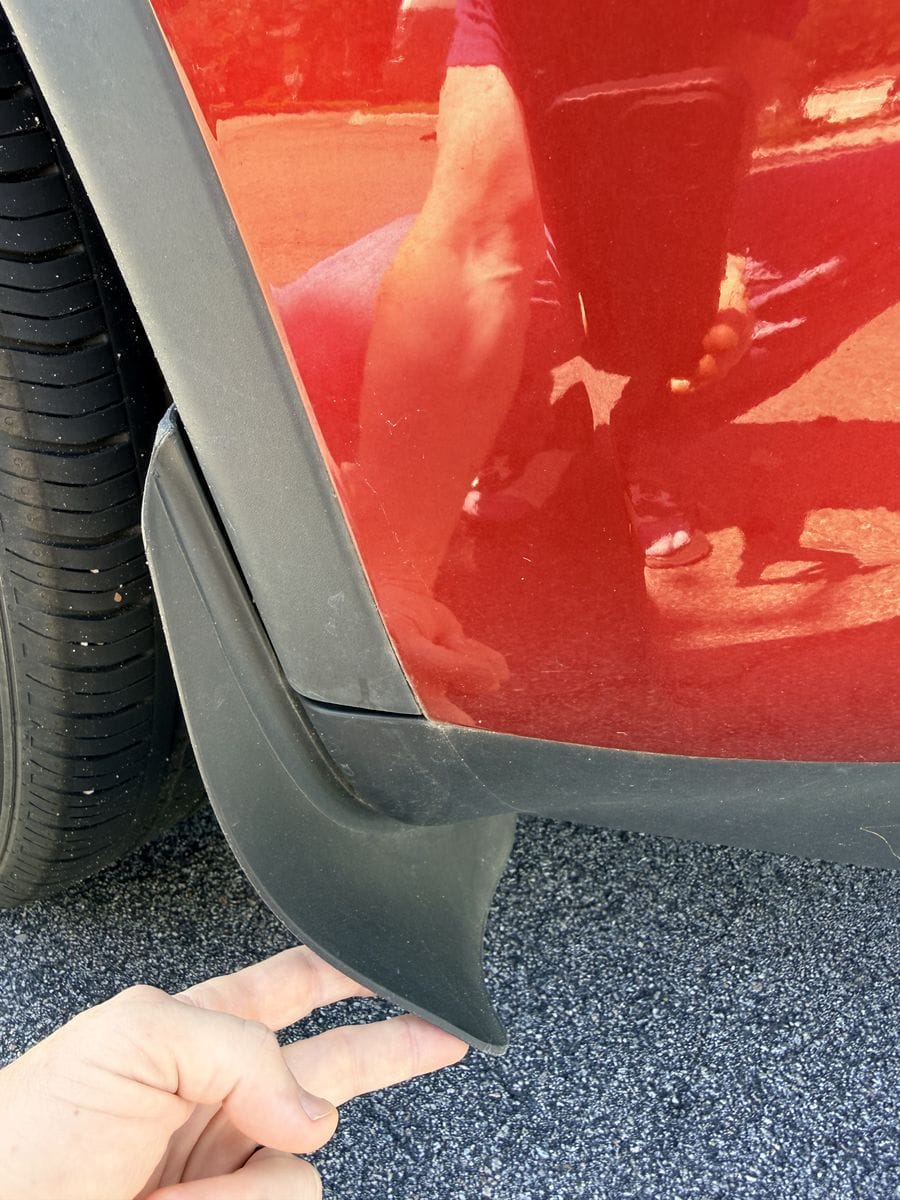
For balance, our 2023 Model Y still wears an older rigid molded set, and those haven’t broken. So this isn’t “rigid always fails.” It’s that rigid has no margin the day it does catch something, and on the 2024 that day came in a parking lot.
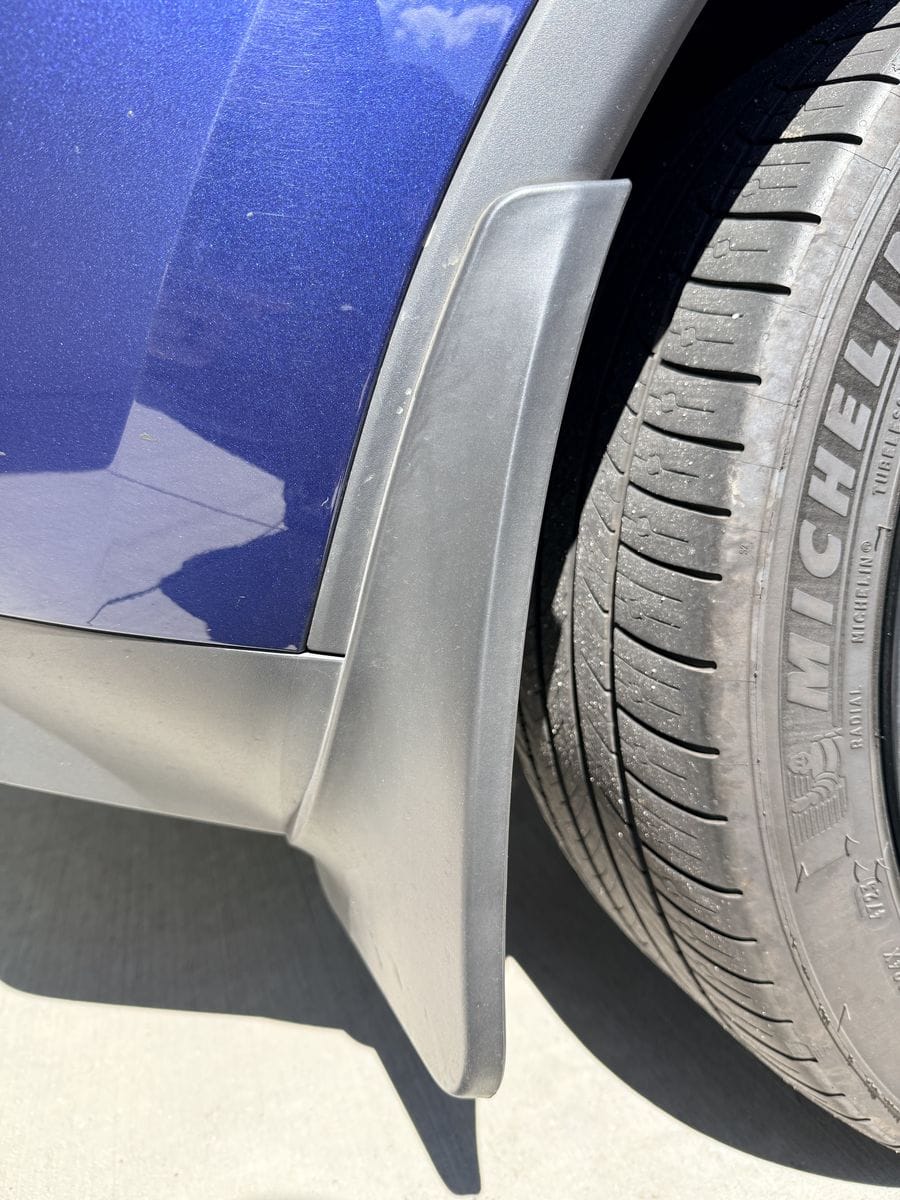
The other thing that matters is fitment, and it’s unforgiving: these are molded parts, per generation, not per model. A Juniper set will not fit a legacy Model Y. A Highland set will not fit a 2019 Model 3. Buy the generation, not the badge.
Model Y — what to buy instead
CYBERBEANS Mud Flaps, Tesla Model Y (Set of 4)
Fitment, read the caveat: the title says 2022/2023/2024 and the listing opens with “Not Fit 2025 Model Y Refresh Juniper!”, but a later bullet claims it fits 2020 through 2025. That’s the listing contradicting itself on 2025, which was the changeover year. We’re going with the narrower read: 2020–2024, legacy only. If you have a 2025 car, establish whether it’s legacy or Juniper before you order.
Why it’s the top pick: this is the closest in-stock equivalent to what’s actually on my Model Y, and its listing makes a tier-two claim rather than a tier-three one — PP+TPE that is “highly flexible and will not break even if it encounters foreign objects during driving.” That’s the specific failure I had, addressed specifically. It also uses the added bottom fixing hole rather than side holes only, which is the detail that matters when a flap does catch something. In Stock, ships from Amazon, sold by CYBERBEANS.
What I’m not claiming: I haven’t curb-tested this exact set — mine is the Vugosson. This is the equivalent I’d buy today, not a set I’ve broken or failed to break.
REEVAA Mud Flaps, Tesla Model Y 2019–2024 (Set of 4)
Fitment (from the listing): 2019–2024 Model Y, all trims (Standard / Premium / Performance). Not Juniper. Covers 2019, which the pick above doesn’t.
Why it’s the alternate and not the pick: in fairness, this is a well-built set: PP + TPE, ships from Amazon, sold by REEVAA directly, and the listing claims 6.7 inches of retained ground clearance, which is a real answer to the “will these scrape” worry. But its flex claim is “Flexible Design” and nothing more, which is tier three on the scale above, the same tier BOXI was in. That is not an accusation against REEVAA. It is an absence of evidence, and those are different things. Buy it for the wider year coverage; don’t buy it because that phrase reassured you.
REEVAA Mud Flaps, Tesla Model Y Juniper 2025–2026 (Set of 4)
Fitment (from the listing): 2025–2026 Model Y Juniper, explicitly claiming Standard, Premium and Performance — which is rarer than it sounds, since a lot of Juniper parts quietly print “Not for Standard.” The title adds “Not for YL”: if you’re in a Model Y L, this is not your part.
Why this one: the Juniper generation has fewer options, and this is the one I’d take — the top pick above explicitly excludes Juniper, so REEVAA is effectively the field here. Same “Flexible Design” caveat as its legacy sibling: tier three, take the phrase as decoration rather than evidence. Ships from Amazon, sold by REEVAA.
Model 3 — the honest state of this lane
I have to be straight about the sedan side: right now there’s no Model 3 set I can point you at that’s both in stock and above tier three. The Vugosson Model 3 version, the tier-one listing with the same construction as the set on my Model Y, is out of stock alongside its Model Y sibling. What’s left in stock are well-made, correctly-fitted sets from established Tesla brands whose listings don’t address impact at all, and one of them shares a review section with a Model X buyer reporting a repeat break on rough ground.
So here they are with that caveat attached, because “no flaps at all” is worse than “flaps that might need replacing.” Just go in with your eyes open, and if you park nose-in against concrete every day, weigh that.
BASENOR Mud Flaps, Tesla Model 3 Highland 2024–2026 (Set of 4)
Fitment (from the listing): 2024, 2025 and 2026 Model 3 Highland. Material listed as PP + TPE.
Why it’s here: BASENOR has been making Tesla-specific flaps longer than most of the field, this set uses the factory hole locations with an added bottom fixing point, and it ships from Amazon sold by BASENOR US — which matters in a category full of drop-shippers.
The caveat, stated plainly: the listing makes no flexibility or impact claim, and the review section it shares with BASENOR’s other sizes includes a Model X buyer reporting the flaps break easily on uneven ground, twice. Different car, same material family, and possibly an install-position issue rather than a material one, but I’m not going to pretend I didn’t read it.
BASENOR Mud Flaps, Tesla Model 3 2017–2023 (Set of 4)
Fitment (from the listing): 2017–2023 Model 3 — the widest span available in this lane. Read the listing’s all-caps install note before you start: “THE CORRECT MOUNTING POSITION IS AT THE REAR OF THE WHEEL.” People get this wrong and then blame the fit.
Why it’s here: this is the generation most likely to already have winters on it, and the one where catching up on underbody protection matters most. Same no-drill, no-tape approach, ships from Amazon. Same caveat as its Highland sibling above — no flex claim on the listing.
One honest caveat on all of them: mud flaps are not free aerodynamically. REEVAA’s listing claims its profile retains 98% of original efficiency, and I have no way to verify that — nobody publishes third-party wind-tunnel data on aftermarket Tesla flaps. Treat “negligible range hit” as the manufacturer’s claim, not a measured fact.
PPF: the layer I don’t run, and the honest case for it
I’ll say this plainly so there’s no ambiguity: I don’t run paint protection film on any of our three cars. Everything below is read off product listings and AAA’s guidance, not off my own paint. Take it as a category briefing rather than a recommendation from experience.
Full-car PPF is a four-figure professional job and it isn’t the winter answer for most owners. The winter answer is narrower: the rocker panels and the lower few inches of the doors — the strip directly downstream of the front tires, where grit arrives at highway speed with brine as the carrier. That’s where chips cluster, and every chip is bare metal with a salt solution sitting on it. AAA makes the same point from the repair side, listing “repairing paint chips and body damage that expose bare metal” among its winter recommendations. Pre-cut PPF is that advice, done before the chips.
TWRAPS Partial Lower Doors PPF, 8 mil Rocker Panels
Fitment — one flag: the title says “Tesla Model Y 2019-2026 Including Juniper,” but bullet six says “Tesla Model Y 2019-2025.” Same listing, two spans. Confirm your year with the seller before ordering, especially for a 2026 Juniper.
Why this one: the coverage pattern matches the actual damage — lower doors plus rockers, not a full front-end kit. Precision-cut into multiple pieces, which is far more forgiving for a first-timer than one large panel. 8 mil, self-healing topcoat, ships with a squeegee and slip solution. The listing puts install at roughly 60 minutes.
Expectation setting: “self-healing” means light swirls flow out with heat. It does not mean the film shrugs off a rock strike — a hard hit still marks the film. The film taking the mark instead of the paint is the product working.
Factory Crafts Rear Rocker Panels Pre-Cut PPF Kit
Fitment (from the listing): Tesla Model Y 2020–2024.
Why this one: narrower and cheaper — just the rear rocker zone, which on a Model Y takes the worst of it from the front tires. Self-healing polyurethane, digitally cut.
The listing’s own warning, quoted because it’s the most honest line in this section: “If you have not installed a ppf kit before and are not comfortable stretching the material we highly reccomend bringing it to a professional for installation. (Kit will look small but stretches to perfectly fit the vehicle. Please note: Stretching is difficult).” Believe them. This is a third-party seller with a several-day handling time, so order before the first storm, not after it.
The wash: what I do, and what to do if you don’t have a membership
Hardware helps. Washing is what actually removes the chloride, and it’s the step AAA leads with.
My routine is not complicated and it’s not a DIY detailing ritual: I have a wash club membership, and after driving on salted roads I run the car through the automatic wash, with the undercarriage wash, as soon as I can. That’s it. The membership is what makes “as soon as possible” realistic, because the marginal cost of any single wash is zero, so there’s no reason to talk myself out of it on a Tuesday.
That happens to line up with the published guidance almost exactly. AAA recommends washing after every significant winter storm, with particular attention to the undercarriage, and specifically recommends “car washes that offer undercarriage rinses to remove buildup on critical components.” Connecticut’s DOT says the same in its own report: it “recommends that motorists wash their cars, including their undercarriages, regularly in the winter.” If you’re choosing between spending money on hardware and spending it on an unlimited wash plan, I’d take the wash plan.
Four things from that AAA release that are easy to get wrong:
- Don’t wash below freezing. AAA is explicit — winter washing is fine above freezing, but below it, “soap and rinse water can refreeze on components under the vehicle.” This is the one place my “as soon as possible” instinct needs a check: soon is good, sub-freezing is not.
- Dry the door jambs and seals. Moisture left in jambs freezes as temperatures drop. On a Tesla with flush handles and frameless glass, a frozen seal is a real annoyance, not a theoretical one — and it’s the thing an automatic wash won’t do for you.
- Use car wash soap, not dish detergent. AAA calls this out directly. Dish soap strips whatever protection is on the paint.
- Pull the floor mats. The interior point nobody thinks about: wet mats from melting snow trap moisture against the floor. Take them out, clean them, dry them, put them back.
That last one is a good argument for proper TPE liners with raised edges over carpet — they hold the slush instead of letting it soak through. We go deep on that in the EV floor mats guide.
If you’re washing at home instead
Plenty of people don’t have a wash club, or don’t want an automatic brush anywhere near their paint. Fair. Two things make a home winter wash work without a pressure washer, and I’m recommending these on spec and category rather than as my own routine — the automatic wash is what I use.
If you go this route, use Wash Mode first. It locks the charge port, disables the wipers and Sentry, and stops the car doing something surprising while you’re crouched at the rocker panel with a hose.
Chemical Guys TORQ Foam Blaster 6
Why it’s here: the real constraint on home winter washing is that most people don’t own a pressure washer and the driveway is cold. This attaches to a standard garden hose, the listing is explicit that no pressure washer is required, and it has an adjustable foam-ratio dial. Enough lift to get grit off a rocker panel without the swirl marks you’d get scrubbing dry salt with a mitt. Shipped and sold by Amazon.
CERAKOTE High Foam Vehicle Shampoo, pH Neutral, 32 oz
Why it’s here: this is AAA’s “car wash solution rather than household dish detergent” made specific. pH neutral is stated in the product title, and the listing calls the formula ceramic-safe — which matters if your car has a coating you’d rather not strip every time you chase salt off it. Works with a foam cannon or the two-bucket method. Ships from Amazon, sold by CERAKOTE.
Comparison: what each layer buys you
| Layer | What it protects | Effort | Reversible? | Worth it if… |
|---|---|---|---|---|
| Undercarriage wash | Brake lines, suspension, subframe, seams | Minutes, per storm | n/a | Always. The one non-negotiable — and what I do. |
| Mud flaps — flexible | Rockers, lower doors, wheel wells — at the source | ~5–20 min, one time | Yes — clips out | You drive salted roads at all. Best value here. |
| Mud flaps — rigid | Same, until they don’t | Same, plus doing it again | Involuntarily | Honestly? Don’t. Ask me how I know. |
| Pre-cut PPF (rockers/lower doors) | Paint and clearcoat in the chip zone | ~1 hr, real skill needed | Yes, but tedious | You’re keeping the car 5+ years or care about resale. I don’t run it. |
| TPE floor liners | Cabin floor from melted slush | Drop-in | Yes | Anyone in a snow state. Cheapest interior insurance there is. |
Frequently Asked Questions
Do Teslas rust?
Tesla bodies use a mix of aluminum and steel depending on the model and panel, and aluminum doesn’t rust the way steel does — but that’s not the whole car. The parts AAA names as the expensive failures are brake lines, suspension hardware, fasteners, and electrical connectors, and those are steel on essentially every vehicle sold. The honest answer: the panels are more resistant than a 1990s sedan’s, and the stuff underneath still needs the salt rinsed off it.
Are flexible mud flaps really better than rigid ones?
For durability, that’s been my experience: my first rigid set broke off on parking curbs and the flexible replacements are still on the car. I want to be careful how far I push that: it’s one owner, one car, one pair of products. What I’d say with more confidence is narrower and more useful: a flap that can’t flex has to put the energy somewhere when its bottom edge catches concrete, and parking curbs are unavoidable. The honest counterpoint is that the firm molded ones do look better, and if you never scrape one, they’re fine. Most of us scrape. Also worth knowing: “flexible” in a listing means nothing on its own. The BOXI set that broke on me advertised itself as “sturdy, durable and flexible.”
Do mud flaps hurt Tesla range?
Manufacturers claim the effect is negligible — REEVAA’s listing says its aerodynamic profile maintains 98% of original efficiency. No independent testing of aftermarket Tesla flaps exists that I’ve been able to find, so treat that as a vendor claim rather than a measured result. Directionally it’s believable: these are small, close-fitting molded pieces behind the tire, not the truck-style rubber slabs people picture.
Is a touchless car wash enough, or do I need the undercarriage spray?
AAA specifically recommends washes “that offer undercarriage rinses to remove buildup on critical components,” and for DIY, to “focus on the wheels, wheel wells and underbody.” A top-down wash cleans the part you can see and largely misses the part that costs money. If your local wash charges a couple of dollars extra for the underbody pass, that’s the money spent right — and it’s the specific feature I’d check for before buying a membership.
Will mud flaps fit my car if it’s a Juniper or a Highland?
Only if they’re molded for it. This is a per-generation part, not a per-model one. A 2019–2024 Model Y set will not fit a 2025–2026 Juniper, and the Juniper sets currently on the market print “Not for YL” — the Model Y L is a third body again. Same on the sedan side: 2017–2023 Model 3 and 2024+ Highland take different parts. Match the generation, not the badge.
Our Honest Verdict
Two things, and I do both.
Get an undercarriage wash after salted roads, as soon as you reasonably can. I pay for a wash club membership specifically so that “as soon as possible” isn’t a decision I have to make each time — the marginal wash is free, so I just go. AAA and a state DOT converge on this independently, and it addresses the failures that actually cost money. The one adjustment I’d make to my own instinct: not below freezing.
Get mud flaps, and get the flexible kind, but don’t buy the word, buy the construction. I bought firm hard plastic ones for the Model Y first. They caught parking curbs and broke off. The flexible set that replaced them is still on the car. The trap is that the BOXI listing also called itself flexible, so the adjective is worth nothing: look for a listing that tells you how it flexes, or at minimum makes a specific claim about surviving impacts. And yes, the firm molded ones look better. That’s a real trade, and I made it in the other direction after paying for it once.
PPF I don’t run. The pre-cut rocker kits are a real product and the coverage pattern is right, but one of the sellers in this article tells you outright that stretching the film is difficult and to consider a professional. I’d rather say I haven’t done it than pretend I have.