Updated September 14, 2026
Disclosure: As an Amazon Associate, I earn from qualifying purchases. This comes at no extra cost to you and helps keep this site running.
The battery nobody tells you about
Nobody buys a Tesla thinking about a 12-volt battery. The sales pitch is the big pack — hundreds of miles of range, years of warranty, and if you’re curious how the big pack actually holds up, our real degradation data is here. Then one morning the door handle doesn’t respond, the app can’t reach the car, and you learn the lesson every longtime owner eventually learns: there’s a second battery in there, and it’s the same mortal little battery that’s been dying in gas cars for a century.
I own three Teslas — a 2021 Model 3, a 2023 Model Y, and a 2024 Model Y — and our driveway happens to straddle the exact dividing line in Tesla’s 12V history: the older car has the traditional lead-acid battery, and the newer two came after Tesla switched to a longer-lived lithium-ion design. The photos in this article are the actual OEM battery in our own car, with the cover panel pulled so you can see exactly where it lives.
Here’s what the Tesla 12V battery does, why it fails, how the car warns you, and what to do so a $100-class part never leaves you standing in a parking lot with a paperweight.
What the 12V battery actually does
The high-voltage pack moves the car. The low-voltage battery runs the car: the touchscreen, the computers, the door locks and windows, the lights, the airbag system, and the cellular connection that lets your phone app talk to the vehicle. When the low-voltage battery is dead, none of that works — including, critically, the electronics that would let the car charge its own 12V system from the big pack.
That’s the part that surprises people. The main pack can be sitting at 80% charge, and the car is still bricked, because the systems that manage the pack have no power to wake up.
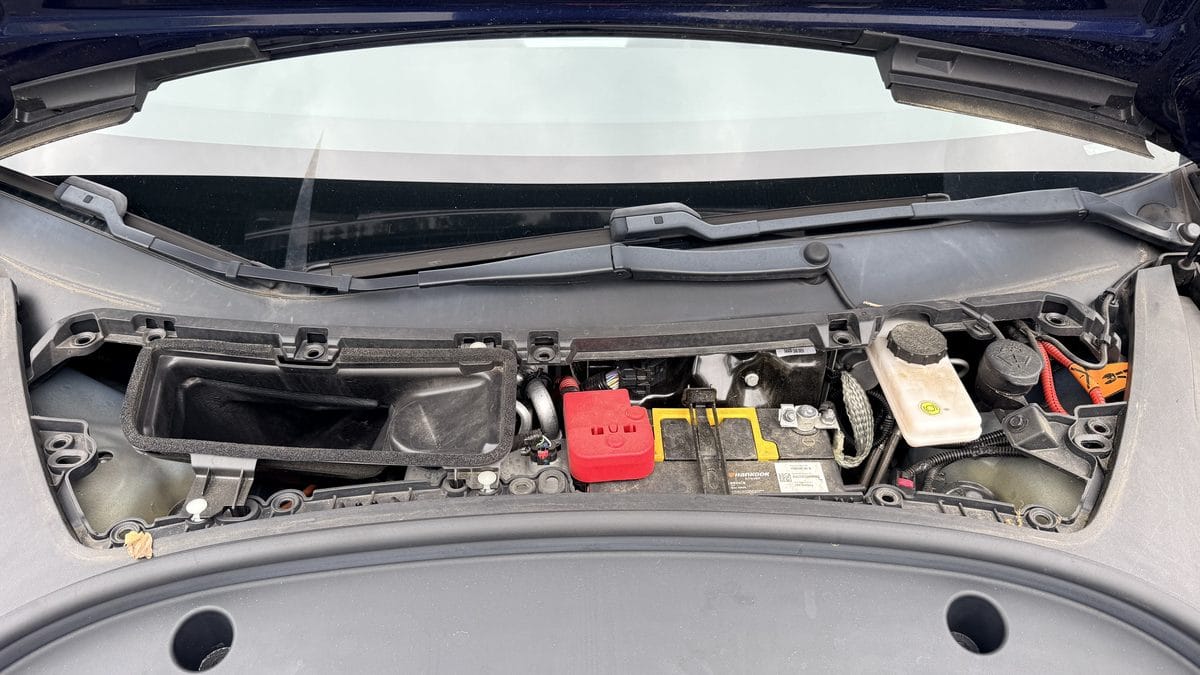
It lives under the cowl panel at the back of the frunk, hidden beneath a plastic cover most owners never remove. Out of sight, out of mind — right up until it isn’t.
Lead-acid or lithium-ion? Check which one your Tesla has
This is the single most useful thing to know, because the two designs age completely differently.
Tesla’s own manual splits the change at the factory line: Model 3 and Model Y vehicles built in Fremont before approximately December 2021 (Shanghai: before ~October 2021) have a lead-acid low-voltage battery. Cars built after those dates have a lithium-ion low-voltage battery. If you’re shopping used, this changeover is one of the year-by-year differences we track in our used Model 3 and used Model Y guides.
You don’t have to guess. In the car, go to Controls > Software > Additional Vehicle Information and it will tell you which type you have.
Why it matters:
Lead-acid (older cars): the same chemistry as a gas car’s starter battery, and it wears out the same way. Community tracking over many years puts typical life around 3–4 years, sometimes less. Treat it as a consumable.
Lithium-ion (newer cars): Tesla moved to this design in late 2021, and coverage of the change reported it as intended to last the life of the vehicle. Early years have been encouraging, but these cars are still young — I’d call it "dramatically better," not "immortal."
Here’s a detail that trips people up: the lithium-ion unit isn’t actually a 12-volt battery. The OEM part is labeled 16V, and reporting on the design describes the car holding it around 15.5 volts in normal use — which is why Tesla’s own documentation stopped saying "12V" and just calls it the "low voltage battery." Everyone still says "the 12V" anyway, including this article. And Tesla hasn’t stopped tinkering: reporting in 2025 described the newest Model 3 and Model Y builds moving to yet another version — a 12.8-volt lithium-iron-phosphate (LFP) design — and the different lithium types aren’t interchangeable parts. One more reason the answer to "which battery do I have?" is that in-car menu, not a forum thread.
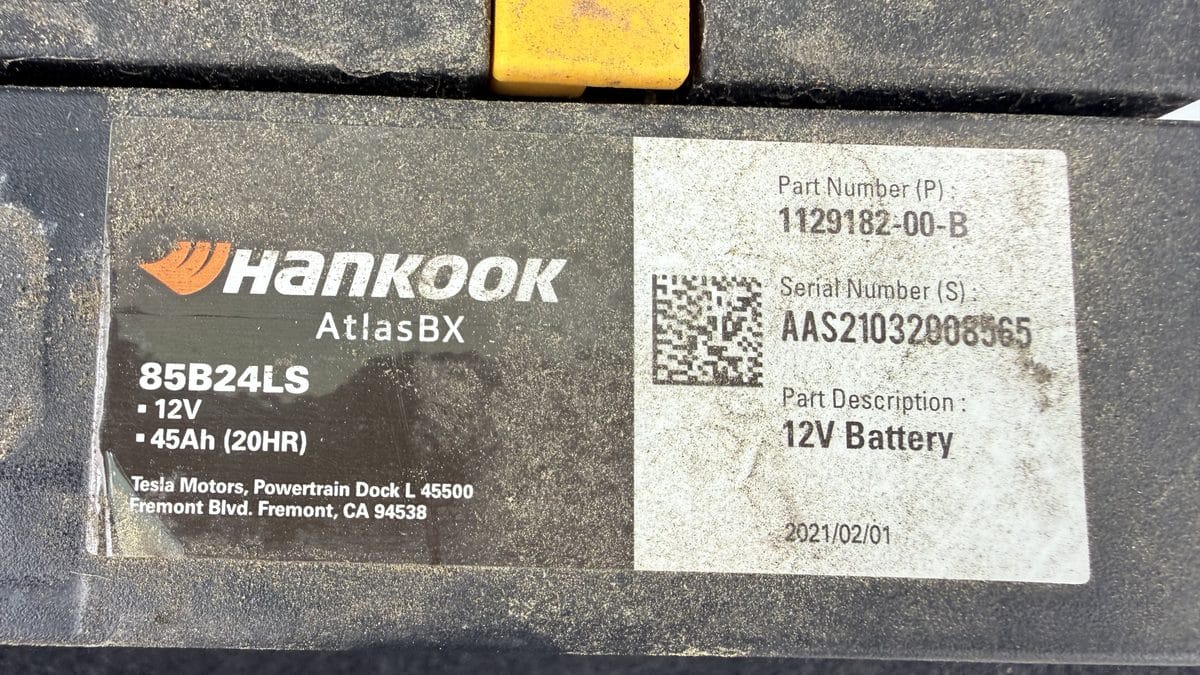
For the record, the OEM lead-acid unit is nothing exotic. The label on ours reads Hankook AtlasBX 85B24LS, 12V, 45Ah — which matches exactly what Tesla’s own manual specifies for North American cars. It’s a small battery, about 25 lb, working a hard job.
The warning signs of a dying Tesla 12V battery
The good news: a Tesla monitors its own 12V system constantly, and in most failures you get real notice.
The on-screen warning. When the car decides the battery is on its way out, it puts a message on the touchscreen telling you the low-voltage battery needs replacement. On lithium-ion cars, Tesla’s service bulletin identifies the degraded-battery alerts as VCFRONT_a182 or VCBATT_a182 — if you see either code, the battery "needs to be replaced," in Tesla’s own words. Longtime owner references describe roughly a few weeks of usable warning after the message appears — but that’s a typical case, not a promise.
The app notification. Tesla has also pushed 12V warnings through the phone app, prompting you to schedule service. If your phone tells you the 12V battery needs attention, believe it.
Subtler hints (worth a service check even without the message): the screen rebooting on its own, accessories behaving oddly after the car sits, or the app repeatedly losing contact with a parked car.
When the warning appears, the play is simple: schedule the replacement that week. When you book in the app, ask whether Mobile Service can come to you — depending on your area, this may not even require a trip to a service center. What you should not do is treat it like a check-engine light you can ignore for a season.
What happens when it dies completely
If the 12V battery goes fully flat, the car won’t unlock from the handle or the app, the screen stays black, and the frunk release button does nothing. (Locked out right now with a healthy 12V and a different culprit? Our lockout guide covers every backup way in.) Tesla’s manual covers this scenario with an "opening the hood with no power" procedure that feeds power from an external 12V supply to release the frunk latch, after which you (or Roadside Assistance) can reach the battery itself.
Two things owners should know from the manual before they’re ever in this spot:
- A portable jump starter is the right tool. Tesla’s own jump-starting instructions assume “an external low voltage power supply (such as a portable jump starter)” — you’re not cranking an engine, just waking electronics, so even a small pack does the job.
- Your Tesla must never jump-start another vehicle. The manual is blunt: it can damage the car. The 12V system isn’t built to source that kind of current.
And one warning that deserves its own paragraph: letting the car run all the way out of range can kill the 12V battery — and Tesla’s warranty explicitly does not cover 12V damage caused by running out of range. If the main pack hits zero, the low-voltage system loses its support, and even at a charger you’ll need to jump the low-voltage system before the car can begin charging. Don’t park the car for weeks at a low state of charge, and don’t ride the range gauge to zero for sport.
What a replacement involves
For most owners: a service appointment, a modest bill, done in under an hour. This is on the cheap end of anything with "Tesla" and "battery" in the same sentence — a low-voltage battery is an ordinary consumable, priced like one, not like a pack replacement. If your car is within the Basic Vehicle Limited Warranty (4 years or 50,000 miles) and the battery fails on its own, talk to Tesla before paying out of pocket — whether a given failure is covered is Tesla’s call, and it costs nothing to ask first.
Handy owners can DIY the lead-acid swap — Tesla publishes the procedure in the owner’s manual, including the requirement to replace like-for-like (same type of battery) and a note that the battery weighs about 25 lb. If you’re not already comfortable working around a car with a high-voltage system, this is a fine job to leave to Mobile Service.
Be ready anyway: the one piece of gear worth carrying
Every warning system can be beaten by a cold snap, a long airport stay, or plain bad luck. The insurance policy is small and cheap: a lithium jump starter. It wakes a dead 12V system, and on a road trip it’ll jump a stranger’s gas car without risking your Tesla doing the job. But where you keep it is the whole game, and it is not the trunk (more on that in our Tesla winter accessories guide). (Building out a road-trip kit? Start with our Model Y accessories hub.)
GOOLOO A5 Jump Starter + Tire Inflator
Why it's here: a compact jump starter with a built-in tire inflator, so one box covers the two most common roadside problems. The listing rates it at 4000A peak for 12V vehicles with a 160 PSI auto-stop inflator, and the whole kit ships with a carrying bag that keeps the cables and nozzles in one place.
Fitment: universal 12V equipment (not a Tesla-specific part) — works for waking a Tesla’s low-voltage system and for jump-starting ordinary cars.
Check it on Amazon →WOLFBOX MV24A Jump Starter + Air Compressor
Why it's here: the same two-jobs-one-box idea — the listing rates it at 4000A peak with a 160 PSI compressor — so pick whichever is in stock at a sensible price when you order. One honest note from the listing: it charges over USB-C but does not include a charging adapter in the box.
Fitment: universal 12V equipment, not Tesla-specific.
Check it on Amazon →Frequently Asked Questions
Can you jump-start a Tesla?
Yes — but only the low-voltage system, and only to wake it. Tesla’s manual walks through connecting a portable jump starter to the 12V (or lithium-ion low-voltage) battery to power the electronics back up. What you can’t do is use the Tesla to jump-start another vehicle; Tesla warns that can damage the car.
How long does a Tesla 12V battery last?
Depends which one you have. The older lead-acid batteries (Model 3/Y built before roughly late 2021) commonly last around 3–4 years. The lithium-ion low-voltage batteries in newer cars were introduced as a life-of-the-vehicle design and have a far better record so far. Check yours under Controls > Software > Additional Vehicle Information.
Will my Tesla warn me before the 12V battery dies?
Usually, yes. The car monitors the battery and shows a touchscreen message when replacement is needed, and Tesla has pushed warnings through the phone app as well. Usually is not always — a battery can occasionally fail faster than the warning window, which is why a jump starter within reach is cheap insurance.
What stops working when the 12V battery is dead?
Effectively everything you touch: door unlocking, the touchscreen, windows, lights, the app connection — and the car can’t charge, because the electronics that manage charging are unpowered. The high-voltage pack can be nearly full and the car still won’t respond until the low-voltage system is woken back up.
Can I replace the 12V battery myself?
On lead-acid cars, yes — Tesla publishes the owner-level procedure, and the battery is a standard-looking ~25 lb unit behind the frunk cowl panel. Replace it with the same type, mind the terminal cautions, and recycle the old one properly. If any of that sounds unappealing, book it with Tesla and ask about a Mobile Service visit.
Our Honest Verdict
The 12V battery is an ordinary part, and it is the most common reason a Tesla ends up temporarily dead. Replacing it is cheap by car-repair standards. Letting it fail costs you a morning, a tow, or a missed shift. So find out today which battery type your car has, take the on-screen warning seriously the day it appears, and do not leave the car parked near zero range for long stretches. Then buy a small jump starter and keep it on the garage shelf, not locked in the trunk of the car it is supposed to rescue. If you have a newer car with the lithium-ion battery, you can mostly stop thinking about this. If your car is from before 2022, put a reminder in your phone.