Updated September 5, 2026
⚡ Quick Summary: Charging a Tesla at a campground comes down to which outlet is on the power pedestal. A 50-amp (NEMA 14-50) outlet gives you true 240-volt Level 2 charging — plug your Tesla Mobile Connector (with the 14-50 adapter) straight in. A 30-amp (TT-30) RV outlet is only 120 volts, so you need a Parkworld TT-30–to–14-50 adapter and you’ll charge slower — fine for an overnight top-up. The one rule that saves you a tripped breaker: dial your charging amps down in the car before you start.
Disclosure: As an Amazon Associate, I earn from qualifying purchases. This comes at no extra cost to you and helps keep this site running.
The situation every camping EV owner runs into
Charging a Tesla at a campground is easier than most people expect — you’ve booked a site, you’re rolling in with the camper, and you realize the same power pedestal that runs your RV can also charge the car. Usually it can. The catch is that campground pedestals hand you two or three very different outlets, and they are not the same thing. Pick the wrong one — or leave your charge current cranked up — and you’ll trip the pedestal breaker, sometimes for your whole loop.
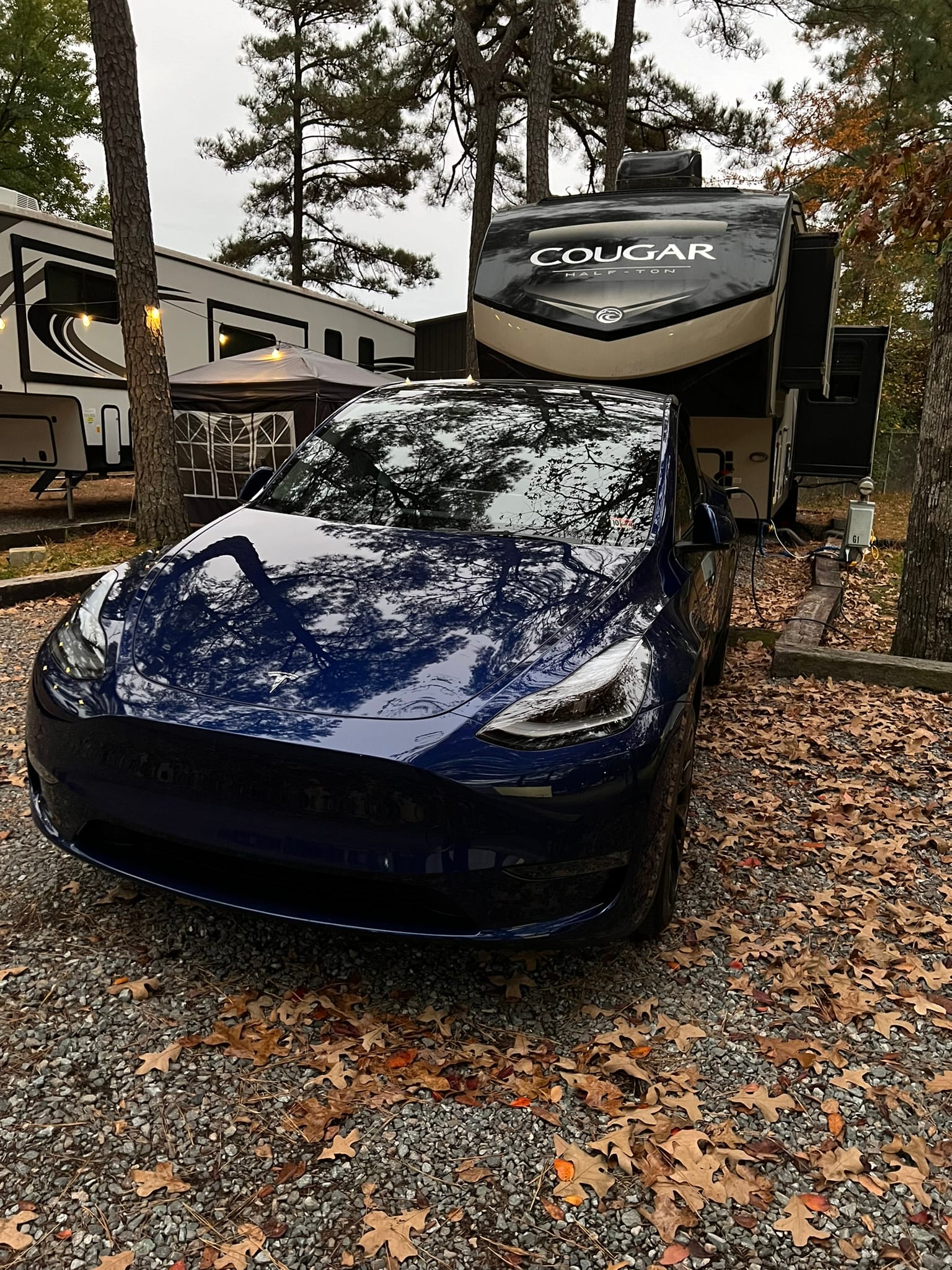
I’ve had a seasonal site for six years, since before we bought our Teslas, and I charge at the campground most weeks. So this isn’t theory. I move between the 50-amp and 30-amp outlets depending on what the camper is doing that day, and below is exactly how I decide, what I plug in, and the mistakes I see other owners make.
Charging a Tesla at a campground: know your pedestal first
Nearly every campground pedestal has some mix of these three outlets. This is the whole ballgame, so it’s worth 60 seconds to understand them. (New to Level 2 in general? Our home EV charging setup guide covers the basics.)
| Outlet | Plug type | Voltage | Real-world charge speed | What you need |
|---|---|---|---|---|
| 50-amp | NEMA 14-50 | 240V | ~25–30 mph of range (best) | Tesla Mobile Connector + 14-50 adapter |
| 30-amp | TT-30 | 120V | ~10–12 mph (overnight top-up) | TT-30 → 14-50 adapter, then dial amps down |
| 20-amp | 5-20 / 5-15 | 120V | ~3–5 mph (trickle) | Standard 5-15 adapter (Level 1) |
The single biggest misconception: people assume a TT-30 “30-amp” outlet with a 14-50 adapter gives them 240 volts. It does not. RV 30-amp service is 120 volts by design. An adapter changes the plug shape so your charger fits — it can’t change the voltage coming out of the pedestal. You’ll still charge; you’ll just charge at Level 1-ish speed.
The 50-amp outlet: your best charge (true Level 2)
If the pedestal has a 50-amp NEMA 14-50 outlet and your camper isn’t already using it, this is where you want to be. It’s real 240-volt Level 2 — the same outlet a lot of people install in their own garage. (It’s also why the best Level 2 home chargers use this exact plug.)
For a Tesla, you don’t need to buy anything extra: the Tesla Mobile Connector with the NEMA 14-50 adapter plugs right in and pulls up to 32 amps, adding roughly 25–30 miles of range per hour — enough to fully recover a day of driving overnight. Grab both straight from Tesla (Mobile Connector and NEMA 14-50 adapter).
And if you’re plugged in for the night and eyeing the back of the car as a bedroom — it’s better than you’d think — our Tesla camping setup guide covers the mattress, window covers, and power gear that make sleeping in the car the comfortable option.
Driving a non-Tesla, or want a backup that fits any pedestal? A portable Level 2 EVSE with a 14-50 plug and adjustable amperage is the most flexible tool in the bag.
bokman Level 1 & 2 Portable EV Charger (32A)
Plugs into a 50-amp 14-50 pedestal for full Level 2 speed, and its adjustable 6–32A current is the real reason it belongs at a campground — throttle it down and you never overload the pedestal. Ships with a 5-15 adapter for standard 120V outlets; the J1772 connector fits every non-Tesla EV (and Teslas via the J1772 adapter most owners already carry). 25-foot cable.
Check price on AmazonIf you want to compare a few portable units first, we round them up in our best portable EV chargers guide.
The 30-amp outlet: the TT-30 adapter you actually need
Here’s the scenario I live constantly: on a hot day the camper needs the 50-amp outlet for both air conditioners, so the Tesla goes on the 30-amp TT-30 instead. That’s exactly what the 30-amp outlet is for when the big one is spoken for. A TT-30 outlet uses a different plug than your charger, so you need an adapter that goes from the TT-30 plug to a 14-50 receptacle your EVSE can plug into.
Parkworld 885378 TT-30P to 14-50R EV Adapter
Adapts a campground’s TT-30 (30-amp RV) outlet to a NEMA 14-50 receptacle so your Tesla Mobile Connector or portable EVSE plugs right in. Note the listing’s own warning: it’s for EV charging only, not for running an RV. Because the outlet is 120 volts, you’ll add roughly 10–12 miles of range per hour — slow, but across an evening and overnight it’s a comfortable top-up.
Check price on AmazonCritical step: set your Tesla’s charging amps to 24A or lower before you start, or you’ll trip the pedestal (see below).
The one rule that prevents a tripped breaker
Whatever outlet you use, turn your charging current down in the car before you plug in. On a Tesla it’s on the charging screen; on other EVs it’s in the charge settings or on the EVSE itself. Electrical code says a circuit should run at no more than 80% of its rating continuously, and a charging car is about as continuous as a load gets.
- 50A / 14-50 pedestal: up to 32A is fine for the Mobile Connector.
- 30A / TT-30 pedestal: set 24A or less (I usually run 20–24A).
- 20A outlet: set 16A. 15A outlet: set 12A.
If the breaker trips anyway, drop another few amps. It costs you a little speed and saves you a walk to the pedestal in the dark — and keeps you from knocking out a neighbor’s power.
A few campground realities
- Ask first. Some parks are fine with EV charging; a few prohibit it or meter it. A quick question at check-in avoids an awkward conversation later.
- Don’t share one outlet between the camper and the car. Give each its own outlet on the pedestal. Stacking adapters to run both off one is how you cook a plug.
- Weather matters. Keep the connection up off wet ground and out of puddles. Pedestals are outdoors, but your connections should stay dry.
- Longer cable beats an extension cord. A 25-foot EVSE reaches most spots. If you need more reach, use a proper EV-rated cable — see our EV charging cables and adapters guide. Avoid cheap household extension cords — they overheat.
- Keep a kit in the car. A basic EV emergency kit — gloves, a headlamp, a tire plug — earns its keep on camping trips.
⚠️ From my own campsite: direct sun can throttle your Mobile Connector. Charging my 2023 Model Y from a TT-30 outlet on a sunny day, the rate throttled down to 12 amps — the connector brick was protecting itself from heat. Shading it didn’t bring the speed back either; I had to shade it, then unplug and reconnect before it would charge at full rate again. If your charging suddenly slows on a hot afternoon, check whether the brick is baking in the sun before you blame the pedestal or your adapter.
Frequently Asked Questions
Can you really charge a Tesla at a campground?
Yes. Most campground power pedestals have a 50-amp (NEMA 14-50) and/or 30-amp (TT-30) outlet, and both can charge a Tesla with the right adapter. The 50-amp outlet gives true Level 2 speed; the 30-amp is slower but works fine overnight.
Does a TT-30 to 14-50 adapter give me 240 volts?
No. A 30-amp TT-30 RV outlet is 120 volts. The adapter only changes the plug shape so your charger fits — it can’t raise the voltage. You’ll charge at roughly Level 1 speed, about 10–12 miles of range per hour.
Why does my charging trip the campground breaker?
Almost always because the charging current is set too high for the outlet. Dial it down in the car — 24 amps or less on a 30-amp pedestal, 16 amps on a 20-amp outlet. Charging is a continuous load, so you can’t safely pull the outlet’s full rating.
Should I use the 50-amp or the 30-amp outlet?
Use the 50-amp if it’s free — it’s much faster. If your RV needs the 50-amp (for example, running both air conditioners), put the car on the 30-amp with a TT-30 adapter. That’s the exact swap I make on hot days.
Do I need anything special for a non-Tesla EV?
Just a portable Level 2 EVSE with a NEMA 14-50 plug (like the bokman above) and, if the site only has a 30-amp outlet, the same TT-30 adapter. The J1772 connector on most portable chargers fits every non-Tesla EV directly.
Our Honest Verdict
If you camp with an EV, buy two things and you’re covered anywhere: a portable Level 2 EVSE with adjustable amps for the 50-amp pedestal, and a TT-30 adapter for the days you’re stuck on 30-amp. Tesla owners already have the Level 2 half handled with the Mobile Connector, so for most of us the real purchase is the ~$40 Parkworld TT-30 adapter — it’s the difference between charging and not charging on a busy weekend when the 50-amp outlet is running your air conditioning. Set your amps sensibly and campground charging becomes a non-event.