Updated September 17, 2026
Disclosure: As an Amazon Associate, I earn from qualifying purchases. This comes at no extra cost to you and helps keep this site running.
I want to cover what to carry in a Tesla for a flat tire, because every Tesla ships without a spare. That is a packaging and weight decision every EV maker has made, and the trunk space is put to better use, so it is not something to be upset about. It does mean that the failure that strands the most drivers, a nail in the tread, has exactly one factory answer, which is to call Roadside Assistance and wait.
There is a second answer, and it fits in a shoebox. A set of Tesla jack pads lets any floor jack lift the car without touching the battery pack. A tubeless plug kit fixes the puncture where it happened, and a torque wrench puts the wheel back on at the number Tesla specifies. All of it takes up less room than a gym bag, and it rides in the frunk or under the trunk floor.
We have 100,000+ combined miles on our three Teslas, and we have already been through this once. Our 2023 Model Y threw a low-pressure warning, and the cause was a nail near the sidewall. That is the kind of puncture no plug and no sealant can fix, and Tesla's own repair-kit guidance below says the same. It ended in a full set of four new tires, since all four were significantly worn anyway. A plug kit will not keep you from ever buying a tire. The point is to know where the line between repairable and replace sits before you are standing on the shoulder looking at the tread.
Why Tesla Jack Pads Aren't Optional
This is the part that costs people real money, so it's worth being precise. The Model Y owner's manual is unambiguous about where a lift can and cannot touch the car:
“DO NOT lift from under the Battery or side rails. Place the lift arm pads under the designated body lift points only. The locations shown are the only approved lifting points for Model Y. Lifting at any other points can cause damage. Damage caused by incorrectly lifting Model Y is not covered by the warranty.”
— Tesla Model Y Owner's Manual, Jacking and Lifting
Read that last sentence again: not covered by the warranty. A jack saddle in the wrong spot can crush a rocker panel or damage the pack enclosure, and that's on you.
The lift points themselves are the four circular openings under the side skirts, just behind the front wheels and just ahead of the rear ones. They're recessed — a bare jack saddle doesn't seat in them, it sits on the plastic skirt beside them. A jack pad is a puck with a locating pin that drops into the opening and gives the jack a flat, load-bearing surface at the right spot. That's the entire job, and it's why four of them cost less than a body-shop estimate. Here's one of ours seated in a lift point:
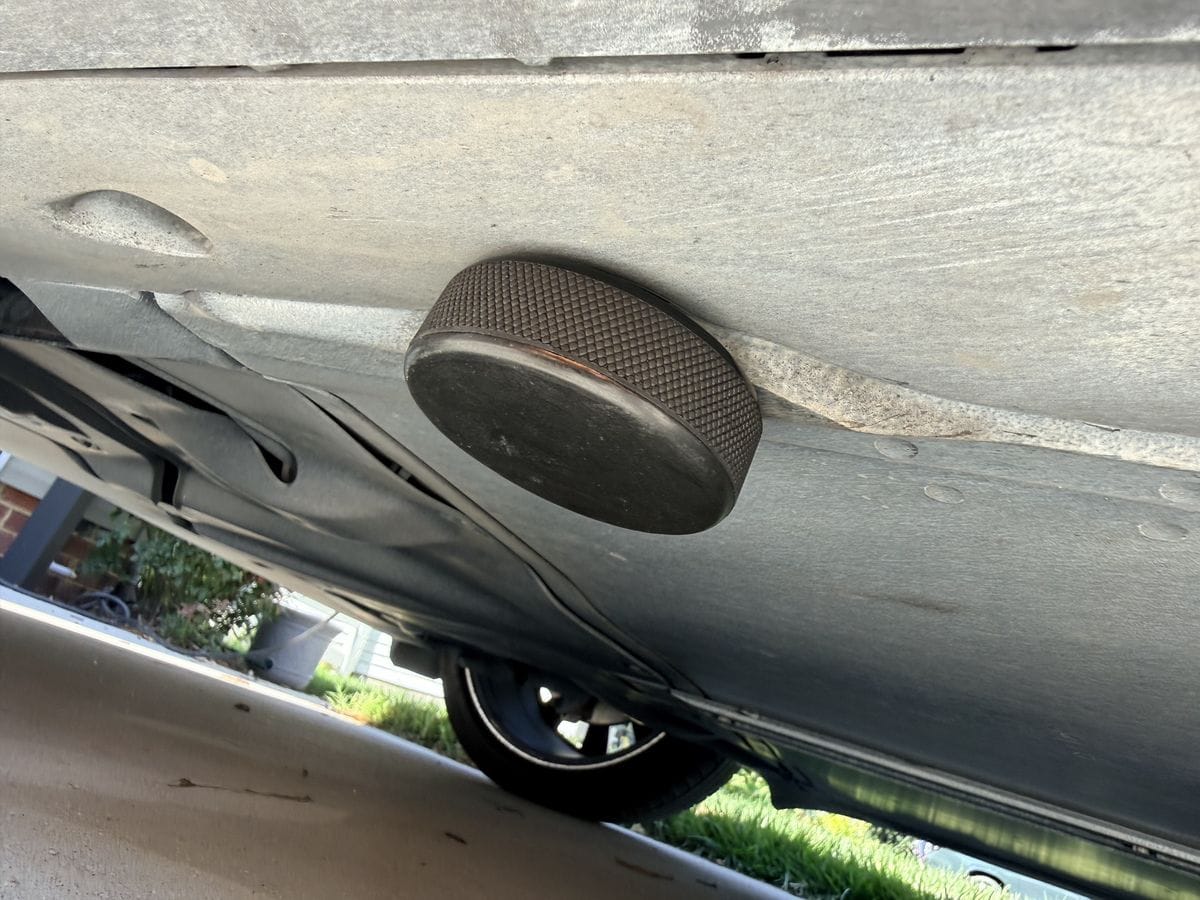
One of our own jack pads seated in the factory lift point — the pin drops into the recessed opening and the puck gives the jack a flat surface exactly where Tesla wants the load.
Two practical notes:
- Buy four, not one. One works for a single-corner tire change with a floor jack. Four is what a shop lift needs, and shops don't always have them. One owner on Tesla Motors Club described exactly this after picking up a nail while traveling: “First tire shop (NTB) couldn't lift a Tesla – no jack pads.” (TMC thread) Handing the tech your own set solves that in ten seconds.
- Keep them in the car, not the garage. They're only useful where the flat happens.
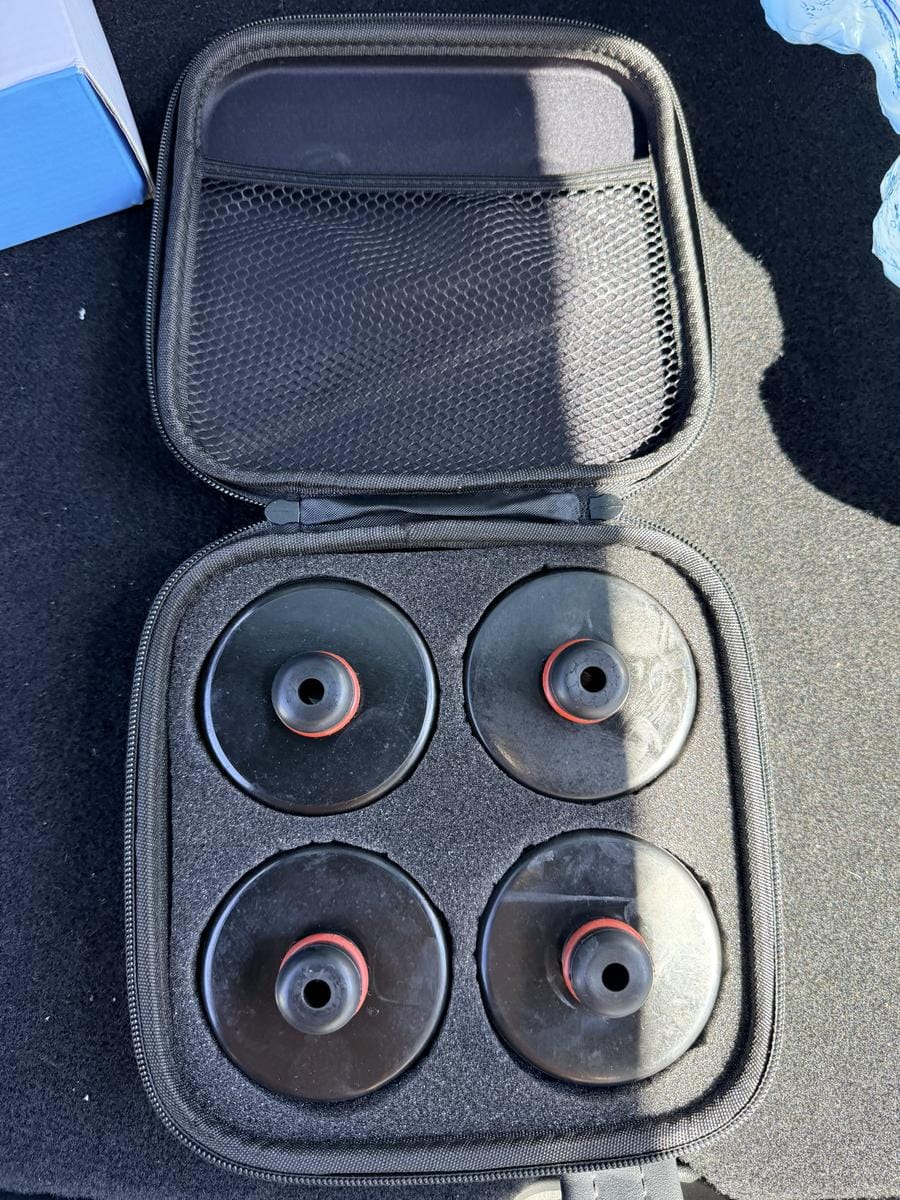
Our set of four in its case — the whole thing is smaller than a lunchbox.
The Tire Repair Half — And the Foam Problem
Tesla sells a temporary repair kit (a compressor plus a sealant canister) and the manual is honest about its limits. Per the Model Y owner's manual's Temporary Tire Repair Kit section, it's for tread punctures only:
“For punctures larger than 1/4″ (6 mm), severe tread damage, a damaged sidewall, ripped tires or tires that have come off the rim, contact Roadside Assistance.”
— Tesla Model Y Owner's Manual, Temporary Tire Repair Kit
The same section warns not to remove foreign objects embedded in the tire, not to run the compressor more than 20 consecutive minutes, and notes the sealant works between −40°F and 122°F and expires — there's a date on the canister.
Here's what the manual doesn't tell you. Many Tesla-fitment tires are acoustic tires — they carry a foam layer bonded to the inner liner to cut road noise, marked with an “Acoustic” logo on the sidewall. Owners have reported for years that sealant struggles with these, because the foam sits between the sealant and the puncture. In the long-running Tesla Motors Club thread on exactly this question, one owner's summary was blunt: “others have mentioned the slime will not work with this type of tire. A plug kit should still work.”
That thread also contains the story that should decide your purchase. The same owner who found a shop with no jack pads went to a second shop: “second tire shop (Mr Tire) lifted it but wouldn't work on the tire due to the foam on the inside.” He ended up on a flatbed to a service center. His own conclusion: “Should have just plugged it myself and that will be my plan next time.”
Treat these as owner reports, not manufacturer guidance — they're consistent and numerous, but they're forum accounts. The takeaway is still directionally clear: a string plug kit is the more reliable roadside tool on a foam-lined tire than a can of sealant, and a proper shop repair on an acoustic tire means cutting the foam back, plugging, and replacing it — which is why some shops decline the job.
One data point from our own driveway: when we replaced all four tires on our 2023 Model Y, I went with standard non-acoustic tires — and I haven't noticed any meaningful increase in road noise. That's one car and one driver's ears, not a lab test, but if you're weighing the foam question at replacement time, the downside of skipping the foam was smaller than I expected.
What to Actually Keep in the Trunk
Five things. In priority order.
- Four jack pads. Non-negotiable, cheapest insurance on this list.
- A tubeless plug kit. The thing that actually fixes the flat.
- A source of air. A 12V inflator or a jump-starter with a built-in compressor — covered in depth in our EV emergency kit guide, so we won't re-card it here.
- A torque wrench that reaches 129 lb-ft. See the next section.
- Gloves, a headlamp, and something to kneel on. Unglamorous, and you'll be grateful.
None of this overlaps with the accessories people actually shop for — it's the boring category that sits underneath them. If you're still building out the rest, start with our Model Y accessories guide and come back for this.
Get the Lug Torque Right — 129 lb-ft, 21 mm
If you take a wheel off, the number is not a guess. Straight from the manual's Wheels and Tires specifications table:
| Spec | Value |
|---|---|
| Lug Nut Torque | 129 lb-ft (175 Nm) |
| Lug Nut Socket Size | 21 mm |
Source: Tesla Model Y Owner's Manual, Wheels and Tires — re-verified the day this article published.
A 1/2-inch click wrench with a 10–150 ft-lb range covers 129 with room on either side. Under-torqued lugs loosen; over-torqued lugs stretch studs and warp rotors. Tighten in a star pattern, in stages, and re-check after your first drive. The full rotation schedule and pressure rules are in the Tesla tire care guide.
The Picks
Every listing below was verified live on Amazon the day this article published — in stock, correct product, correct fitment claims. No prices or ratings here by policy: they change hourly, so check the live page.
Yieokei Tesla Jack Pads — 4-Pack with Storage Case & Tire Repair Tools
Why it's here: four rubber lifting pucks that seat in the factory lift points, plus a hard storage case and a small tire repair tool kit in the same box — the closest thing to a complete trunk kit in a single purchase. The listing states protection for battery, chassis, and paint.
Fitment (per the listing): 2016–2026 Tesla Model 3 / Y / S / X, including Model Y Juniper. (Juniper owner double-checking what carries over? See our Juniper fitment guide.)
Check price on AmazonBoulder Tools Tire Plug Kit — Professional Tire Repair Kit
Why it's here: the full-size version — self-vulcanizing plugs, T-handle insertion tool, spiral probe (reamer), pliers, utility knife, valve core tool and spare cores, valve caps and extenders, lubricant, and a tire pressure gauge, all in a hard case. This is the one to keep in the frunk if you only buy one repair kit.
Fitment: universal — tubeless tires on cars, trucks, and SUVs.
Check price on AmazonBoulder Tools Compact Tire Plug Kit — MOLLE Storage Pouch
Why it's here: same idea, smaller footprint — a heavy-duty plug kit in a soft MOLLE pouch instead of a hard case. The budget play, and the one that actually stays in the car because it fits anywhere.
Fitment: universal — tubeless tires.
Check price on AmazonARB Speedy Seal 2 — Universal Heavy Duty Tire Repair Kit
Why it's here: the premium pick, and the one built to be used more than once — self-vulcanizing repair cords, quality pliers, blade, and a high-visibility case. Overkill for a commuter; correct if you tow, road-trip remote routes, or want the kit a shop-grade repair actually uses.
Fitment: universal — tubeless radial and cross-ply tires.
Check price on AmazonLEXIVON 1/2-Inch Drive Click Torque Wrench (10–150 ft-lb) + Flip Impact Socket Set
Why it's here: the wrench-and-socket answer in one order — the 10–150 ft-lb range brackets Tesla's 129 lb-ft spec, and the flip-socket set includes the 21 mm size Tesla calls for (alongside 17 mm, 19 mm, and imperial sizes), plus a 3-inch extension bar. It's an Amazon bundle listing, so the two items may ship separately.
Fitment: universal — 1/2-inch drive. Already own sockets? The wrench alone is the LEXIVON LX-183 (same 10–150 ft-lb range).
Check price on AmazonTesla also sells its own compressor-and-sealant kit through the Tesla Shop (not an affiliate link). It's the convenient option and it's what the manual documents — just know its limits, and know what owners report about sealant and foam-lined tires.
Comparison Table
| Item | What it solves | Tier | Keep it where |
|---|---|---|---|
| Jack pads (4-pack) | Lifting without damaging the pack, skirt, or paint | Essential | In the car — frunk or under-floor bin |
| Complete plug kit (hard case) | Tread punctures, roadside, on foam-lined tires | Essential | Frunk or under trunk floor |
| Compact plug kit (pouch) | Same, minimum footprint | Budget / second car | Glovebox or door pocket |
| ARB Speedy Seal 2 | Repeat repairs, remote travel, towing | Premium | Trunk, road-trip loadout |
| Torque wrench + 21 mm socket | Putting the wheel back on at 129 lb-ft | Essential if you remove a wheel | Garage, or trunk for long trips |
| Inflator / jump starter w/ compressor | Air — a plug is useless without it | Essential | See our EV emergency kit guide |
Frequently Asked Questions
Do I really need jack pads, or can I just use the pinch weld?
Your Tesla doesn't have a conventional pinch weld to jack from. The manual specifies designated body lift points and warns against lifting under the battery or side rails, with damage from incorrect lifting excluded from warranty coverage. The pads exist because the lift points are recessed openings that a bare jack saddle can't seat in properly. At the price of a set of four, this is the cheapest way to make an expensive mistake impossible.
Will a tire plug work on a Tesla's foam-lined acoustic tires?
Owner reports consistently say a plug is the better bet than sealant on foam-lined tires, because sealant has to get past the foam layer to reach the puncture. A proper shop repair on an acoustic tire usually means cutting the foam back, repairing, and replacing it — which is why some shops decline the job entirely. Treat a roadside plug as what it is: a temporary repair that gets you to a shop, not a permanent one.
What's the actual lug nut torque on a Tesla?
The current Model Y manual specifies 129 lb-ft (175 Nm) with a 21 mm socket. Check your own model's manual — specs are published per model — and re-check the torque after your first drive. A 10–150 ft-lb click wrench covers the range with margin.
How big a puncture can I fix myself?
Tesla's guidance for its own temporary kit draws the line at 1/4 inch (6 mm) in the tread. Anything larger, any sidewall damage, severe tread damage, a ripped tire, or a tire off the rim is a Roadside Assistance call — not a DIY repair. The manual also says not to pull foreign objects out of the tire before you're ready to repair it. Our own nail-near-the-sidewall flat was on the wrong side of that line — which is exactly why it's worth knowing before you kneel down with a plug kit.
Where should I keep all of this?
The frunk, or the under-floor bin in the trunk — ours rides under the trunk floor, where the case sits flat and never shifts. Either spot beats cargo space you'd have to unload on a shoulder, and the whole kit — pads, plug kit, gloves — fits with room left. The real rule: in the car, not the garage. Jack pads that live in your garage have never helped anyone.
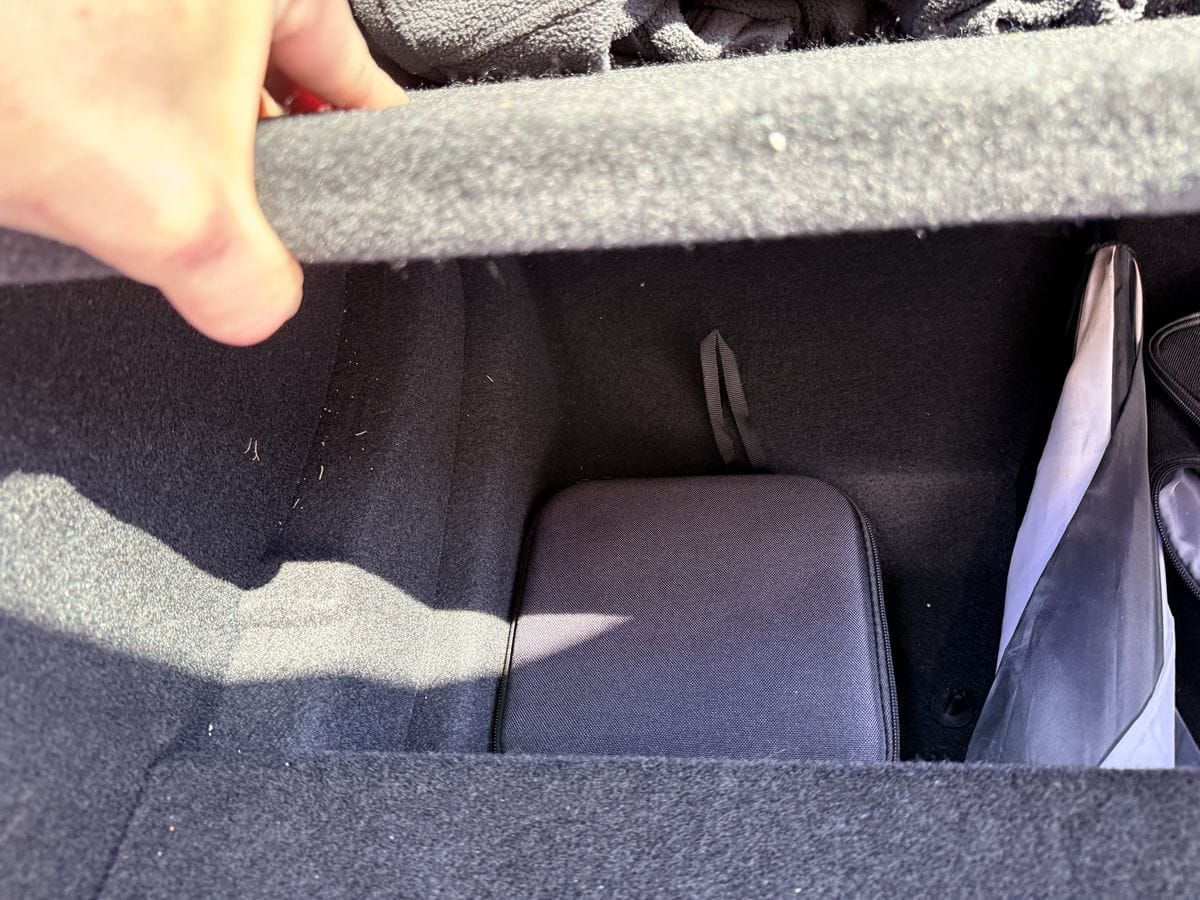
Where ours actually lives — the under-floor bin in the trunk, flat and out of the way.
Our Honest Verdict
Buy the jack pads today whether or not you ever plan to change a tire yourself. They are the cheapest item here and they protect the most expensive part of the car. If a tire shop tells you it cannot lift a Tesla, you hand them the set from your frunk and the job goes ahead.
Buy a plug kit if you'd rather fix a flat than wait for one to be fixed. The full hard-case kit is the one to get if it is your only kit. The compact pouch makes sense as a second kit for another car, and the ARB is for people who travel where a tow takes hours instead of minutes.
Buy the torque wrench only if you'll actually take a wheel off. If your plan is to plug the tire in place and drive to a shop, which is a perfectly reasonable plan, you do not need one. A properly seated plug on an inflated tire does not require removing the wheel at all. Skip the sealant-first approach on foam-lined tires and carry the plug kit and the air instead. It costs the same, and it works in the cases where the canister might not.