Updated September 5, 2026
Disclosure: As an Amazon Associate, I earn from qualifying purchases. This comes at no extra cost to you and helps keep this site running.
EVs need very little maintenance, but when something does go wrong on the road, two things catch new owners off guard, and they are why the best EV emergency kit looks different from a gas car’s. First, most electric cars, Teslas included, do not come with a spare tire. Where a gas car has a donut, an EV has a frunk with nothing in it. Second, every EV has a small 12-volt battery, just like a regular gas car, and that battery is what wakes up the car’s computers. If the 12V dies, the car will not unlock or power on. It does not matter how much charge is left in the big drive battery.
Both problems can happen to any EV. A compact emergency kit that stays in the frunk covers both, and it is worth putting together before you need it. Below is what belongs in the kit, why each piece matters for an EV in particular, and the best products to buy in 2026.
1. Tire Inflator + Plug Kit — Your “Spare Tire” Replacement
This is the single most important item, because a flat is the most common roadside failure and your EV almost certainly can’t carry a spare. A modern portable inflator reseats a low tire in minutes, and paired with a cheap plug kit it can permanently repair most tread punctures on the spot. Look for a fast airflow rate (35–45 L/min) so you’re not standing on the shoulder forever — the GOOLOO A3-class inflators do Tesla Model 3/Y tires quickly at ~35 L/min.
GOOLOO A5 4-in-1 Jump Starter + Tire Inflator (2026)
The do-everything unit: jump starter, built-in tire inflator, 20,000mAh power bank for your phone, and an LED work light. A color display tracks inflation in real time and stays readable in direct sun. One device covers two of the four EV essentials.
Check Price on Amazon →2. A Portable 12V Jump Starter — For the Low-Voltage Battery
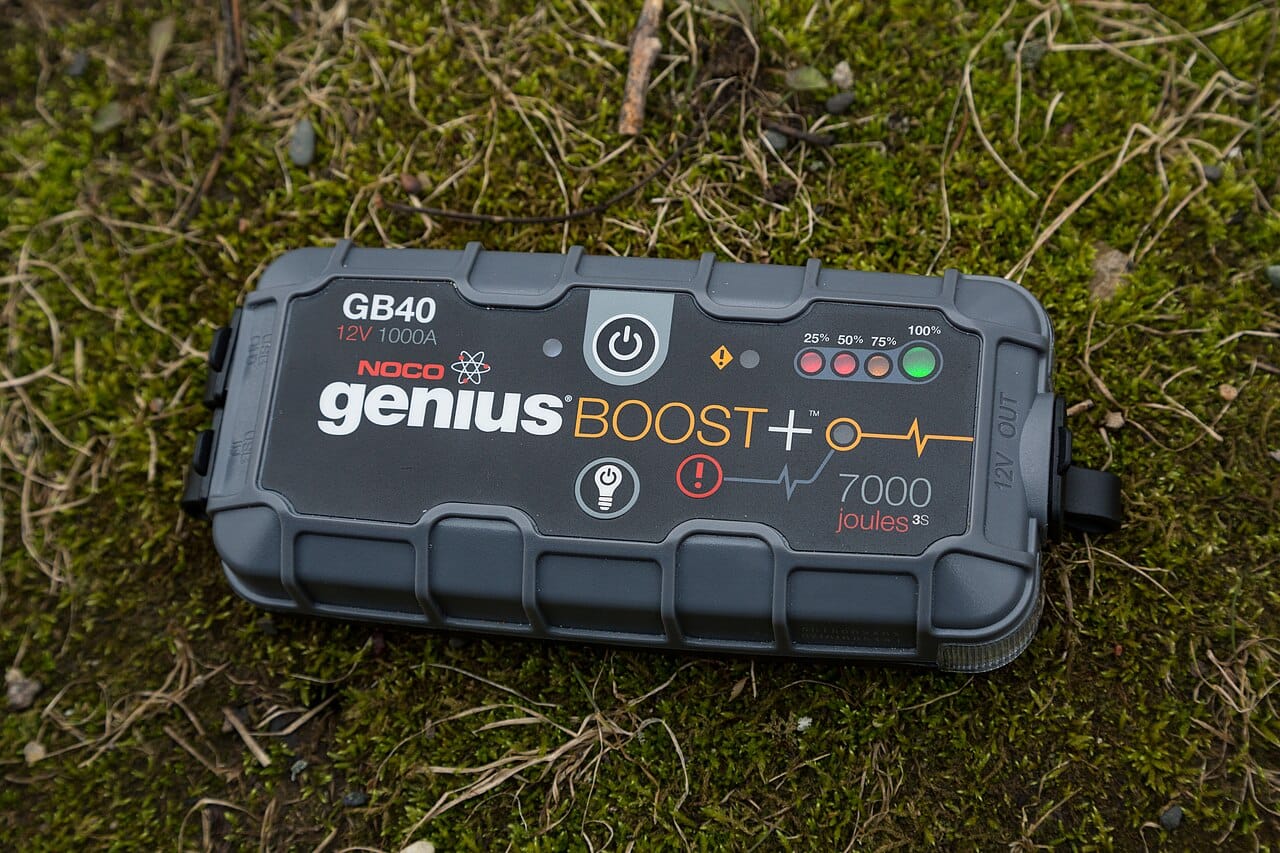
Every EV has a small low-voltage battery — separate from the big drive pack — that powers the door handles, screens, and computers. When it dies (often with little warning after a few years), the car can become a brick: it may not even unlock or power on, no matter how much charge is in the main battery. A compact portable jump starter is the tool that gets you back in.
One important 2026 update: most EVs (and older Teslas) use a 12-volt lead-acid aux battery, but newer Teslas — the Model 3 “Highland,” the latest Model Y, and the refreshed Model S/X — switched to a 16-volt lithium-ion low-voltage battery, and the Cybertruck uses a 48-volt low-voltage architecture — either way, it sits under the frunk and is not easy to reach. The good news: you don’t access that 16V battery on the roadside, and a standard ~12V jump starter is still the right tool, because these systems are designed to accept a 12V input to wake the car.
WOLFBOX 4000A Jump Starter + Air Compressor
4000A peak output, a 24,000mAh battery with 65W USB-C fast charging, and a built-in 160 PSI compressor (45 L/min) that airs up a truck tire in under three minutes. Overkill for a small EV’s 12V — which means total peace of mind.
Check Price on Amazon →3. A Portable EV Charger — For Low-Charge Emergencies
Running low on miles far from a fast charger is the EV equivalent of running out of gas. A portable Level 1/2 charger lets you top up from any standard 120V outlet (or a 240V dryer-style outlet) — a campground, a friend’s garage, a roadside business that lets you plug in. It won’t be fast, but it can add the handful of miles you need to reach a real charger. Keep one in the frunk alongside your safety gear; see our full ranked list in the best portable EV chargers guide.
Portable Level 1/2 EV Charger (120V/240V)
A compact emergency charger that plugs into a normal wall outlet for slow-but-steady top-ups, with an adapter for 240V outlets when you can find one. The “range insurance” every EV owner should carry.
Check Price on Amazon →4. Roadside Safety Gear — The Basics That Save Lives
Round out your EV emergency kit with the non-electronic essentials: a set of reflective warning triangles or LED flares to make you visible on the shoulder, a compact first-aid kit, work gloves, a high-lumen flashlight or headlamp, a seatbelt cutter / window breaker tool, and in cold climates a thermal blanket and hand warmers. A pre-assembled roadside kit covers most of this in one box and costs less than buying à la carte.
All-in-One Roadside Emergency Kit (90+ Pieces)
Reflective triangle, first-aid supplies, gloves, jumper basics, tow strap, and a window-breaker tool in a compact zip bag that tucks into the frunk. The easiest way to check the “safety basics” box in one purchase.
Check Price on Amazon →Frequently Asked Questions
Do EVs come with a spare tire?
Most don’t. That’s why a tire inflator plus a plug kit is the most important item — it’s your functional “spare,” handling the common slow leak or nail puncture roadside.
Why does an EV need a 12-volt jump starter if it has a big battery?
The large traction battery doesn’t power the car’s electronics directly — a separate 12V battery does, and if it dies you can be locked out or unable to power up. A compact jump starter revives it.
Can I charge my EV from a portable charger in an emergency?
A portable Level 2 charger lets you add miles from a standard or 240V outlet when you’re low and far from a station — slow, but often enough to reach a proper charger.
What basic roadside safety gear should every EV carry?
A reflective triangle or flares, a flashlight, a first-aid kit, gloves, and a tow strap — the essentials that apply to any car, EV or not.
The Complete EV Emergency Kit at a Glance
| Item | Why an EV Needs It | Budget |
|---|---|---|
| Tire inflator + plug kit | Most EVs have no spare tire | Mid-range |
| 12V jump starter | The 12V battery strands a dead EV | Mid-range |
| Portable EV charger | Backup miles when far from a charger | The big-ticket item |
| Roadside safety kit | Visibility, first aid, escape tool | Budget-friendly |
| Total for a complete EV kit | Four purchases, one trunk corner | |
Tip: a combined jump-starter-with-inflator (like the GOOLOO A5) collapses the first two rows into one purchase, trimming the total.
Our Honest Verdict
An EV emergency kit takes the place of the spare tire and roadside flares your car did not come with. If you build just one part of your EV emergency kit, make it a combo jump-starter-plus-inflator (the GOOLOO A5 is our top pick). It covers the two most likely failures, a flat tire and a dead 12V battery. Add a portable charger and a basic safety kit, keep it all in the frunk, and you are covered for the problems most likely to stop you on the road.