Updated September 10, 2026
Disclosure: As an Amazon Associate, I earn from qualifying purchases. This comes at no extra cost to you and helps keep this site running.
I want to lay out what it cost to charge a Tesla over the last 12 months, using my own numbers rather than a national average. A calculator estimate multiplies an average electric rate by an assumed efficiency. That gets you in the ballpark, but it is not what lands on your bill. I pulled 12 months of charging data and every Supercharger session across our three Teslas, a 2021 Model 3, a 2023 Model Y, and a 2024 Model Y. Below is what I paid, how the charging split out, what it works out to per mile, and how that compares with gas.
Two of the three cars charge overnight at home and did not touch a Supercharger all year. I work out of town during the week, so the third car, the 2023 Model Y, makes the drive out on Monday and back on Friday, about a 200-mile round trip each week. It charges near work on a campground Level 2 pedestal, billed at the same 16 cents I pay at home. Between the three cars we added just under 39,000 miles in 12 months. Every figure below comes straight from each car's Charge Stats screen in the Tesla app and from my real utility rate, and the screenshots are included.
Where These Charging Costs Come From: The Tesla App Tracks Everything
There are two buckets to any honest Tesla charging cost: the electricity you buy on a Level 2 plug at a known rate (home, and in my case a campground near work), and the electricity you buy on the road at Superchargers. They're priced completely differently — and the Tesla app already tracks them separately for you, automatically.
There's no manual tracking here — the app's Charge Stats screen builds all of this on its own: 12 months of kWh by source, spend, Supercharger sessions, and miles added, per car. The only math I added is multiplying the Level 2 kWh by the rate I actually pay. I'm on Dominion's standard flat residential plan — no time-of-use tiers — and my all-in effective number works out to $0.16 per kWh. The campground pedestal I use during the work week bills me the same 16 cents, which keeps the math simple. For Supercharging, every session is itemized in the app with the exact kWh and dollars charged — real receipts, no estimating. No TeslaFi, no dedicated EV meter, no spreadsheet gymnastics — if you own a Tesla, this data is already sitting in your app under Charge Stats: just the app's own numbers and my real rate.
My Real Cost to Charge a Tesla: The 12-Month Numbers
Here's the real breakdown — combined across all three cars, first by where the electricity came from, then car by car. The numbers are read straight off each car's Charge Stats screen.
| Where I charged | kWh | Rate I actually paid | Cost |
|---|---|---|---|
| Home (overnight Level 2) | 9,992 | $0.16/kWh flat | $1,599 |
| Campground Level 2 near work | 3,365 | $0.16/kWh | $538 |
| Superchargers (10 sessions, one car) | 239 | ~$0.30–0.45/kWh | ~$100 |
| 12-month total | 13,596 | ~16.5¢/kWh effective | ~$2,237 |
And per car:
| Car | kWh added | Miles added | My cost | Cost per mile | Tesla's in-app “Total Spent” |
|---|---|---|---|---|---|
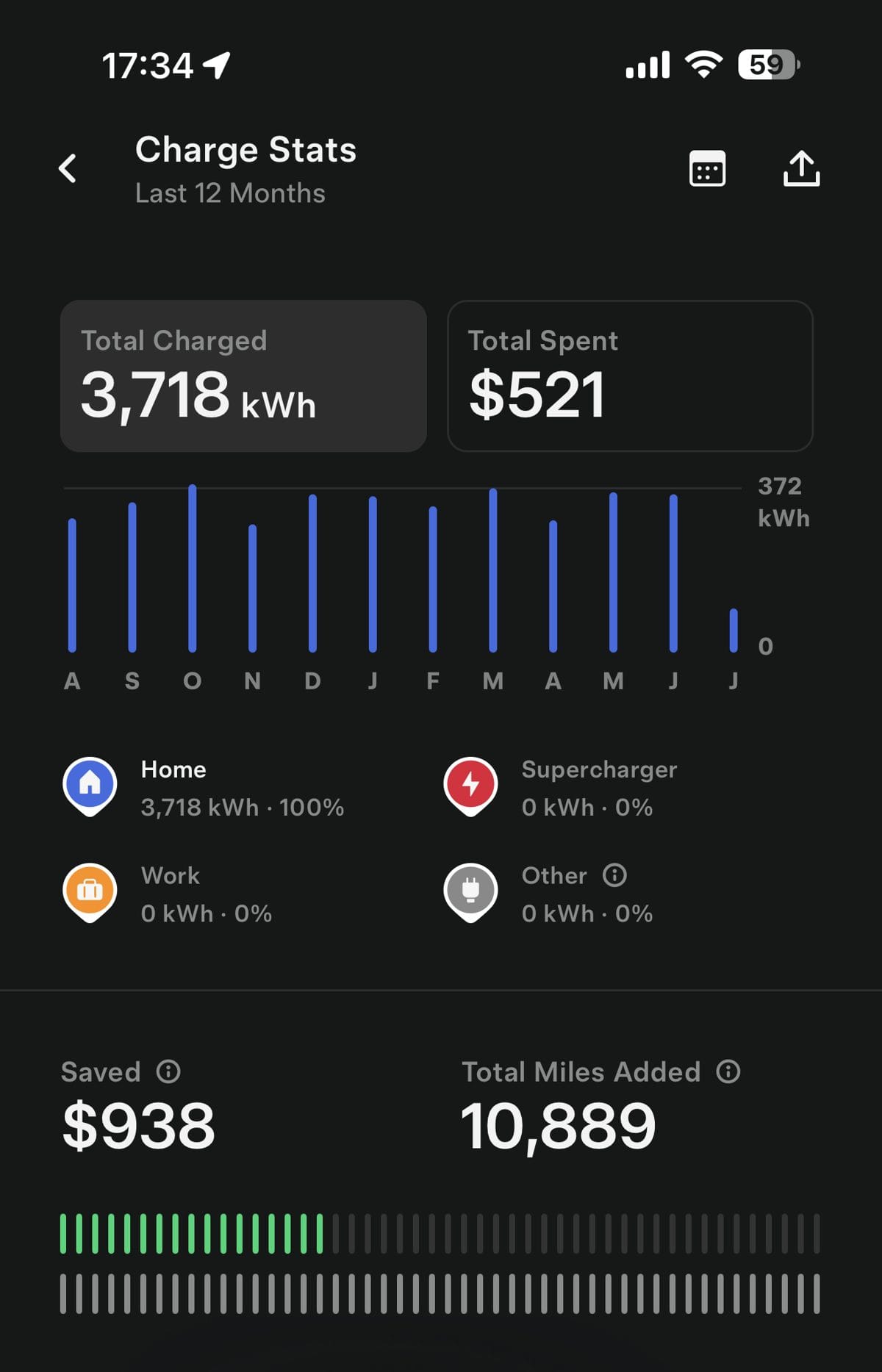
| 2021 Model 3 | 3,718 | 10,889 | $595 | 5.5¢ | $521 |
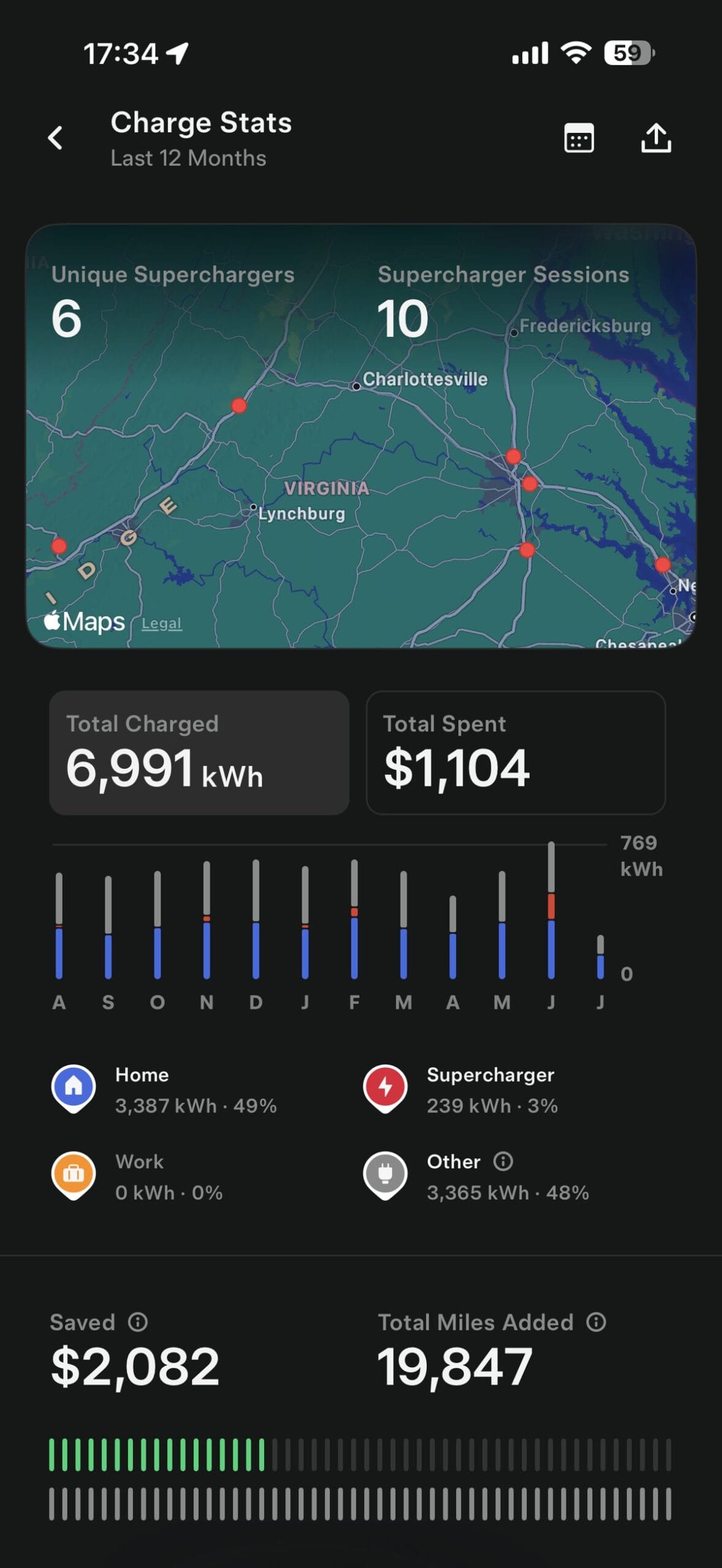
| 2023 Model Y | 6,991 | 19,847 | ~$1,180 | ~5.9¢ | $1,104 |
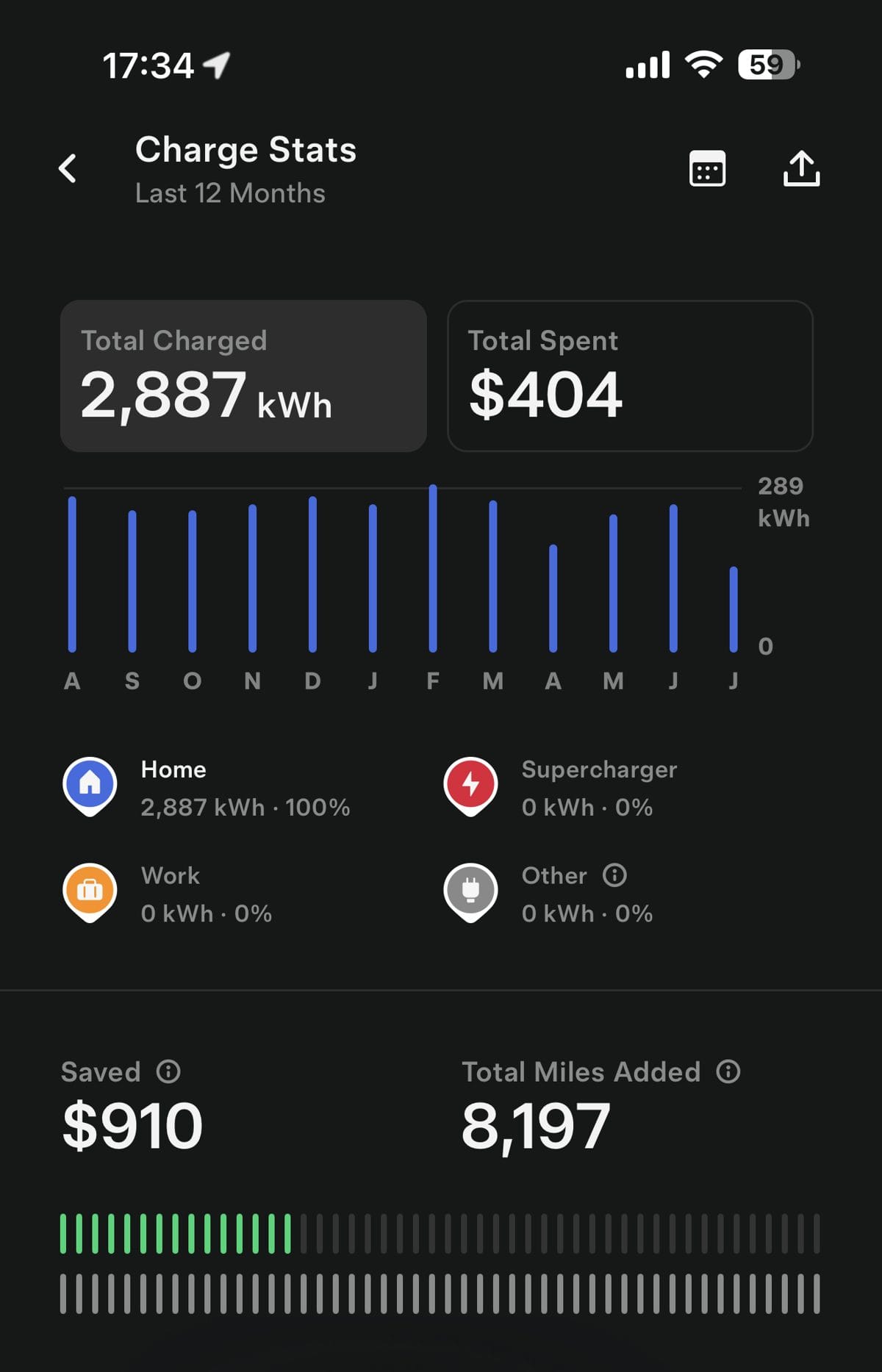
| 2024 Model Y | 2,887 | 8,197 | $462 | 5.6¢ | $404 |
| All three | 13,596 | 38,933 | ~$2,237 | 5.7¢ | $2,029 |
A quick word on whose dollars these are. The “my cost” column is each kWh multiplied by the 16 cents I actually pay, plus the Supercharger sessions at 2026's going $0.30–$0.45 per kWh — roughly $100 for my 239 kWh. Tesla's in-app “Total Spent” figure runs a little lower because the app applies its own assumed home rate rather than your real bill. The two methods land within about 10% of each other — which tells you Tesla's estimate is decent, but your utility bill is the truth. I'll use my numbers.
A few things stood out when I ran them:
- Two of the three cars went the entire year without a single Supercharger session. 100% home charging, zero charging stops, nothing but a 16-cent flat rate. That's the normal Tesla ownership experience nobody writes about.
- Only 1.8% of my total energy came from Superchargers — 239 kWh across 10 sessions, all on the one car that travels. The other 98% was Level 2 power at 16 cents.
- My blended cost per mile was about 5.7¢ — $2,237 across 38,933 miles. Even with one car commuting 90 miles each way every week, the total for three cars was less than what many households pay to fuel one gas SUV.
The Campground Trick: Level 2 Charging at 16¢ Away From Home
The 2023 Model Y's Charge Stats confuse people at first glance: 49% home, 3% Supercharger, and 48% “Other.” That “Other” isn't expensive public charging — it's a campground Level 2 pedestal near where I work during the week, billed at $0.16 per kWh, the same as my home rate. I plug in when I arrive, and the car makes the run home on Friday without ever touching a Supercharger.
Campgrounds are one of the most overlooked charging resources in the country — nearly every RV park has 240V NEMA 14-50 power at every site. If you travel for work or road-trip off the Supercharger grid, I wrote up exactly how to do this — the adapter you need, what to ask for, and campground etiquette — in my guide to charging a Tesla at a campground.
The Market Context: What Charging Costs in 2026
My bills are one household in Virginia — useful, but your rate is what matters for you. Here's the verified 2026 landscape so you can slot in your own numbers:
- Home electricity (U.S. average): about 18.6¢ per kWh as of spring 2026 (per EIA residential rate data, March 2026) — up roughly 25% in four years as grid upgrades, data-center demand, and higher natural-gas prices push rates up. Where I am in Virginia the average is lower, around 17.1¢, and Dominion Energy's effective residential rate lands near 15¢ on the standard plan.
- Superchargers (U.S.): most sites fall in the $0.30–$0.45 per kWh band in 2026, with high-demand or high-cost regions hitting $0.50+ at peak times. A reasonable planning number is about $0.45/kWh — roughly two to three times what the same energy costs at home.
- Efficiency: a typical Tesla uses roughly 250–290 watt-hours per mile in mixed driving, so about 3.5–4 miles per kWh. That's the multiplier that turns a per-kWh rate into a per-mile cost. My own 2023 Model Y's lifetime figure is 288.3 Wh/mi over 56,642 miles (screenshot below) — right at the top of that band, which is what a mostly-highway commute does.
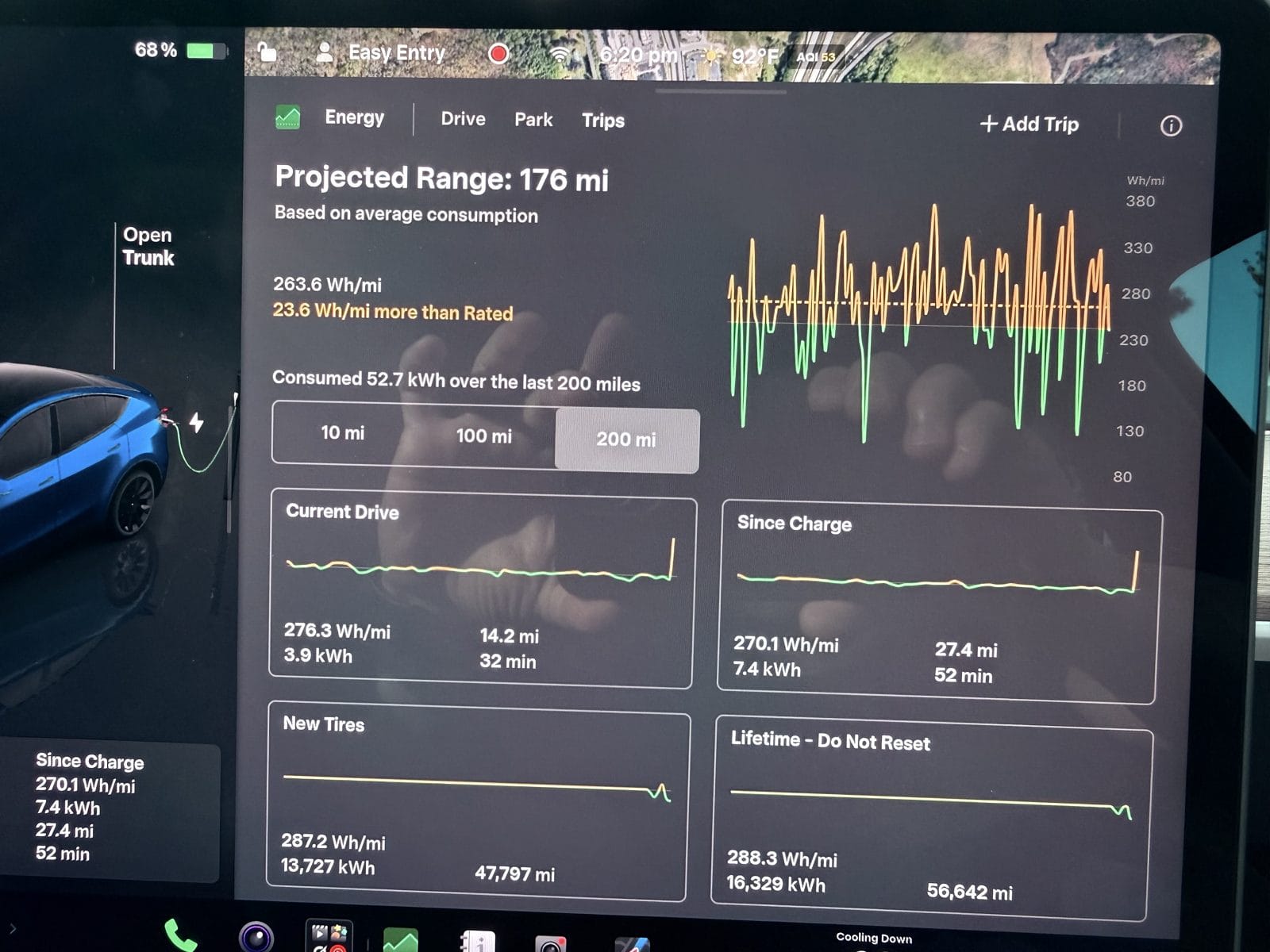
Put those together and home charging works out to roughly 4–5¢ per mile for most drivers, while Supercharging runs closer to 11–13¢ per mile. Both beat gas — but the gap between them is exactly why where you charge is the whole ballgame.
Home vs. Supercharger vs. Gas: Cost Per Mile
This is the comparison that actually matters. The gas column uses the national average of about $4.09 per gallon (AAA, late July 2026); adjust for your local price and your own car's mileage.
| How you “fuel” | Price | Efficiency | Cost per mile |
|---|---|---|---|
| Home charging (my main source) | ~15–18¢/kWh | ~3.7 mi/kWh | ~4–5¢ |
| Supercharging (road trips) | ~$0.30–0.45/kWh | ~3.7 mi/kWh | ~11–13¢ |
| Gas sedan (28 mpg) | $4.09/gal | 28 mpg | ~15¢ |
| Gas SUV (22 mpg) | $4.09/gal | 22 mpg | ~19¢ |
| My real blended cost | 16.5¢/kWh blended | ~2.9 mi/kWh at the plug | 5.7¢ |
Why does my table show ~2.9 miles per kWh at the plug when the car drives at 288 Wh/mi (about 3.5 mi/kWh)? Because your bill pays for everything the efficiency screen doesn't count: charging losses, Sentry Mode, summer cabin cooling, vampire drain while parked. Real-bill math includes all of it — calculator articles don't. It's also why my honest 5.7¢ per mile runs slightly above the 4–5¢ the averages predict, and I'd rather give you the number that matches a utility bill. Winter pushes that per-mile figure up further; I ran the two big cold-weather studies against this same 5.7¢ baseline in the winter range loss guide.
Against my actual 38,933 miles, a 22-mpg gas SUV at $4.09 a gallon would have burned about $7,200 in fuel — call it $5,000 saved in one year across the fleet. (Tesla's own in-app “gas savings” estimate is more conservative at $3,930 combined — that's the app's assumed gas price, not mine.) Scaled to a single car driving 12,000 miles a year, that's roughly $1,300–$1,400 in fuel savings — before you count the oil changes and maintenance you skip.
The Hardware That Unlocks the Cheap Home Rate
Every dollar of savings above depends on one thing: being able to charge at home overnight on your residential rate instead of paying Supercharger prices. That's what a home Level 2 charger buys you — it turns a 240V circuit into a full overnight charge, so you leave every morning “full” without ever thinking about it.
ChargePoint Home Flex Level 2 EV Charger (NEMA 14-50, up to 50A)
A proven plug-in Level 2 unit that charges any Tesla at full home speed and works with future non-Tesla EVs too. Plug it into a 14-50 outlet or hardwire it. This is the category of hardware that moves your miles from the expensive Supercharger column to the cheap 16-cent column — the entire savings story in this article runs through a plug like this one.
Specs: Up to 50A / 12kW | NEMA 14-50 plug-in or hardwired | J1772 (Tesla adapter included with the car) | Wi-Fi scheduling
Check Price on Amazon →For what it's worth, my own garage runs two Tesla Wall Connectors — one per daily driver — and they've handled essentially all 10,000 kWh of my home charging this year without a hiccup. Amazon rarely stocks the Wall Connector at list price, so if you want Tesla's own unit, buy it direct from Tesla. The ChargePoint above is the one I'd pick on Amazon, and the smarter buy if a non-Tesla EV might ever share your garage.
For the full breakdown of home charger options — including hardwired units, amperage, and install cost — see our Level 2 home charger guide and the home EV charging setup guide. If you don't have a 240V outlet yet, a portable Level 2 charger is a lower-commitment way to start charging at home.
Frequently Asked Questions
How much does it cost to charge a Tesla at home?
For most U.S. drivers, charging a Tesla at home costs about 4–5 cents per mile, or very roughly $8–$15 to add a couple hundred miles of range, depending on your electricity rate. At the 2026 U.S. average of about 18.6¢/kWh and ~3.7 miles per kWh, every mile costs about 5 cents. In a lower-rate area like much of Virginia (~15–17¢/kWh), it's a bit less. My own blended cost came to about 5.7¢ per mile — real bills, not calculator math — because 98% of my charging happened on 16-cent Level 2 power.
Is Supercharging more expensive than charging at home?
Yes — usually two to three times more. In 2026 most Superchargers charge $0.30–$0.45 per kWh, versus roughly $0.15–$0.18 at home. Supercharging is fast and convenient for road trips, and it still costs less per mile than gas, but if you can charge at home you'll save meaningfully by making home your default and using Superchargers mainly on trips.
Is charging a Tesla actually cheaper than buying gas?
In almost every case, yes. Home charging at about 4–5¢ per mile compares to roughly 15¢ per mile for a 28-mpg gas car and about 19¢ for a thirstier SUV, at mid-2026 gas prices near $4.09 a gallon (AAA national average, late July). Over 12,000 miles that's roughly $1,250–$1,750 a year in fuel savings — and that's before the oil changes, belts, and other ICE maintenance you no longer pay for.
What's the cheapest way to charge a Tesla?
Charging at home overnight on your standard residential rate — and, if your utility offers it, a time-of-use or EV plan that discounts overnight power. Set the car to charge during off-peak hours in the Tesla app, and you capture the lowest rate your utility offers. For what it's worth, I'm on Dominion's standard flat rate — 16 cents all-in, no time-of-use tiers — and still landed under 6 cents a mile. A good TOU plan would push that lower still.
How do I find out exactly what I'm paying?
The Tesla app tracks it all automatically — Charge Stats shows kWh added by source and every Supercharger session's exact cost, no logging required. Pair the Level 2 kWh figure with the effective rate on your utility bill (the all-in number, not just the headline rate) and you'll have your true cost — the same way I pulled the numbers in this article.
Our Honest Verdict
The real cost to charge a Tesla comes down to two numbers, and which one you get depends on where you plug in. Cheap Level 2 power costs about a third of gas per mile. If you Supercharge everything you are still ahead of gas, but you give back a big chunk of the savings. After tracking a full year across three cars, my advice is to make cheap Level 2 power your default, at home or anywhere you can find a known rate. Save the Superchargers for road trips. That one habit is what kept my 12-month fuel bill at about $2,237 instead of the roughly $6,700 the same 38,933 miles would have cost in a gas SUV.
If you're setting up to charge at home — where all the savings live — start with our Level 2 home charger guide and the home charging setup guide. Deciding between a Tesla Wall Connector and a third-party unit? Our Wall Connector vs. ChargePoint comparison breaks it down. And if you're still weighing the switch at all, the running-cost math is a big part of our honest gas-to-electric guide.