Updated September 5, 2026
Disclosure: As an Amazon Associate, I earn from qualifying purchases. This comes at no extra cost to you and helps keep this site running.
Ask how long do Tesla batteries last and you usually get one of two extremes: “the battery dies in 5 years and costs $20,000” from the skeptics, or “it'll outlast the car” from the fans. I own multiple Teslas, so instead of quoting someone else's numbers at you I'm going to show you mine, with the real miles, the charging habits, and the capacity each car has lost. Then we'll put those numbers next to Tesla's 200,000-mile fleet data so you can see that my cars are typical.
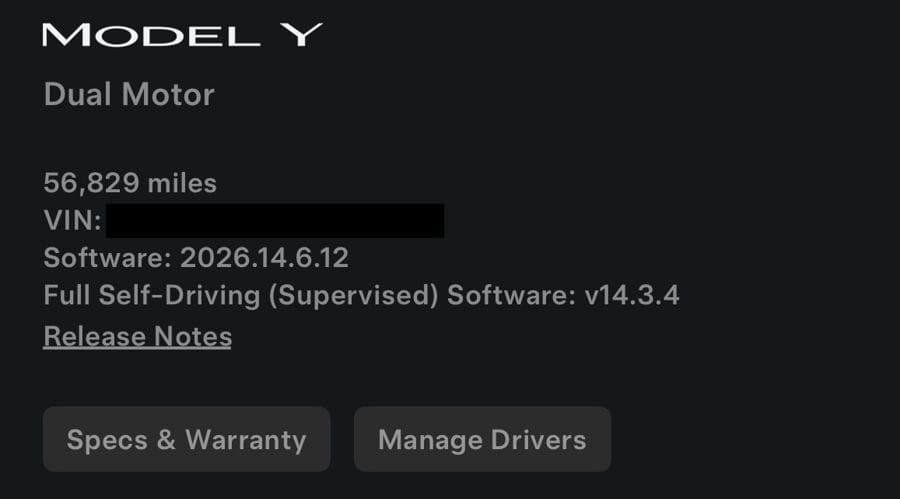
There are three Teslas in my driveway right now: a 2021 Model 3 Standard Range Plus at 37,887 miles (my daughter's daily driver), a 2023 Model Y Long Range AWD at 56,829 miles (my commuter, and the workhorse of this article), and a 2024 Model Y Long Range AWD at 14,018 miles.
My Actual Tesla Battery Degradation Data
This is the part nobody else can copy. Here's where each of my cars stands today.
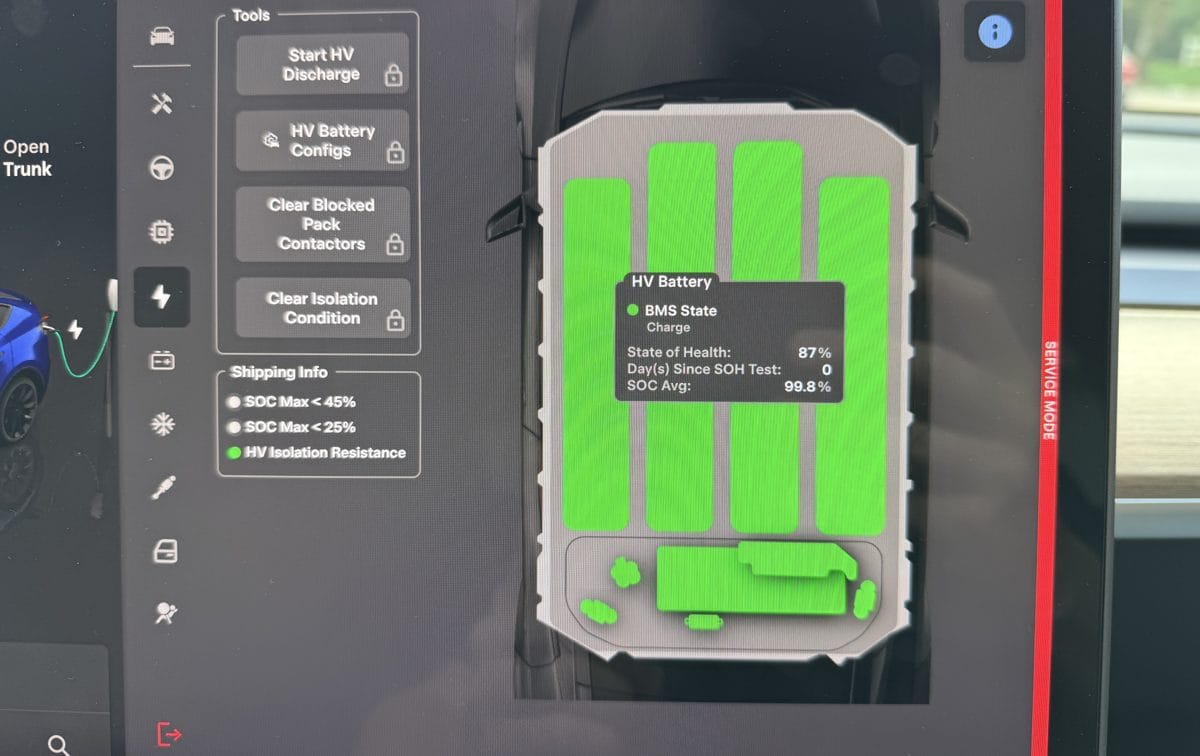
First, the headline number. This weekend I ran Tesla's official Service Mode battery health test on my highest-mileage car, the 2023 Model Y. It's not a quick check — the car has to sit plugged in from a low state of charge while it drains and cycles the pack, about 17 hours start to finish. The result: 87% state of health at 56,829 miles.
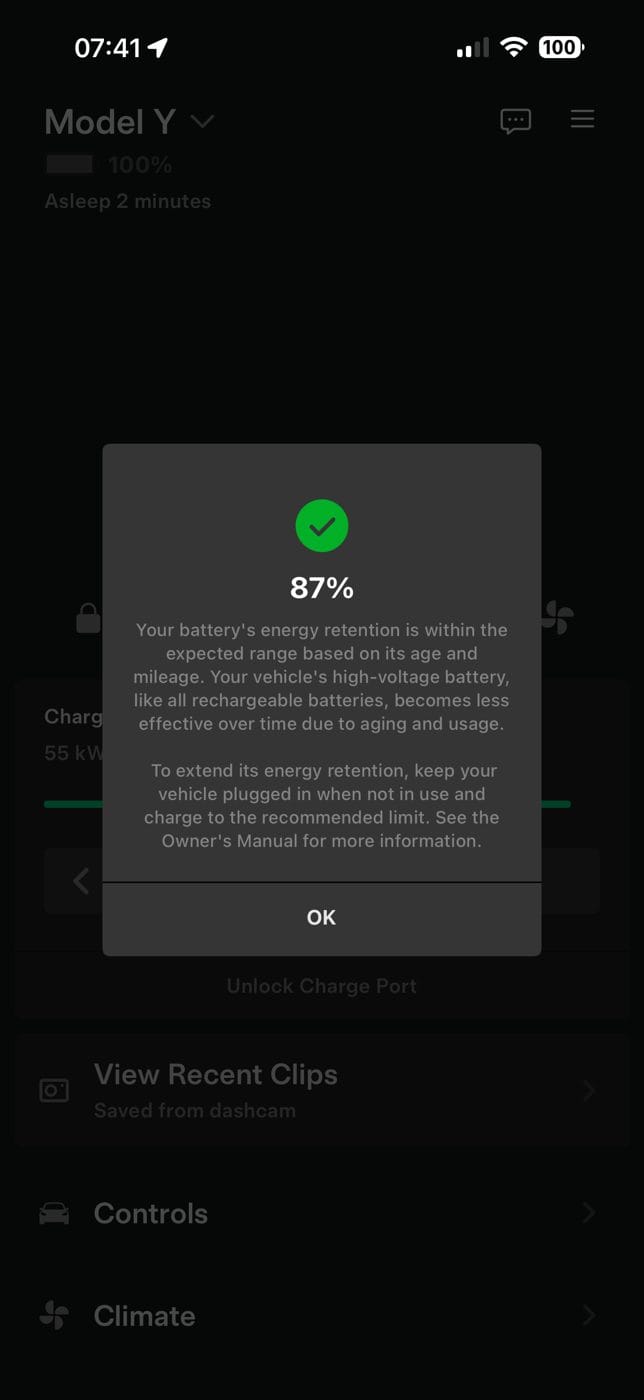
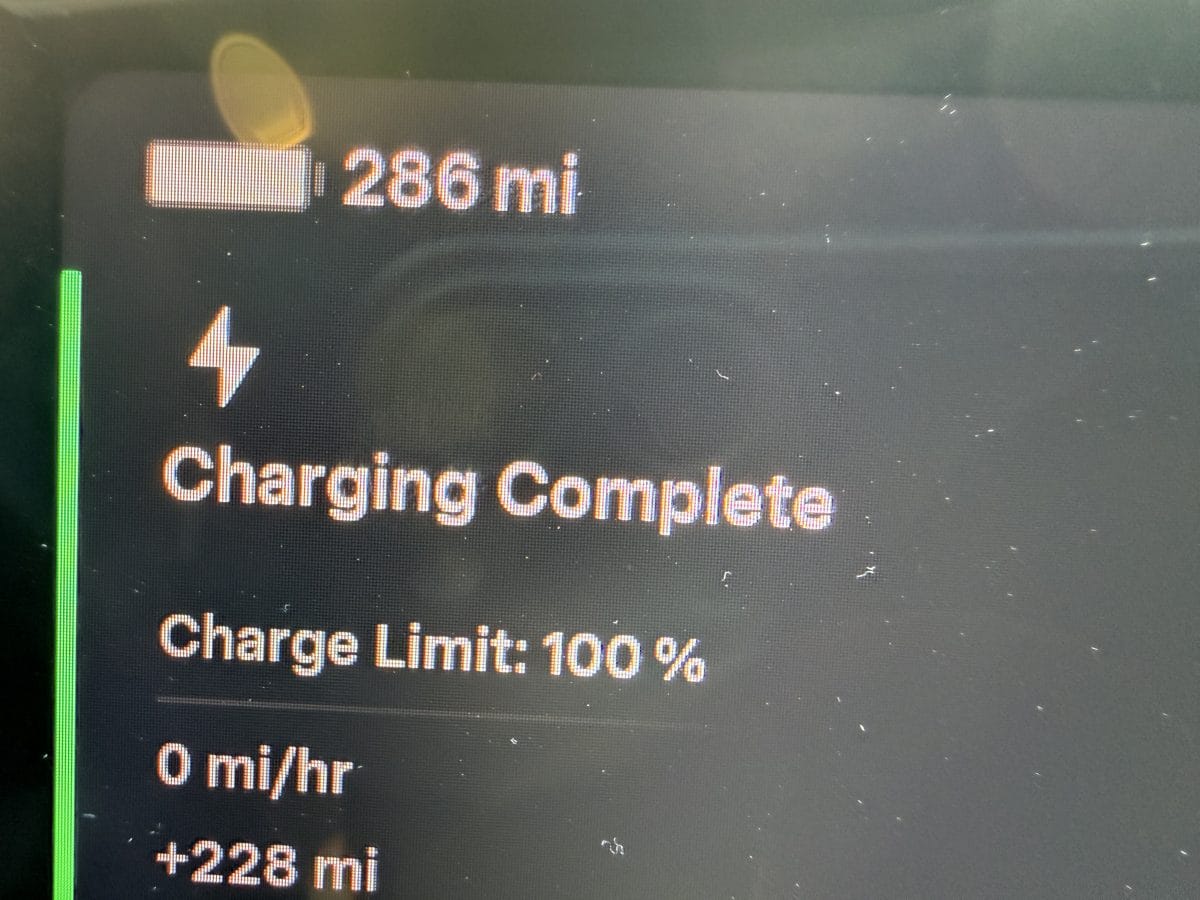
The Tesla app reported the same 87% and called it “within the expected range based on its age and mileage.” The math checks out independently, too: at 100% charge the car shows 286 miles against its original 330-mile EPA rating — 86.7%. Two methods, same answer.
The other two cars haven't run the full Service Mode test yet (it's a 17-hour commitment per car — they're next). For those, the numbers below are the energy-screen method: displayed range at a known charge percentage against the original EPA rating. Less official, clearly labeled.
| Car | Miles | Original range (EPA) | Range today (100%) | Capacity lost | Method |
|---|---|---|---|---|---|
| 2023 Model Y Long Range AWD | 56,829 | 330 mi | 286 mi | 13% | Official Service Mode test (87% SoH) |
| 2021 Model 3 SR+ (NCA pack) | 37,887 | 263 mi | ~225 mi | ~14% | Energy screen (180 mi at 80%) |
| 2024 Model Y Long Range AWD | 14,018 | 310 mi | ~290 mi | ~6.5% | Energy screen (232 mi at 80%) |
All three charge the same way: Level 2 at home to an 80% daily limit (more on that below). And two things in that table are worth an honest comment. The car that “looks worst” — the Model 3 at ~14% — is actually the smallest battery doing the most work: a Standard Range pack covers the same errands with more charge cycles per mile, so slightly higher loss at fewer miles is exactly what the chemistry predicts, not a lemon. And put the two Model Ys side by side: the 2024 has already given up ~6.5% in just 14,018 miles, while the 2023 — with four times the mileage — sits at 13%. Same model, same pack family, same charging habits, and the older car didn't lose capacity anywhere near four times as fast. That's the flattening curve showing up in my own driveway. None of my cars has had a Supercharging-heavy period (they live on Level 2), and the numbers reflect it.
What Tesla's 200,000-Mile Fleet Data Shows
Tesla publishes battery retention data in its annual Impact Report, and the current figures line up with what independent trackers see: about 12% average capacity loss at 200,000 miles for Model S/X, and roughly 15% at 200,000 miles for Model 3/Y Long Range packs. Flip that around: after 200,000 miles — more than most people drive in 13+ years — the typical pack still holds ~85–88% of its original charge.
Independent fleet studies back this up. Geotab's analysis of tens of thousands of EVs puts average degradation at 2.3% per year (its current study of 22,700 EVs, published April 2026; Geotab's earlier 2023 study had found 1.8%), and finds the biggest accelerant isn't age or mileage — it's heavy DC fast-charging and heat (more on that below).
The degradation curve isn't a straight line
This is the single most misunderstood thing about Tesla battery life. Packs lose capacity fastest when they're new — typically 5–8% in the first 20,000–30,000 miles — and then the curve flattens dramatically. Miles 100,000 to 200,000 often cost less capacity than the first 30,000 did.
So if you just bought a Tesla and you're watching your range estimate drop, don't panic. That early dip is normal chemistry (the battery settling into its working capacity), not a warning sign of early failure.
My own driveway is a live demonstration of this curve: my 2024 Model Y lost roughly 6.5% of its capacity in its first 14,018 miles, while my 2023 Model Y needed 56,829 miles — four times the distance — to reach 13%. In other words, more than half of the older car's total degradation happened in the same early window the newer car is in right now.
How Long Do Tesla Batteries Last Under Warranty?
Every Tesla carries an 8-year battery and drive unit warranty with a 70% capacity retention floor — if the pack drops below 70% inside the warranty window, replacement is covered. The mileage cap varies by model:
| Model | Battery warranty | Capacity floor |
|---|---|---|
| Model 3 / Y (RWD / Standard) | 8 years / 100,000 miles | 70% |
| Model 3 / Y (Long Range / Performance) | 8 years / 120,000 miles | 70% |
| Model S / X / Cybertruck | 8 years / 150,000 miles | 70% |
Put the warranty next to the fleet data and you see why battery replacements are rare: typical degradation at the warranty limit is 10–15%, while the warranty doesn't kick in until 30%. The average pack isn't anywhere near the line. (What it costs if you're the unlucky exception — and whether it's ever worth paying out of pocket — is a big enough question that it got its own article: my real Tesla battery replacement cost breakdown.)
What Actually Wears Out a Tesla Battery
After 108,000+ combined miles across my three Teslas, here's what the research says degrades packs fastest — and it's mostly habits, not mileage:
- Heat — sustained high temperatures are the #1 enemy. Garage parking and pre-conditioning while plugged in help more than any gadget.
- Living at 100% charge — high state of charge stresses the standard (NMC/NCA) chemistry. That's why Tesla's default daily limit is 80%.
- Heavy DC fast charging — fleet data shows cars that fast-charge more than ~12% of the time degrade up to twice as fast as home-charged cars. Occasional road-trip Supercharging is fine; using a Supercharger as your only plug isn't.
- Deep discharges — regularly running to near-0% adds stress. Plug in nightly and it's a non-issue.
LFP vs. standard packs: the 100% rule is different
If you have an LFP pack (most recent RWD Model 3/Y), Tesla tells you to charge to 100% at least once a week — LFP needs the full charge to keep its range estimate calibrated, and tolerates it far better than NMC. Long Range and Performance packs should live at 80% daily and only see 100% right before a road trip. Your car knows which pack it has: check Controls → Software, or just look at what the charge limit screen recommends.
For what it's worth, none of my three is LFP — the 2021 Model 3 SR+ is the NCA-pack version, built before Tesla switched Standard Range cars to LFP. So all three follow the same rule: 80% daily, 100% only ahead of a long trip (or, this weekend, a battery test). They also stay plugged in whenever they're parked — two Tesla Wall Connectors mounted outside, one on each side of the driveway, and a Mobile Connector on a campground hookup near work — which is exactly the “plugged in, gently charged” pattern the fleet data rewards. Tesla gives the same plug-in advice for hot weather, especially if you run Cabin Overheat Protection, so the parked climate load comes from the wall instead of the pack.
The Cheapest Battery Insurance: Charge Slow at Home
Notice the pattern above — almost everything that protects a pack comes down to gentle overnight AC charging. A Level 2 home setup is the single best thing you can buy for battery longevity (and your sanity). I've covered the full decision in my best Level 2 home chargers guide, but the short version:
Tesla Universal Wall Connector
The one I recommend for most homes: up to 48A, NACS with built-in J1772 compatibility so a second, non-Tesla EV later doesn't need an adapter. I have two Tesla Wall Connectors hardwired outside on my own driveway — gentle overnight AC charging is exactly how the cars in my table above got their numbers.
Specs: Up to 48A / 11.5 kW | NACS + J1772 | 24' cable | Indoor/outdoor
Check Price at Tesla →Emporia Level 2 EV Charger (48A, WiFi)
The value pick if you want full 48A speed without the Tesla badge premium. WiFi scheduling lets you charge overnight on off-peak rates — slow, cool, and cheap is exactly what the pack wants.
Specs: 48A hardwired / 40A on NEMA 14-50 | J1772 | 25' cable | App scheduling
Check Price on Amazon →Portable Level 2 Charger (32A, NEMA 14-50)
Renters and road-trippers: plugs into a dryer-style outlet, no install required. A portable Level 2 unit is also what keeps my third car charged on a campground hookup — more options in my portable EV charger roundup.
Specs: 32A / 7.7 kW | NEMA 14-50 plug | 25' cable | J1772 (NACS adapter included with your Tesla)
Check Price on Amazon →If you're still on a wall outlet, start with my home EV charging setup guide — Level 1 works, but you'll want more.
How to Check Your Own Tesla's Battery Health
Three ways, from easiest to most precise:
- The energy screen math — charge to 100% (or your LFP weekly full charge), compare displayed range to the original EPA rating. Quick, but range estimates drift with driving style.
- Service Mode battery health test (2023+ vehicles) — the official number. Requires ~12+ hours plugged in at low state of charge; the car cycles the pack and reports a capacity percentage. This is where my 87% number above came from — I ran it on the 2023 Model Y overnight (about 17 hours all-in), and used the energy-screen method on the other two until they get their turn.
- Third-party reports — useful mainly when buying used, where a verified battery report is worth real money in negotiation. If you're shopping used, my used Tesla Model 3 first-car guide covers what battery numbers to demand before you hand over cash.
Frequently Asked Questions
How many miles do Tesla batteries really last?
Tesla's fleet data shows only 12–15% capacity loss at 200,000 miles, and real-world high-mile examples (taxi fleets, 300,000+ mile private cars) routinely reach 300,000–500,000 km on the original pack. For most owners, the battery will outlast their ownership of the car — and possibly the car itself.
Should I charge my Tesla to 80% or 100%?
Standard (NMC/NCA) packs: 80% daily, 100% only before long trips. LFP packs (most recent RWD cars): Tesla recommends 100% at least weekly. Check your charging screen — the car tells you which rule applies.
Does Supercharging damage a Tesla battery?
Occasional Supercharging, no. Constant Supercharging, measurably yes — fleet studies show cars that DC fast-charge heavily can degrade at roughly double the rate of home-charged cars. If Superchargers are your only option, the battery will still last years; it just won't age as gracefully as a garage-charged car.
Is it normal for a new Tesla to lose range in the first year?
Yes. The steepest degradation — typically 5–8% — happens in the first 20,000–30,000 miles, then the curve flattens for years. An early dip is settling, not failure. My own 2024 Model Y is living through that window right now (~6.5% at 14,018 miles), and its older twin shows where the curve goes from there.
When should I actually worry about my Tesla battery?
Two triggers: capacity trending toward the 70% warranty floor while you're still inside the 8-year window (get it documented at a Service Center before the warranty lapses), or sudden range loss — a fast drop over weeks isn't normal degradation and deserves a service visit either way.
Our Honest Verdict
The battery is the most durable of the expensive parts in a Tesla. The fleet data has said so for years, and my own cars back it up, at 13%, about 14%, and about 6.5% lost, all three close to the fleet curve. If you're deciding whether to buy, degradation should not be what stops you. If you already own one, park in the shade, charge slowly at home, follow the 80%/LFP-100% rule, and stop worrying over the range estimate.
The real financial question isn't whether the battery lasts — it's what happens in the rare case it doesn't. I've covered that in Tesla battery replacement cost 2026: real numbers — and if you're still weighing the gas-to-EV switch itself, battery anxiety is one of the concerns I take on point-by-point in my honest gas-to-electric decision guide.