Updated October 2, 2026
⚡ Quick Summary
The short version: Tesla tire care comes down to four numbers from the owner’s manual. Rotate every 6,250 miles. Check pressure cold, against the door-pillar label, not the number on the tire. Replace at 4/32 in. of tread, and don’t drive winter roads below 5/32 in. Tires lose about 1 PSI for every 10°F drop, so the first cold snap is when the warning light shows up.
- Own these: an accurate pressure gauge, a tread depth gauge, and an inflator. That covers ninety percent of tire care.
- If you rotate at home: jack pads and a torque wrench set to 129 lb-ft (Model Y). Otherwise a shop or Tesla does it.
- Winter tires: Tesla recommends them for snow and ice. All four at once, matched, and reset the tire configuration on the screen afterward.
Disclosure: As an Amazon Associate, I earn from qualifying purchases. This comes at no extra cost to you and helps keep this site running.
Tesla tire care: why it’s different, and why it isn’t
I want to cover Tesla tire care plainly, because most of what you’ll read about it is either a scare story about EVs eating tires or a generic tire article with the word Tesla added. The truth sits in between. These cars are heavy and they put torque down instantly, so they do wear tires faster if you drive them hard. But the actual maintenance is the same as any car: keep the pressure right, rotate on schedule, watch the tread, and put the right tires on for the season. Tesla publishes exact numbers for all of that in the Model Y owner’s manual, and I’ll quote them so you’re not taking my word for it.
From 100,000+ combined miles across our three-Tesla household, the one tire event that mattered was a low-pressure warning on our 2023 Model Y. The cause was a nail near the sidewall, which isn’t repairable. All four tires were significantly worn by then, so I replaced the set instead of one. I went with standard non-acoustic tires on purpose, and I haven’t noticed any meaningful increase in road noise. That’s one car and one driver, not a test, but it’s the kind of decision this article is meant to help with.
For the record, I don’t rotate my own. Mine go to Discount Tire every 10,000 miles. I’ll say up front that this is further apart than the manual asks for, and I’ll come back to that below rather than pretend the gap isn’t there.
Tire pressure: check it cold, against the label on the door pillar
Start here, because it’s the cheapest thing on the list and the manual is blunt about how much it matters: “Under-inflation is the most common cause of tire failures and can cause a tire to overheat, resulting in severe tire cracking, tread separation, or blowout.” It also costs you range and tread life. The car will warn you when a tire is significantly low, but Tesla says outright not to rely on that: “It is the driver’s responsibility to maintain correct tire pressures.”
Three things people get wrong. First, the target number is on the Tire and Loading Information label on the driver’s door pillar, and the manual says to use it “even if it differs from the pressure printed on the tire itself.” The number on the sidewall is a maximum, not a recommendation. Second, check it cold. Tesla’s definition is after the car has been “stationary for over three hours,” and it warns that about a mile of driving is enough to change the reading. If the tires are warm, expect the number to read high, and “do not let air out of warm tires in an attempt to match recommended cold tire pressures.” Third, the cold weather part: “The tires will lose approximately one PSI for every 10° F (6° C) drop in outside temperature.” A car set right in September will be several PSI low on the first freezing morning, which is why the tire pressure light shows up for so many owners in the same week each fall.
Your car shows all four pressures on the screen under Controls, then Service, and in the app, if it has direct TPMS (sensors in the wheels). Some configurations use indirect TPMS, which only estimates and only warns; the manual says if the visualization shows PSI values, you have the direct kind. Either way, don’t treat the screen as your gauge. Tesla’s own procedure says to use “an accurate tire pressure gauge,” which is why the first card below is a gauge and not an app.
JACO ElitePro Digital Tire Pressure Gauge, 100 PSI
Why it’s here: the manual asks for an accurate gauge, and this listing puts a number on accuracy instead of an adjective: “calibrated accurate to professional ANSI 2A standards” with “dual pressure sensors certified to ±0.50% FS (0.50 PSI)” and a readout resolution of 0.10 PSI. A 100 PSI range is the right one for a car; the 200 PSI version of the same gauge gives up resolution you don’t need.
Per the listing: brass and steel body with a rubber guard, a 10-inch hose with a 360° swivel chuck, a built-in bleeder valve so you can let air out while watching the reading, a backlit display, and two AAA batteries included. Readings lock on the display until you reset.
Fitment: universal. Works on any Tesla and on the bicycle in the garage.
Tesla tire rotation: every 6,250 miles, and reset the screen afterward
Here is the number everyone searches for. Tesla’s manual: “Tesla recommends rotating the tires every 6,250 miles (10,000 km) or if tread depth difference is 2/32 in. (1.5 mm) or greater since the last rotation, whichever comes first.” It adds that “aggressive driving can lead to accelerated tire wear and may require more frequent tire service,” which means that if you use the acceleration a lot, you’ll rotate more often.
Now the part where I don’t match my own advice. I rotate at 10,000 miles, not 6,250, because that’s the interval my shop works on and it’s the one I actually keep. That’s a real gap, and it’s worth being straight about what it buys and costs: the manual’s 6,250 is the conservative number that keeps all four tires wearing together, and stretching to 10,000 on a rear-biased car means the rears do more of the work between visits. The manual’s second condition is the one that actually protects you either way, and it’s the one to watch if you stretch the interval like I do: rotate sooner if the tread depth difference reaches 2/32 in., whichever comes first. If you’re checking tread with a gauge anyway, that condition will tell you when 10,000 is too long for how you drive. If you use the acceleration hard, it will be.
Why it matters on a Tesla: with instant torque going to the rear wheels, the rear tires tend to wear faster than the fronts, and rotation is what evens that out. Skip it and you end up replacing a pair early, which costs more than a rotation ever did. The manual also says to put “tires with the most tread on the rear of the car” for hydroplaning resistance, which is one more reason to keep the four close together.
Two things the shop often forgets. The car tracks miles since the last tire service under Controls, then Service, under Last Tire Service. After any rotation or replacement, Tesla says to reset it there (“touch Reset, or Wheel & Tire > Tires”). That resets the learned tire settings and, on cars with direct TPMS, clears the tread wear alert. Second, if you notice uneven wear on one side of a tire, or the car pulls with the wheel held straight, that’s an alignment, not a rotation problem. The manual recommends an alignment after a new set of tires too.
I should admit I haven’t been doing this myself. The photo below is the tire screen on my own 2023 Model Y, and the top right corner says Tire Service Mileage: 20,000+ miles ago. The tires do get rotated. Nobody at the shop has ever reset that counter, and until I took a photo for this article, neither had I. That’s why I’m telling you to reset it yourself. It takes one tap, and if you leave it, the number on your screen stops meaning anything.
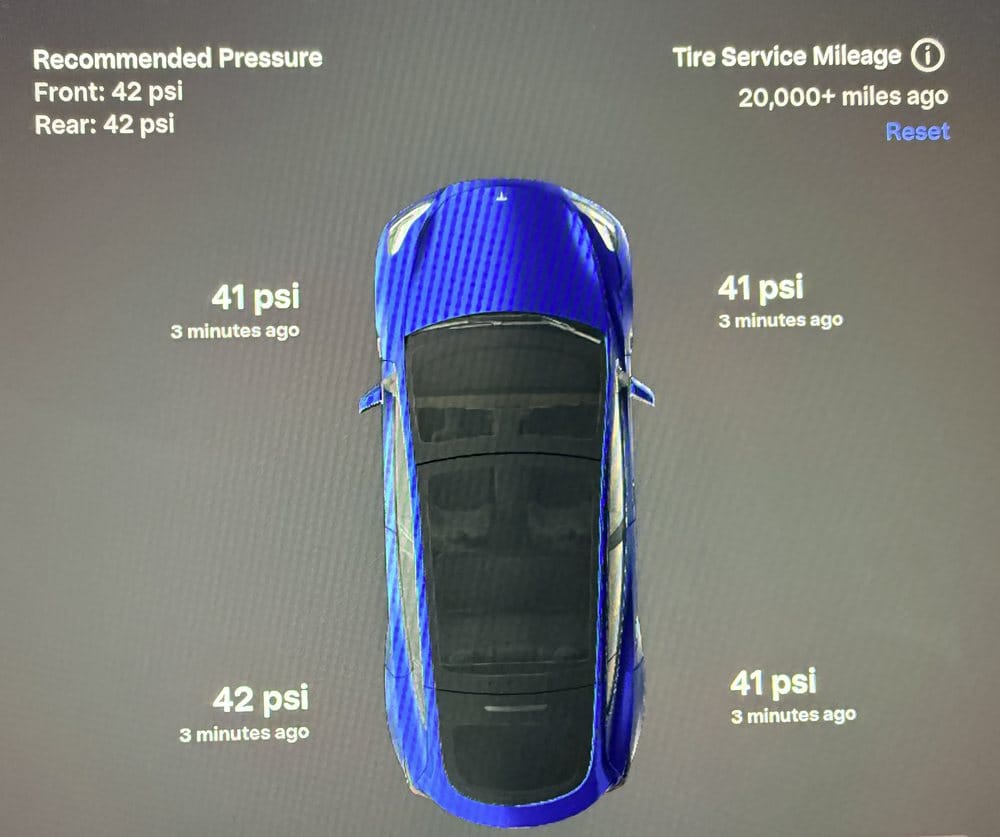
You’ll find this screen under Controls, then Service.
Rotating at home: what you need and the one number you can’t guess
Plenty of owners do this in the driveway. It’s a normal job with two Tesla-specific catches. The first is the jack point. The battery pack runs under the whole floor, so the car has four reinforced lift points and you use a rubber jack pad that locates in the hole so the jack never touches the pack. I own a set and I’d call them mandatory, not optional. I went through the pads and the puncture-kit question in detail in Tesla jack pads and tire repair kit, so I’ll keep it short here.
The second catch is torque. The Model Y manual’s wheel spec table lists lug nut torque as “129 lb. ft (175 Nm).” That’s higher than a lot of cars, and it’s not a number to eyeball with a breaker bar. A click-type torque wrench that covers 129 lb-ft is the tool. Model 3, S, and X owners: check your own manual’s Wheels and Tires page rather than assuming the Model Y figure. After a rotation, the manual says to reset the tire configuration on the screen, and if your car has indirect TPMS it also needs the calibration routine under Controls, Service, Tire Pressure.
Yieokei Tesla Jack Pads, 4-pack with case and tire tools
Why it’s here: a four-pack means you can lift each corner without moving one pad around, and the listing states fitment for the whole line: “specifically designed for 2016-2026 Tesla Model 3/Y/S/X. Fit Model Y Juniper.” The post that goes into the lift hole is “0.9 inch (24 mm),” which is the detail that keeps it from wandering under load.
Per the listing: one-piece molded rubber, a storage case, and a plug-style tire repair kit in the box.
Fitment: Model 3, Model Y (including 2025+ Juniper), Model S, Model X, 2016–2026 per the listing.
LEXIVON 1/2-inch Click Torque Wrench, 10–150 ft-lb, with flip lug socket set
Why it’s here: the range covers the Model Y’s 129 lb-ft with room to spare, and the listing says it “ships pre-calibrated to +/- 4% accuracy” with a calibration certificate. The bundled flip sockets include 21 mm, which is the lug nut socket size in the Model Y manual’s wheel spec table, so you’re not hunting for a socket on the day.
Per the listing: this is an Amazon bundle listing (wrench plus socket set), so the two items may arrive separately. Chrome-vanadium ratchet head, dual-range scale with highlighted markings.
Fitment: universal 1/2-inch drive. Sockets: 17, 19, 21 mm and 3/4, 13/16, 7/8 in.
You still need a floor jack that clears the sill; that’s a garage tool, not a Tesla accessory, so I’ll leave it to you. The Tesla-specific gear I recommend is in the Model Y accessories guide. And if the whole thing sounds like more Saturday than you want, Tesla service and any tire shop will rotate for a modest fee. Just make sure they reset the tire configuration on the screen, or do it yourself when you get home.
Tread depth: the two numbers Tesla gives, and how to measure them
The manual sets two floors, not one. “Tires with a tread depth less than 4/32 in. (3 mm) are more likely to hydroplane in wet conditions and should not be used.” And for winter: “Tires with a tread depth less than 5/32 in. (4 mm) do not perform well in snow and slush and should not be used when driving in winter conditions.” The factory tires have wear bars that surface at 4/32, but Tesla says to replace before the bars show, and the 5/32 winter floor arrives sooner than most people expect. A tire that’s fine in August can be below Tesla’s winter line by December.
Tesla also gives a rule for early replacement: if you have to replace one tire because of damage, “we recommend replacing the tires in pairs unless the other tires are within 2/32 in. (1.5 mm) of tread depth of the new tire,” matching brand and model, with the new pair on the rear. That 2/32 comparison is why a tread gauge belongs in the door pocket. The penny test can’t tell you 2/32 from 4/32. A dial gauge can, and it takes ten seconds a tire.
GODESON Dial Tire Tread Depth Gauge 88703
Why it’s here: it reads in the units Tesla uses. The listing says it “reads in 1/32 inch increments” on a “legible 2” dial,” so you can check a tire against the 4/32 and 5/32 lines without doing math, and check the 2/32 pair-matching rule when one tire has to be replaced.
Per the listing: zinc cast body, color zones on the dial for a quick read. No batteries, nothing to charge, lives in a door pocket.
Fitment: universal.
An inflator, because the warning always comes on a cold morning
There’s no spare in the trunk and no pump in the box; the manual mentions only an “optional tire repair kit available from Tesla.” The manual also says that if the TPMS light appears in the cold, “inflate the tires before driving,” which is hard advice to follow at 6 a.m. with no pump. I already recommend a jump starter for the 12 V battery in Tesla 12V battery failure; the one I point people to has an inflator built in, so it does both jobs. One rule carries over from that post: don’t store it in the trunk. The trunk release is electric, and a flat 12 V is exactly when you can’t get to it. Keep it in the cabin, where the manual door release still works.
GOOLOO A5 Jump Starter with Air Compressor, 160 PSI
Why it’s here: it’s the inflator that also solves the other cold-morning failure. The listing describes a “160 PSI” pump with “5 inflation modes” that “auto-stops inflation to prevent over-inflation” when you hit the preset, plus the jump-start function and a 20,000 mAh pack for phones. Its own example is a sedan tire “from 30 PSI to 36 PSI in 30 seconds,” which is the size of top-up a cold snap usually needs.
Per the listing: operating range “-4°F to 140°F,” an 18-month warranty, and a full accessory kit in the box. GOOLOO’s own bullet says to keep it in the trunk; the site’s standing advice is the opposite, for the reason above. GOOLOO also says to recharge it at least every three months in storage; put it on the calendar with the rotation.
Fitment: universal. Tesla’s own note on this: the low-voltage outlet can’t jump-start the car, and this unit isn’t for that either. It’s for the car’s 12 V battery, covered in the linked post.
Tesla winter tires: what the manual recommends
This is the part of Tesla tire care that depends on where you live. Tesla’s position is direct: “If driving in cold temperatures or on roads where snow or ice may be present, Tesla recommends using winter tires,” and it warns that “in cold temperatures or on snow or ice, summer and all-season tires do not provide adequate traction.” It also notes that performance (summer) tires lose grip below 40°F, snow or not. If your car came on summer tires, that applies to a Virginia January, not just a Minnesota one.
The rules if you do switch, all from the manual: install “a complete set of four tires at the same time,” the same “diameter, brand, construction and tread pattern on all four wheels,” look for the mountain-and-snowflake symbol on the sidewall, and expect “more road noise, shorter tread life, and less traction on dry roads.” One Tesla-specific thing catches people every year: aggressive winter tires can temporarily reduce regenerative braking until the car recalibrates. Tesla says to go to Service, then Wheel & Tire, then Tires, select winter tires, and it relearns faster. Do that the day they go on, and reset the tire configuration the day they come off.
I’m not carding winter tires here. The right tire is a size-and-model decision per car (different wheel sizes take different tire sizes, and the manual notes staggered setups can’t be rotated front to back at all), and it should be mounted and balanced by someone with a machine. Tesla sells winter sets through its shop, and any good local installer can match the size on your placard. The tools above still apply: winter tires need the same cold pressure checks, and the 5/32 tread floor applies to them too. If a chain-law sign is part of your winter, the snow chains guide covers which chains Tesla approves for each wheel and when a snow sock is the better buy.
All three of ours run all-seasons year-round. That’s the honest answer, and here in Virginia it’s a common one. If you’re in a place that gets real winter, a dedicated set will out-grip anything all-season on cold pavement, and the trade is storage space and a swap twice a year.
Replacing tires: pairs, sets, and the acoustic-foam question
When a set is worn, Tesla says to “replace all four tires at the same time” and points you to Tesla-designed or Tesla-approved tires, marked with a T-code on the sidewall (T0, T1, T2). It also says something worth knowing before you shop: Tesla-approved tires “may not contain acoustic foam,” and there “may be a slight increase in road noise and vibration” as a result. That’s the trade I made on our 2023 Model Y when the nail took out a tire and the other three were worn: standard non-acoustic tires, deliberately, and I haven’t noticed a meaningful difference in noise. One car, one driver. Your ears and your roads may differ, and the foam-lined tires cost more, so it’s a real choice rather than an obvious one.
Two more manual rules after any tire change: give the tire lubricant “up to 24 hours” to dry before hard acceleration so the tire doesn’t slip on the rim, and replace tires “every six years, or sooner if required, even if tread depth is above the minimum.” If you bought a used Tesla, check the date code on the sidewall.
To put names on it: the blue 2023 is on Michelin Pilot Sport All Season now, the set I bought to replace the Pirellis it came with. The red 2024 is still on its original Continentals. Those may not be the right tires for your car, since that depends on your size and your roads. It’s just what I chose when the decision came up.
Comparison: the five tools
| Tool | What it’s for | Who needs it | Price tier |
|---|---|---|---|
| JACO ElitePro gauge | Cold pressure check against the door label | Every owner | Budget |
| GODESON tread gauge | 4/32 and 5/32 floors, 2/32 pair-matching | Every owner | Budget |
| GOOLOO A5 inflator + jump starter | Cold-morning top-ups; 12 V battery rescue | Every owner, especially outdoor parkers | Mid |
| Yieokei jack pads | Lifting without touching the battery pack | Home rotation | Budget |
| LEXIVON torque wrench + sockets | 129 lb-ft lug torque (Model Y) | Home rotation | Mid |
Frequently Asked Questions
How often should I rotate Tesla tires?
Tesla’s manual says every 6,250 miles (10,000 km), or sooner if the tread depth difference between tires reaches 2/32 in. since the last rotation, whichever comes first. The car counts miles since the last tire service under Controls, then Service. Reset it after every rotation.
What tire pressure should a Tesla run?
Whatever the Tire and Loading Information label on the driver’s door pillar says for your wheel size, checked cold. The manual says to use that number even if it differs from the one on the tire’s sidewall. The touchscreen also displays the recommended cold pressure next to the live readings on cars with direct TPMS.
Why did my tire pressure warning come on when it got cold?
Because air contracts. Tesla’s figure is about 1 PSI lost per 10°F drop, so a 30-degree overnight swing can pull a tire several PSI under the threshold. Inflate before driving, when the tires are cold, and the light clears after a short drive above 15 mph.
Do Teslas need winter tires?
Tesla recommends them anywhere you’ll drive in cold temperatures or on snow and ice, and says summer and all-season tires don’t provide adequate traction in those conditions. Whether you need them is a local call. If you switch, it’s all four at once, matched, and you tell the car under Service, then Wheel & Tire, then Tires so regen recalibrates faster.
Can I rotate Tesla tires myself?
Yes, with jack pads for the lift points, a floor jack that clears the sill, and a torque wrench. The Model Y lug nut torque in the manual is 129 lb-ft (175 Nm); check your own model’s manual for the figure. Reset the tire configuration on the screen when you’re done.
Our Honest Verdict
Every owner: get the pressure gauge and the tread gauge. Together they cost less than one tire rotation at a shop, and they’re the only way to actually follow Tesla’s numbers instead of guessing.
If you park outside or drive far from home: add the GOOLOO. It fixes the two things that fail on cold mornings, low tires and the 12 V battery. Keep it in the cabin, not the trunk.
If you’d rather rotate at home: jack pads and the torque wrench. Set it to 129 for a Model Y, check your manual for anything else, and reset the tire screen afterward.
What I’d skip: buying tires online by size alone. Get the placard size matched, mounted, and balanced by a shop, and tell the car what you put on it.
The habit that matters most: check pressure cold once a month and the first cold morning of every fall. That one habit prevents most of the tire problems these cars ever have.